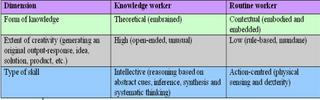
contrasted with those of routine workers undertaking the type of work.These two types can be seen as the far extremes- many employees will lie somewhere between these two types if the various aspects of their work are analysed according tothe dimensions suggested here. It is important to recognise tht particular job can vary between the dimensions, for instance, a landscape gardner could be considered to rely on contextual knowledge and action-centred skill (so closer to a routine worker in these aspects). Saturday, July 09, 2005
Knowledge worker and the Professional:
contrasted with those of routine workers undertaking the type of work.These two types can be seen as the far extremes- many employees will lie somewhere between these two types if the various aspects of their work are analysed according tothe dimensions suggested here. It is important to recognise tht particular job can vary between the dimensions, for instance, a landscape gardner could be considered to rely on contextual knowledge and action-centred skill (so closer to a routine worker in these aspects). Friday, July 08, 2005
Types of Knowledge:
Embrained knowledge: This type is knowledge contains the abstract, conceptual and theoretical information that we have in our heads. It can be applied to solve problems and 'think around' issues in the creativity way.
Embodied knowledge: This type of knowledge contains practicle and applied ways of doing things learned from experience. Problems are solved by drawing upon previous experience and a wealth of information about the specific context.
Encultured knowledge: This type os knowledge contains shared understandings about 'how things are done around here'. This can be an essential part of the organisational culture or the workgroup's culture.
Embedded Knowledge:This kind of knowledge contains systematic routines that mean a person can perform a task or activity 'without thinking'. The task becomes 'second nature' to the person, to such an extent that knowledge, learning and skill behind it is when discussing tacit skills.
Encoded knowledge:This type of knowledge contains information conveyed by signs and symbols. This blogger is a form of encoded knowledge. Information technology has increased potential to encoding, manipulating and transmitting knowledge.
Blackler observes that these five forms indicate that 'all individuals and all organisations, not just the so-called knowledge workers or knowledge organisations are knowledgeable'
References: Blacker,F.(1995) 'Knowledge, knowledge worker and organizations:an overview and interpretation', Organisational studies, 16 (6): 1021-46
Thursday, July 07, 2005
Goal Verses the World
Execution involves doing something;
Evaluation is comparision of what happened in the world with what we wanted to happen (our goal). These two human actions can be
shown in figuare as follows:Stages of execuaions: Start at the top with goal, the state that is to
be achived. The goal is translated into an intention to do some action. The intention must be translated into a set of internal commands, an action sequence that can be performaned to satisfy the intention. The action sequence is still a mental event: nothing happens until it is executed, performaed upon the world.Stages of evalutions: Evaluation starts with our perception of the world. This perception must then be interpreted according to our expectations and t
hen compared (evaluted) with respect to both our intentions and our goals.Seven stages of actions: The stages of execution from (intentions
, actions sequence and execution) are coupled with stages of evalution from (perception, interpretation and evalution) with goal common to both stages:
Sunday, July 03, 2005
Education and its Impact in Development:
The private sector was re-allowed into education after about a decade-long experience-in-failure of nationalized education under t
he so-called New Education Policy of early 1970s in Nepal. Dr. Tirth Raj Khaniya says his view, despite a two-decade long involvement into this field the private sector in education is still at infancy and confused. Most of the teachers in government school motivated less by professional ethics and more by party politics so that our current education cannot depend entirely on the government school, technical education and University for quality education. The books prepared in the style of the grandfather are taught by the teachers who are of the father’s age. And the poor students of today are always at loss as to what is being taught to them in government school. However, the new law has left education as a battlefield of the private and the public sectors. The policymakers have kept the government as the producer of education whereas logically it should be the buyer only.The government current policy in which the people should have been left free to choose the type of higher education. Government should create such an environment to the people have been made to bear the expenses as well for such education could help to improve the education quality and competition between government and private school/college/university. It will make people ready to pay for such education because with this sort of education they are sure of being employed and recovering the expenses in future. However, as everybody would not be able to afford the full cost of such education, the government should develop a mechanism to make it affordable for everyone interested. Such mechanism can be a system of scholarship or loan facility or a combination of both. If it is a scholarship, it is a case of education being bought by the society; if it is loan-financed the implication is that the person who pays the loan can appropriate the benefits as he/she wishes. Nepal’s experience in sending people to good educational institutes for higher level technical education, such as Medicine and Engineering can be regarded as the example of how the scholarship system can be used.
But the problem in education in Nepal is not only the cost. In closer scrutiny, it can be found that cost is not the problem at all. If the courses offered are such that the person who receives the education is going to be employable immediately after completing the course, meeting the cost is only a matter of arranging the loan from a bank or elsewhere.
The next issue of debate in education is quality and that is related with the cost. People complain, for example, that the students who come out of the private schools pass with good marks in the examination but lack the analytical capability. In other word we can say that education always has a cost attached to it, and better the quality of education, the higher is the cost likely to be. Better teachers and better methodologies of teaching will be available at a higher cost. The implication is that, if we maintain on reducing the cost, the quality also will suffer.
Of course, we can take an example so far as Japan, where the educational priorities and the rights of citizens and residents against the local authorities to provide school education assumed a leading role in the beginning of rapid economic expansion. Let us take one good example in this issue, as a whole education consumed as much as 43 per cent of the budgets of the towns and villages between 1906 and 1911 for Japan. In this period in Japan, the progress of elementary education in particular was rapid, and the recruiting army officers noted the remarkable fact that while in 1893 one third of the army recruits were illiterate similarly by 1906 there was hardly anyone who was not literate. By 1913, though Japan was economically still quite underdeveloped and very poor. It had become one of the largest producers of books in the world publishing more books than Britain and indeed more than twice as many books as the United States. To a great extent the fast economic expansion of East and South-east Asia has drawn on the lessons of these experiences, particularly through the arrangements associated with the enhancement of human resources and skill. These developments were at once social (they deal with education and other social opportunities) and economic (they influenced economic performance), as well as legal (they were associated with creating a pattern of rights and duties which influenced the lives of citizen).
Another interesting area, which has come into importance very recently in context of Nepal, is India’s rapid success in the development of computer software (India has become the second largest software producer in the world after the United States). This process has been made possible not only by the expansion of technical education in India, but also by the comparatively flexible legal arrangements that govern these businesses compared with the much more rigid regulations that apply to more traditional commerce and industrial production, in which progress has been much slower.
References:
Saturday, July 02, 2005
1901 Japanese predications:
2. worldwide colour photo instant transfer
3. Extinet wild animals
4. Green Sahara
5. Rise of China, Japan and Africa
6. Round the world trip in 7 days, global travel for everyone
7. Warship in the air
8. Extermination of flies and fleas
9. Air conditioner
10. Cultivation by electricity of tropical plants
11. Advanced voice transmitter, love talk over 10 miles
12. Picture telephone
13. Shopping by picture telephone
14. Electricity as fuel
15. Bullet train 2.5 hours between Tokyo and Kobe
16. Rubber tire trains in the air and under the ground
17. worldwide rail network
18. Natural disaster control
19. Everybody taller than 6 feet
20. Electric needle medical treatment without pain or medicine
21. Automobiles without horse
22. Animal language literacy
23. Advanced education
24. Countrywide electricity distribution
Source:Moody & Morley, How Manufacturing will work in the year 2020 "The Technology Machine" The Free Press, page:62
Friday, July 01, 2005
The Real Meaning of Innovation:
what we have always done just a little bit better. Innovation suggests new peaks of performance, surges of wealth and growth, the creation of new markets, and creation of even more wealth and resources. The challenge for innovation leaders, who may not exactly predict the precise mechanisms to take them to the next level, is to understanding physics, computer sciences, human behaviour, and trading. Innovation leaders live with time at their back, a lingering competitive presence whose pressure magnifies the weight of everyday market and financial concerns.Leaders of small and medium size business must struggle with resource allocation that fosters innovation; leaders in the few large innovative business, such as Motorola, must clear away the brush and attack the organisational encumbrances-fiefdoms and denial-that dishonour the energy and sprit of Galvin family founders.
Wednesday, June 29, 2005
The Grand Challenges:
· To be or not to be reachable anytime, anywhere
· To have instant access to all information
· To be present or absence anytime, anywhere
Provide ready access to improved health
· Reliable, cost effective medical diagnostics and prostheses
· Design/manufacturing for sustainable planet
Simplify the transactions of daily life
· The paperless office
· The cashless society
Allow mankind to live in dignity and comfort
· Intelligent highways and transportation systems
· Abundant, clean, safe, affordable energy
New, high value added products and industries
Source: George Gilder, Telecommunications policy Roundtable, Forbes ASAP, 5th December, 1994, page.162
Tuesday, June 28, 2005
How blog changing our attitude towards reading?
Few a generation ago, the world is better able to read and more knowledgeable. There are top 35 nations which have 99 percent or better literacy. In advanced nations, computers and the Internet are changing the way people reading and knowledge sharing process. It can make now clear that the younger generation prefer the internet to the printed media for reading general news and express their view to the world. Search engines and hyperlinks, those underlined words or phrases that when clicked take us to a new Web page, have turned the online literary tour into a kind of U-pick island-hop. We can take an example of Sakuntala’s drama written by Kalidasa in 3rd century which a student of the play can read probably all the way through and then search separate commentaries and analyses in web. The reading experience should be better on online compare to paper. Techniques like PARC’s ScentHighlights highlights whole sections of text it determines we should pay special attention to, as well as other words or phrases that it predicts we will be interested in are offering the kind of reading that is above and beyond what paper can offer.Stanford University research group is taking a different approach in hopes of making reading on mobile phones faster and easier. Analysts expect mobile phones to evolve into a multipurpose "third screen," along with televisions and computers displaying both pictures and text. But the small screen size has made reading bulky, as users scroll through tiny screen after screen. To solve that, Buddy Buzz, a project of a small group within the Stanford Persuasive Technology Laboratory, flashes text to the viewer a word at a time. Users who sign up can download news from Reuters and CNET, from several popular Internet bloggers. Users can also feed their own texts into the website and have them sent to their mobile phone, or offer their content to other Buddy Buzz users. Neither ScentHighlights nor Buddy Buzz is commercially available, though a free test version of the latter is available at the Buddy Buzz website.
Sunday, June 19, 2005
Indians in the Race of development:
The key secret is that India is taking work from Europe or America not simply because of low wages because Indians are ready to work harder and can do anything from answering your phone to designing your next airplane or car. They are not racing with Western developed country to the bottom however they are racing to the top. In fact, there is a huge famine breaking out all over India today, an incredible hunger which is not for food however it is a hunger for opportunity that has been unexpressed like volcanic lava under four decades of socialism, and it's now just started to bursting out with India's young generation. Few of my article like Bhrat Varsha’s civilization in which I have tried to include the different phases of ancient development in India. The Editor of The Indian Express Shekhar Gupta has expressed his view in his paper that India is the oldest civilization, the largest democracy and the youngest population - almost 70 percent is below age 35 and almost 50 percent is 25 and under. A grass-roots movement is now spreading in India who are demanding that English should be taught in state schools, where 85 percent of children go- beginning in first grade, not fourth grade. Even the poor have been to the cities enough to know that English is now the key to a technology sector job, and they want their kids to have access of those opportunities.The Indian state of West Bengal has the oldest elected Communist government left in the world today. The Communist government declared Information Technology work an "essential service," making it illegal for those workers to strike. This is not about wages at all - the whole wage differential thing is going to reduce very quickly. It is about people who have been starving "finally seeing the ability to realize their dreams.
Thursday, June 16, 2005
Do We Know about Money:
Sometime in my mind one question always strikes that Why are so many people unable to get out of their financial problems despite a ruthless struggle to make money throughout their lives? This question has been mystifying people across the globe, not only me. If you ask an average Nepalese person, he/she might reply that there are few earning opportunities in Nepal. I agree in that answer however this is a not a genuine answer only. The genuine answers of Nepal’s economic activities are at low which is going out i.e. the atmosphere is not favourable for business, Job opportunities are not being created and skilled manpower is being brain-drained every day to overseas and other countries, to say nothing of the dilemma of uneducated and unskilled. 
Muglan is a popular Nepali everyday word that is often used to refer to any foreign destination where people go to earn money. The term “mass muglanization” has been used here to describe the mass departure of Nepalese youth to other countries in search of better earnings. It seems as if the queue of youngsters aspiring to go abroad is endless. Certainly, this situation has arisen out of rising financial desperation among people. The government is delighted that a sum nearly equal to the country’s annual budget is coming in, both officially and unofficially, as inward allowance every year. But I wonder if the government is worried about the fate of our young generation, which has a direct bearing on the destiny of this country. However, I believe that a good earning opportunity or a high paying job alone will not rescue a person out of financial distress. What people need is financial literacy and basic knowledge about money, which our education system fails to convey to our children. To earn a good income and to be financially safe and secure are two completely different things. Even if you earn a handsome salary, you can still continue to remain financially helpless or desperate. Financial education is the difference between making money and retaining money.
Pointless to say, the sole objective of many of those who are leaving the country to overseas today is to earn money. Only a few of the diaspora have been in hunt of higher studies or careers; many of them too would not spare any chance to convert themselves into permanent non-resident Nepalese (NRNs) – a lot hardly of any help for the nation as has been observed so far. Most of the people who has gone to other countries or overseas for employment are destined to end up as labourers in factories, construction sites, slaughter houses, gas stations, restaurants, convenience stores and so on. After working as unskilled labourer for some years, they come back home with the money earned but few skills or creativity. The best they can do with this money is to clear off their prior obligations/debts, to incur some social expenditure and to create new liabilities by acquiring a house, vehicle, etc. for personal use. Brainwashed and obsessed by years of unskilled labour, overtime duty and drawing weekly wages, they are neither left with any idea or skill for entrepreneurship nor with any knowledge about proper utilisation of their hard earned money. The government is a simple witness: it fails to address the root of the problem and to create opportunities for both careers and money back home. Neither has it got any clear/plain plans before it to have such allowance fund utilised for creative or development activities.
Wednesday, June 15, 2005
Feeling:
Tuesday, June 14, 2005
let's discuss about money:
e surprising that there is no such education about money to everybody which is the main instrument for financial well-being of the humanity.All of us should admit that money is a must in our life. There is one proverb in Nepali “If you have money then everybody is yours, if you don’t have money then you don’t have even your own”. If we continue hypocritical about it and treat it as an outlawed fruit or sour grapes, we will remain slaves until change our concept to it. However, if we try to understand about it and develop knowledge/awareness about handling it properly, we can become masters of it.
Sunday, June 12, 2005
Bharat Varsha's civilisation:
Saturday, June 11, 2005
Let's discuss about Nepal:
Friday, June 10, 2005
Attitude towards Entrepreneurship in Nepal
# Awareness about entrepreneurship is high (44% of the sample was found aware).
# 80% of respondents were prepared to take risks by taking bank loan and they were confident of being able to repay it back in a year.
# 73% of the respondents said they regarded the traditional caste based division of labour as an obstacle to development, thus indicating that they were open to modernization.
#· Only about a quarter of the respondents said they had ever heard of business promotion policies of the government.
# 25% of the respondents were found highly enterprising (when tested using TV Rao’s locus of control Entrepreneurship Orientation Inventory).
# Rural respondents more enterprising (1% higher) than urban respondents
# Women more potentially enterprising (31%) than men (23%)
# People from high social standing and educated lot were found preferring fixed income jobs while the less educated were more inclined to self-employment.
Thursday, June 09, 2005
Entrepreneurship and religion:

In 1994 research study had been done by SBPP which has proved Bista's hypothesis wrong. About 60% of the respondents in the survey did not believe in fatalism. On the contrary, the study has confirmed that the country-frog syndrome (a phenomenon of everybody pulling everybody else down and not allowing him/her progress, also called "leg pulling" tendency or in Nepali Khutta Tanne Prabritti) is one of the major hurdles in the entrepreneurial development. According to the report, this indicated to the lack of unity in the society. And this seems to be an area where the state interventions for reforms would be very much helpful. The hypothesis that Hinduism & Buddhism is less encouraging to entrepreneurship is proven wrong by examples also from elsewhere, such as India, Fiji, the East Africa and Malaysia where the occupation of Hindus has been business and entrepreneurship. In these sectors they are quite success.
In my view, Lack of genuineness and honesty with oneself or with others seems to be a characteristic common not only to intellectual person but to many leaders, government worker and to many other people. It is difficult to understand because everybody can not know what other people think they are hiding from others when they not only do not treat them reasonably and decently but think they are successfully pretending they are. There is no such successful simulation; only the additional proposition that one is as hypocritical and dense as one is incompetent or unkind.
Wednesday, June 08, 2005
Developent in Nepal:
nd analysts also argue that such situations which cause substantial displacement of people can create the good breeding ground for business development in future. We can take such an example to exemplify this is available from Nepal itself. Still in Tibet, most of the Tibetans people were more engaged in spiritual pursuits, some studies (such as by Laurie Zivetz) have concluded that displacement is one of the major reasons that some Tibetan refugees in Nepal have established themselves as successful business in Nepal. This indicates to the prospects for emerging business and development out of the Maoists victims as well as from the Bhutanese refugees. The more delayed is the return of Bhutanese refugees, the higher is the likelihood of their adjustment into the Nepali society. It may be recalled that many of those who had returned from Burma in the past had started business enterprises and some of the major business houses of today have their origin in those Burma returns.Tuesday, June 07, 2005
Performance................
Since 1927 to 1932, Roethlisberger and Dickson researched on work situations that affect the morale and productive efficiency of shop-workers. They unexpectedly observed that people’s performance reflects the way they are measured. This study is known as the Hawthorne Effect nowadays.
In the mid of 1930, Kurt Lewin developed a dynamic theory of personality. This was based on empirical observation to predict psychological behaviour in which researcher has to consider the whole situation: the momentary structure and the state of the person and the psychological environment. This observation leads to a new way of thinking. Lewin established that the behaviour of the people could be described in terms of the person and environment. This definition can be expressed as follows:
B = f (P, E)
where, B stands for behaviour, E stands for Environment and P stands for the Psychological profile of a person.
In 1930s, Tolman and Lewin formulated the general “expectancy-theory” model of human motivations that provides one way to analysing and predicting which courses of action an individual will follow when he has the opportunity to make personal choices about his/her behaviour. The motivational “force” to engage in behaviour is a multiplicative function of (1) the expectancies the person holds about what outcomes are likely to result from that behaviour and (2) the valence of these outcomes. Recently it has been usefully applied to behaviour in organisational setting (Vroom, 1964; Porter & Lawler, 1968) which can be expressed in symbols as follows:
MF = E x V
where, MF stands for motivational force, E stands for expectancy and V stands for valence.
There has been done other research about people at work which includes of behavioural research and applied psychology. Bonnes and Secchiaroli analysed the literate in environment psychology in which they found that physical factors such a light, noise and temperature can affect performance of an individual. Some of the recent studies also include factors such as air quality and colours.
Lewinian research helps to conceptualise the relationship between people, their environment and their behaviour. The main focus of previous work has been on understanding the interactions between physical, social and economic environment and behaviour.
Monday, June 06, 2005
Theory
or process, postulated by analogy with familiar mechanisms or processes and used to construct a theory to correlate a set of observations. It is the source of the analogy ‘the familiar system’ where ‘familiar’ means better understood rather than everyday. The model drawn from the familiar system suggests a theory. It also suggests possible relationships between some of the terms of the theory and some observation terms; these correlations linking theory and observation are called ‘rules of correspondence’. A theoretical model is used to generate a theory to explain the behaviour of an observable system. A theory, believed to be correct, may after a long time, be falsified or improved. A theory can only describe a natural phenomenon which does not necessarily follow from experimental observations (Benson, 1991) however it may have different kinds of origin. Sunday, June 05, 2005
Laws of Robotics:
First law: A robot may not injure a human being or, through inaction, allow a human being to come to harm.
Second law: A robot must obey orders given it by human beings except where such orders would conflict with the first law.
Third law: A robot must protect its own existence as long as such protection does not conflict with first and second law.
Zeroth: A robot may not injure humanity or, through inaction, allow humanity to come to harm.
Saturday, June 04, 2005
Human Factors
- Extensive acknowledgment of the reality that people, technology and organisations from strongly interacting systems;
- Acknowledgment by senior management of the importance of human factors and organisational design to the performance of their organisation;
- Systematic application of existing knowledge in this field with organisations and making it an accepted part of procedure;
- Improved access and spread (esp. ideas) widely the knowledge of the researchers and practitioners;
Friday, June 03, 2005
Human behaviour:
The history of industry related development contains many interesting and useful pieces of information. It is also relevant at the present date when it comes to manufacturing system development and improvement. In the prospect of today’s development process, Most of the manufacturing organisations invest their money on computer based simulation to improve their manufacturing performance however the performance evaluation based on combination of human judgement, bargaining and analysis. Despite of all the developments in the different sectors such as social sciences and Information technology with in the company, it is still ill-equipped to understand the effects of the relationships between the people, environment and performance within the company.
People behave differently in differently situations. The main challenge on today’s organisation is to enhance human behaviour by taking account of human factors.
Thursday, June 02, 2005
Emotion & Personality
1) The degree to which X likes Y;
2) The degree to which X dislikes Y;
3) The degree to which X has formed a cognitive unit with Y;
4) The degree to which X is familiar with Y.
Two additional parameters were added for implementation purposes, to be used in determining the intensities of standards-based and preference-based emotions, respectively:
1) The degree to which X views Y as an agent;
2) The degree to which X views Y as an object.
Tuesday, May 24, 2005
Literature based research.
the next phase of research project.
l and theory based approach. Synthesis relates to the ability to bring different parts together to form a new whole. This may involve a set of abstract relations in human behaviour and performance. These learning outcomes in this range emphasis creative behaviour express precisely new patterns and structures. Gummesson (1991) refers five types of preunderstanding based on knowledge and personal characteristic which are necessary in order to fully understand process in organisation which are as follows:
Knowledge of theories;
Knowledge of techniques;
Knowledge of institutional conditions;
An understanding of social patterns;
Personal attributes;
Effective research is not disciplinary, interdisciplinary, or multidisciplinary; it is transdisciplinary (Ackoff, 1999). In the process of development of understanding to result in correct, a number of issues relevant to management science, physiology and scientific issues of more practical nature, related to the conducted research and discussed together with scientifically sound research have been taken into account and dealt with.
A complete analysis has been used to set up evidence and explanation constructing in read as well as written material however there are possible dangers of only managing theoretical studies. According to Gummesson, (1991) the researcher runs the risk of penetrating a vicious circle of academic research, where researchers quote each other without adding new, consistently tested material, which may lead to inaccurate results. Another risk is that it may miss a lot of facts or misunderstand facts because of lack of practical experience, risking the deduction of incorrect conclusions.
Thursday, May 19, 2005
Human Performance:
The performance of people which is generally based on environment within which they work, however this research purpose is to make the results adaptable to focus on performance factors of the readers or users choices. This research also provides the means for achieving performance in manufacturing systems which can manage the changes together with achieve flexibility in other hand. The results should be relevant in many different circumstances.This dissertation has been divided into three parts: The development of manufacturing systems design method, Improvement of human performance and the further development of manufacturing systems design strategy.
Wednesday, May 18, 2005
The Idol God
I born in Nepal and I grew up in idol God worshipping which are images and statues of Gods however an idol represent on the beholder believe. The word idol came from the Greek work eidos that include guide, wise, wisdom, guise, wit, view, visa, vision, advice, clairvoyance, idea, history and story. Every religion trying to find other religion’s wrong. Christian prostrate themselves in front of the images of crucified Jesus, Mary and other saints however when Hindus and Buddhists prostrate themselves in front of images of their gods images, statues or saints then they say that it is wrong. This makes confuse in distinction between their arguments. Muslims have taken one further step in their religion for images which are banned all of them. They are at least in harmony by rejecting all images. The definition of the word 'idol' from the American Heritage Dictionary on the web:
1. An image used as an object of worship, a false god
There is one crucial issue arise that those who abuse idol worshipping. Rajiv Srinivasan has stated his view behind idol and images worshipping in his word that those who worship idol are not under the belief that the idol or images are the fact God of choice. They are perfectly aware that it is only a representing of an idea so that they do not worship it however the idea behind it. They only use it as a means of concentrating their energies in prayer. He also stated that this distinction seems lost on the average iconoclast. Sometimes, desperate people, when their backs are to the wall facing defeat, death or disintegration, make a miraculous recovery. Examples are found among warriors, businessmen, athletes, people on their death bed, prisoners (McCain 1999), former addicts of one kind or another, etc.
It is fairly true that the image does not have any inherently meaning however we can imply to gain meaning through a process of transmutation. Rajiv Srinivasan again states his view that the image, through the ritual of consecration, gains something of the personality of the divine, which the image always had the potential to carry. This is the theory in Hinduism, because of Advaita Vedanta, Absolute Monism, whereby everything, every living and inanimate object, is suffused with the spirit of the one.
The idol is transmuted from its base material to a vehicle for the power of the deity, a point of focus for the energies of the worshipper. R. Srinivasan also put point that the transmutation of objects happens all the time. For example: Let us take a plain paper which has no special divinity associated with it. When it has been printed with certain text and word like Gita, Dharmapad, Bible, Koran and so on in the same paper then it becomes holy book. In this case the holy book is also an idol. Especially as it is believed to be the literal truth, the word of God, and that no word in it may be altered. This can fairly suggest that every religion worship idols who put their blind faith in an object (paper with print marks on it) that has no intrinsic divinity.
If somebody asks a Christian or a Muslim believer about the idol worshiping, they will give simple answer that it is obviously irrelevant and disgusting. Nobody will give a truly logical answer. They think so simply because their holy books say so God is supposed to have spoken the words in their books that is a final answer.
Let us take recent bloody riots in Pakistan and Afghanistan after the story, which appeared in Newsweek's May 9 edition, claimed that interrogators at the U.S. detention centre in Guantanamo Bay, Cuba, flushed a Koran, the Islamic holy book, down the toilet. The news led to violent protests across the Muslim world, the deaths of 15 Afghans and the injuries of 100 others. Muslim scholars recently denied reports that leaders threatened a holy war against the United States if the alleged interrogator is not punished. Together with they have made sacred other object too. I always remember a few years ago there was news in Zee television (Indian Channel) that there was a religious riot in Bangalore because the municipal corporation knocked down a wall at a mosque. The wall had been built by encroaching on to public land. The very wall of the mosque had somehow acquired divinity!
At Somanath, Bamiyan, Benares, Goa, Semites tried to destroy Hinduism and Buddhism by destroying the physical manifestations of the ideas. Thus, in a bizarre way, they themselves have become crypto-idolaters, for they are the ones who pay attention to the material objects without careful attention to the abstract truths embodied in them which is blind hatred instead of blind faith however in principle the same thing (Rajiv Srinivasan, 2000).
Now, let us move our point in images god. Richard Davis who has explained about the images in three primary functions in his book “Lives of Indian Images” which is as follow:
"first, for the instruction of the unlettered, who might learn from them as if from books; second, so that the mystery of the Incarnation and the examples of the saints might remain more firmly in our memory by being daily represented to our eyes; and third, they excite the emotions, which are more effectively aroused by things seen than by things heard.".
The conclusion would be the image is not essential by itself however that it represent is important. Let us move on another point that more possibility by differentiating and one religion from another to show and market human being that their religion is better than another.
When we go market to buy shampoo, we can see different branded shampoo however one brand would be our main choice. In market, the shampoo vendor lies about the shampoo and its brand to create its market. Suppose, somebody switch brand. In the same way, I may be very loyal or swear by my religion and may even sincerely wish to change my religion to others because I have bought brand so that brand is very powerful force in marketing.
Similarly, we can take in Hinduism and Buddhism in Southeast Asia. When Buddhism arrived after Hinduism, it differentiates from the Hinduism in certain area in some dramatic way. The Sikh claim on the visible signs of their religion. It was done on purpose to ensure that Sikhs are differentiated from Hindus, Buddhist and Muslims immediately. Similarly, the Muslim insistence on beards, on distinctive clothing, etc are at least partly determined by the need to create an in-group/out-group dichotomy. In Christianity: Catholic and Protestant, in Muslim: Shaia and Sunni however let us take good historical example. In Egyptian religion serpent was an important deity when Christian trying to take place in that region. Christian declared that idols ipso facto were bad however the pre Christian people had already idols. In that situation Christian used very good tactic that truth by repeated assertion.
When Islam came in that region, they used another marketing differentiator: Look and observe in which they strictly prohibition on all images and whatever kind. This tactic certainly differentiates Islam from its main competitor which is Christianity because the latter allows for images. Thus the Islamic prohibition on all images can be seen as a sensible marketing tactic. Similarly, Marxist brought his idea which reject God and of course differentiates themselves than religion. They didn't rule out images in stead they also copied everything else that Christianity has. Their church, their schism, their protestants, their pope, their holy book, their prophets, their martyrs, their satan, their missionaries: namely, the Soviet Communist Party, the Russo-Chinese split, the Chinese Communist Party, Mao, Das Capital, Marx and Engels, Che Guevara, America, the CPI-M. The comparisons are striking. Obviously, this is also the prime reason that the Vatican collaborated strongly with the CIA to destroy the USSR: it was literally a new crusade for the glory of Christ's empire on earth (Srinivasan, 2000). For example, if a new religion comes along now, its supporters may try to differentiate themselves from Hinduism, Buddhism, Christianity, Islam, Communism by adopting some new dogma and some new method of smearing themselves as the Chosen Ones.
Monday, May 16, 2005
God and Religion
In Gita, Krishna has explained when human beings allow their mind to muse on objects of sense-enjoyments, an attraction for them is created. Attraction develops into craving and from craving follow causes for anger. Anger produces delusion. Delusion confuses the memory and understanding of things; from this confusion of understanding follows the disintegration of the power of discrimination; with discrimination gone, the human perishes. Krishna has also told that for a conscious being, to exist is to change, to change is to mature, to mature is to go on creating one’s self endlessly. In Buddhist philosophy it has been described that when the mind is disturbed, the multiplicity of things is produced, but when the mind is quieted, the multiplicity of things disappear. Fritjof Capra (1983) has stated his view in Eastern mystics, all things and events are perceived by senses are interrelated, connected, and are but different aspects or manifestations of the same ultimate reality. Our tendency to divide the perceived world into individual and separate things and to experience ourselves as isolated egos in this world is seen as an illusion which comes from measuring and categorizing mentality. However I tried to expose myself as a mature and educated person who can analyse other thoughts and can find out what is wrong and right to convince myself. Edward Thorndike (1910) the father of American educational psychology has stated his view in terms of education that the aim of education is …….…changing (the student) for the better …..….to produce in him the information, powers, habits, interests, ideas which are desirable. Intelligence has neither distinct grades no is it constituted by faculties that are truly independent but its highest manifestations are effects of a complication that has arisen by insensible steps out of the simplest elements. At last, I decided to write it down so it will help me in future that I had gone through this situation as well. In the beginning, I was simply thinking that I an entity who came to play as role in this earth. I tried to flow my mind to find out; how spiritual insights come on own, without any effort, emerging from the depth of consciousness. Consciousness seems proportionate to the living beings power of choice. It lights up the zone of potentialities that surrounds the act. It fills the internal between of what is done and what might be done. Sprit means breath, minds means a measure and thinking points to a thing, nevertheless these are cross media through which soul must be expressed. It made to think analytical, give logic and reason and pour out my impressions however in a diary to remember in future for reference purpose.
Sunday, May 15, 2005
God and Religion
In Gita it has also stated that as long as our view of the world is fragmented, as long as these are under the spell of Maya and think that we are bond of Karma means to realise the unity and harmony of all nature, including ourselves, and to act accordingly. To free from the spell of Maya, to break the bonds of Karma to realise that all the phenomena we perceive with our senses are part of the senses of the same reality. It means to experience, concretely and personally, that everything, including our own self, is Brahman. This experience is called Moksha or liberation in Hindu philosophy.
Saturday, May 14, 2005
God and Religion
We human beings are separated in colour, religion, race, nationality, caste, different thoughts and etc. As far I am aware, we have been separated ourselves in theists and agnostics in our daily life. The religions ask every individual to surrender himself/herself to the God. There are so many people have surrendered themselves to the god and the result is war and hate between each other. Today, everybody is trying to prove that they are the best race, colour, religion, nationality, caste and so on. Humans experience the world in their own ways. We all have different experiences and unique backgrounds in our life. Every experience in life shapes our mind in a unique way preunderstanding and knowledge. Knowledge is a biological phenomenon. Through their internal processes, each human engages in a creative relationship with the external world, bringing forth a myriad of different models. Anyway, I am not going to argue and involve in any debate. My objectives are simple that I want to learn and know others experiences about God and religion. I don’t have any motive to offend anybody so if anybody does not like this article, I want to request them, please, simply ignore it.
I know that I cannot answer everything through scientific reasoning. It is true that it is acute sense of limits of human intellect, the limits of understanding depends on an individual, not in science itself that differentiates agnostics from theists. The interest between our current knowledge and understanding of universe is enormous, in other word probably infinite.
One of the Hindu’s Vedic scholar Swami Vivekananda (1893) has stated his views in terms of religion and god in his word:
"...if there is ever to be a universal religion, it must be one which will have no location in place or time; which will be infinite like the God it will preach, and whose sun will shine upon the followers of Krishna and of Christ, on saints and sinners alike; which will not be Brahminic or Buddhistic, Christian or Mohammedan, but the sum total of all these, and still have infinite space for development ..."
James W. Dow (2004) has stated his view in terms of religion is involved in adaptation, and all measures show that it promotes well being of human. Desire and hunger are part of religion. Probably the largest source of religious symbols is food. Food is a primary survival need for any organism. Food symbolism in religion needs to be studied, because perhaps the trophic obligation involved in religion surfaces in cultural symbolism in this way.
Thursday, May 12, 2005
Religion and God
he world:If we assume that God has created us and this universe then who has created God? We also know that something cannot come from nothing. If there would be answer nothing then we are accepting that something can come nothing. Then it would true that we and the universe came from nothing. However some of the Atheism say that God gave Human free will, without it, we couldn’t love or do anything virtuous. Without free will we would be non-rational automatons. While God can and does intervene in the universe, if He intervened to stop all evil doing and natural disasters we would be effectively like helpless infants. And if God constantly intervened against nature’s laws, there would be no pattern by which man could discover how the world works. There would not be science, no pre-dictabilty of nature to rely on. The universe would be irrational. But if these laws originate in the mind of God, we are brought back to the question of God is own origins, which theists do not account for. Whereas neither side of the debate can solve the problem of first cause, what are we to believe?
The phenomena as human consciousness and sensation (including the sensation of free will) were used as evidence for the existence of a God because these things cannot be explained by scientists. But this amounts to taking anything that is beyond our present comprehension as evidence of a complex, creator of the universe. Such reasoning renders the human intellect powerless to investigate the unknown. Imagine if past declare that God causes such things as fire, thunder, rain, and biodiversity were left unchallenged in similar fashion. The world would be a simple place.
Continue.............................
Wednesday, May 11, 2005
God and Religion
Prayer Quality = 0.5*(Prayer Trueness + Prayer Intensity)
When Prayer Quality reaches 100%, which is the "forgiveness threshold", the Forgiveness Response is triggered and one Knot in Heart is removed in a ratchet-like fashion. Action then shifts to the negative feedback loop associated with Heart Openness: The removal of this one knot unseals the restricted and rigid or tight heart a bit, causing Psychic Stress to decrease rapidly, which then causes the Heart Unfoldment Rate valve to open. This causes Heart Openness to fill or open further, causing Psychic Stress to rise again as the heart begins to encounter the next knot. As a result Fear Death Due To Knot, and then Prayer Intensity and Willful Attention, begin to rise again. The rise in fear and the attention leads to a shift in loop dominance: Action shifts to the cognitive mechanism, which is essentially a negative feedback loop concerned with problem solving (Ellis 1995). The fear and attention driven Primary Information Processing Rate in the cognitive mechanism speeds up, leading to an increase in Knot Origin Insight. This increasing insight is concerned with the solution to the following problem: What is the particular sin, guilt, or hatred that is at the origin of the knot? The gradual solution to this problem and its gradual acceptance lead to greater Prayer Trueness and then greater Prayer Quality until the latter reaches the "forgiveness threshold," triggering the Forgiveness Response again. Then, the next knot cycle begins.
God was a central part of Aristotle's vision of ethics because to him proper morality was considered divine and highly prized. Aristotle reasoned the "best" things are described as blessed and happy because this was the status of God and the most god-like men. Animals cannot attain in this status however humans only can achieve that status if they properly develop their souls.
Aristotle felt that happiness was not a state of feeling, enjoyment or pleasure; however rather it was the definition of that which is the most desirable and satisfying of life. Aristotle did not believe that God provided us with such a life but rather we had to earn it as a result of our good actions. Our good actions were the result of our acquired virtues we developed though learning, training, and cultivation of proper habits. If this were done, he believed we had acquired the most god-like blessed prize that humans can achieve in the world. To Aristotle, study and care rather than chance is how virtue, which was the greatest and most noble accomplishment of all, is won.
Thursday, May 05, 2005
Religion Vs Reality
| RELIGION | REALITY |
| God first | People first |
| Fits people to environment | Fits environment to people |
| One person's vision | Everyone's vision |
| Moves perceptions | Moves things |
| Causes culture | Causes progress |
| Born into a prison that you cannot smell or taste or touch. A prison for your mind." | Like coming out of Matrix "Welcome to the real world!" |
| Kills people for breaking discipline or forbidden quests | Rewards people for it and calls it creativity and exploration |
| Believes in punishment | Believes in opportunity |
| Believes in afterlife | Believes in present life |
| Tells what to do to live | Tells what not to do to live |
| If you don't perform you are accepted, if you behave well you are accepted | If you perform you are a celebrity, if you don't perform you are accepted |
| Disagreement eliminated by eliminating the odd one(s) | Disagreements accepted, negotiated for common ground. |