Saturday, May 14, 2005

God and Religion

I was searching of my mind and language for a name for the formless and unsurpassable. I was born and raised in Nepal and Nepali is my native language. Ultimately, I settled on the only name I could find that satisfied my heart and mind: the word, Ishwor (God), the name my precious mother spoke to me about when I was a boy. If I had been born and raised in a Christian culture, the name I would have chosen would have been Jesus Christ; If born and raised in a Muslim culture, the name would have been Allah; etc. As humans, we are limited to viewing the world from our own perspective based on experiences, knowledge, language, etc. When we don't actually know how to describe something that we don't fully understand (nature being an example), we express an idea and thought in terms that are familiar to us. The danger comes in an individual's interpretation of the word. For example, the word aggressive may have either a negative connotation (pushy, overbearing) or a positive connotation (powerful, ambitious). Second, with regard to common sense, instinct, and intuition, I do not believe that science should be used in an attempt to explain how these "skills" are applied by people in understanding something.
We human beings are separated in colour, religion, race, nationality, caste, different thoughts and etc. As far I am aware, we have been separated ourselves in theists and agnostics in our daily life. The religions ask every individual to surrender himself/herself to the God. There are so many people have surrendered themselves to the god and the result is war and hate between each other. Today, everybody is trying to prove that they are the best race, colour, religion, nationality, caste and so on. Humans experience the world in their own ways. We all have different experiences and unique backgrounds in our life. Every experience in life shapes our mind in a unique way preunderstanding and knowledge. Knowledge is a biological phenomenon. Through their internal processes, each human engages in a creative relationship with the external world, bringing forth a myriad of different models. Anyway, I am not going to argue and involve in any debate. My objectives are simple that I want to learn and know others experiences about God and religion. I don’t have any motive to offend anybody so if anybody does not like this article, I want to request them, please, simply ignore it.
I know that I cannot answer everything through scientific reasoning. It is true that it is acute sense of limits of human intellect, the limits of understanding depends on an individual, not in science itself that differentiates agnostics from theists. The interest between our current knowledge and understanding of universe is enormous, in other word probably infinite.
One of the Hindu’s Vedic scholar Swami Vivekananda (1893) has stated his views in terms of religion and god in his word:
"...if there is ever to be a universal religion, it must be one which will have no location in place or time; which will be infinite like the God it will preach, and whose sun will shine upon the followers of Krishna and of Christ, on saints and sinners alike; which will not be Brahminic or Buddhistic, Christian or Mohammedan, but the sum total of all these, and still have infinite space for development ..."
James W. Dow (2004) has stated his view in terms of religion is involved in adaptation, and all measures show that it promotes well being of human. Desire and hunger are part of religion. Probably the largest source of religious symbols is food. Food is a primary survival need for any organism. Food symbolism in religion needs to be studied, because perhaps the trophic obligation involved in religion surfaces in cultural symbolism in this way.

Thursday, May 12, 2005

Religion and God

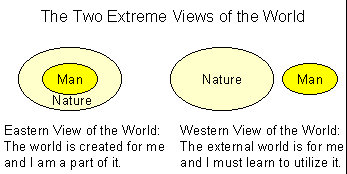
When describing reality, we must be careful not to weave in our own wishful views. For example, history does not have any purpose, as Hegel's metaphysics claimed it has. However, the purpose of studying history is to predict the future. The following two extreme worldviews painted so far by the organised religions, morality, culture, and metaphysics which are collections of linguistic and other kinds of logical fallacies. The Pythagorean view of the world was to study the world as an external entity. This gave rise to the Western scientific and analytical tradition. However, the mysticism view of Eastern world, as expressed, e.g., by I Ching (i.e., Book of Changes), is based on the attitude that man is inseparable from the world. The following figure depicts these two extreme views of the world:
In economic point of view, we cannot get developed just worshipping god and doing what has written in holy books. Most of the religion and cultures, people say that it was god’s wish so that it happened. If God wish for tsunami in which millions of people have lost and separated with their love ones. How a God can do if he creates? It is better to prevent than blame God. One of the economist has said that if you don’t have anything to do then go and dig your field whole day and fill it back at night. This statement trying to explain that we have to work for development, not just praying God to be developed. However in Gita as well, Krishna has told to Arjuna to engage yourself in proper activities. Action is better than non-action. Without work, even the bare substance of life is not possible.
If we assume that God has created us and this universe then who has created God? We also know that something cannot come from nothing. If there would be answer nothing then we are accepting that something can come nothing. Then it would true that we and the universe came from nothing. However some of the Atheism say that God gave Human free will, without it, we couldn’t love or do anything virtuous. Without free will we would be non-rational automatons. While God can and does intervene in the universe, if He intervened to stop all evil doing and natural disasters we would be effectively like helpless infants. And if God constantly intervened against nature’s laws, there would be no pattern by which man could discover how the world works. There would not be science, no pre-dictabilty of nature to rely on. The universe would be irrational. But if these laws originate in the mind of God, we are brought back to the question of God is own origins, which theists do not account for. Whereas neither side of the debate can solve the problem of first cause, what are we to believe?
The phenomena as human consciousness and sensation (including the sensation of free will) were used as evidence for the existence of a God because these things cannot be explained by scientists. But this amounts to taking anything that is beyond our present comprehension as evidence of a complex, creator of the universe. Such reasoning renders the human intellect powerless to investigate the unknown. Imagine if past declare that God causes such things as fire, thunder, rain, and biodiversity were left unchallenged in similar fashion. The world would be a simple place.
Continue.............................

Wednesday, May 11, 2005

God and Religion

Arlen Wolpert has described in his article “General theory of Religion” in mathematically that Knots in Heart, Heart Openness, and the three memories in the cognitive mechanism are called state variables. In system dynamics they are called stocks. Forgiveness Response, Heart Unfoldment Rate, Primary Information Processing Rate, and Background Information Processing Rate are examples of rates. They act like either the bathtub's inlet faucets or outlet drains. The arrows indicate causation. For example, the arrows coming from Prayer Trueness and Prayer Intensity and pointing at Prayer Quality indicate that the first two variables determine the value of Prayer Quality at any time. Specifically, the mathematical model gives the following definition of Prayer Quality:
Prayer Quality = 0.5*(Prayer Trueness + Prayer Intensity)
When Prayer Quality reaches 100%, which is the "forgiveness threshold", the Forgiveness Response is triggered and one Knot in Heart is removed in a ratchet-like fashion. Action then shifts to the negative feedback loop associated with Heart Openness: The removal of this one knot unseals the restricted and rigid or tight heart a bit, causing Psychic Stress to decrease rapidly, which then causes the Heart Unfoldment Rate valve to open. This causes Heart Openness to fill or open further, causing Psychic Stress to rise again as the heart begins to encounter the next knot. As a result Fear Death Due To Knot, and then Prayer Intensity and Willful Attention, begin to rise again. The rise in fear and the attention leads to a shift in loop dominance: Action shifts to the cognitive mechanism, which is essentially a negative feedback loop concerned with problem solving (Ellis 1995). The fear and attention driven Primary Information Processing Rate in the cognitive mechanism speeds up, leading to an increase in Knot Origin Insight. This increasing insight is concerned with the solution to the following problem: What is the particular sin, guilt, or hatred that is at the origin of the knot? The gradual solution to this problem and its gradual acceptance lead to greater Prayer Trueness and then greater Prayer Quality until the latter reaches the "forgiveness threshold," triggering the Forgiveness Response again. Then, the next knot cycle begins.
God was a central part of Aristotle's vision of ethics because to him proper morality was considered divine and highly prized. Aristotle reasoned the "best" things are described as blessed and happy because this was the status of God and the most god-like men. Animals cannot attain in this status however humans only can achieve that status if they properly develop their souls.
Aristotle felt that happiness was not a state of feeling, enjoyment or pleasure; however rather it was the definition of that which is the most desirable and satisfying of life. Aristotle did not believe that God provided us with such a life but rather we had to earn it as a result of our good actions. Our good actions were the result of our acquired virtues we developed though learning, training, and cultivation of proper habits. If this were done, he believed we had acquired the most god-like blessed prize that humans can achieve in the world. To Aristotle, study and care rather than chance is how virtue, which was the greatest and most noble accomplishment of all, is won.

Thursday, May 05, 2005

Religion Vs Reality

RELIGION

REALITY

God first

People first

Fits people to environment

Fits environment to people

One person's vision

Everyone's vision

Moves perceptions

Moves things

Causes culture

Causes progress

Born into a prison that you cannot smell or taste or touch. A prison for your mind."

Like coming out of Matrix "Welcome to the real world!"

Kills people for breaking discipline or forbidden quests

Rewards people for it and calls it creativity and exploration

Believes in punishment

Believes in opportunity

Believes in afterlife

Believes in present life

Tells what to do to live

Tells what not to do to live

If you don't perform you are accepted, if you behave well you are accepted

If you perform you are a celebrity, if you don't perform you are accepted

Disagreement eliminated by eliminating the odd one(s)

Disagreements accepted, negotiated for common ground.

Tuesday, April 19, 2005

Laxmi Prasad Devkota's poem


Muna Madan written by Laxmi Prasad Devkota:
http://literature.wnso.org/2002/munamadan.htm


We Nepalese
Poet:Laxmi Prasad Devkota Translated by:David Ravin
We are the children of Aurora,
Offspring of Asia's reawakened age,
Sons of the Hiamlayas we crave,
To climb the peaks wreathed with the golden rays.
We are the products of the Buddha's soil
The honey-sweet playmates of Janaki,
the flower of our earth,
We are the fulgence of the fingers of Araniko,
And the ripe harvest of Prithvinarayana.
We are the golden dreams of Tribhuvana.
We are Mahendra's garden rich in flowering shrubs,
We are the rivals of the tiger,
And the sentinels of demaocracy.
We are the still small voice of humanity;s dove,
With the Danphe's prismatic plumes of fancy,
We are the scented breath of the Himalayan flowers that grow
out of the dust of the sages that lie in their long silence.
We are the songsters of the luxuriant wilds
That trill and warble love upon the leafy boughs of the world,
We are the mountain temples, of humanity,
We are the liberal liquefaction of the Himalaya's snow-breast
that nourishes the life of India in network of serpentine rills.
We are the prophetic angels of the east,
That dwell in the dominion of the first sun-beam.
We are the partners of this round home,
this terrestrial sphere,Partaking of a single plate.
We are the worshippers of self sacrifice,
We are the citizens of the world.

http://www.albinoblacksheep.com/flash/blockedme.php

Sunday, April 10, 2005

The reason I worship:

The reason of worship, I believe is to keep people out of the way of progress. Obviously, everybody is not going to follow a given culture. My mother used to hand me a toy while she cook food in kitchen which I realised now a good strategy to keep me out of her way till she finished cooking. Today, my mother’s strategies are being widely used by Politicians by raising "non issues" to divert public attention from more important things to their momentary profit. Sometime, she used to tell me story before going to bed and I started to dream. She used to make somebody good character who used to do some extraordinary things in our daily life. Then I used to reflect in my mind: How did they do it? I want to do same thing when I will grow up. Next night, I used to ask again to continue that story. Today, I found that story had great impact in my development process. May be the strategy was that some bright minds would progress while others merely were engaged in worship for their images of "salvation" or "moksha". Many say that all great men were created with the flow of culture, or because of their cultural heritage, but I don’t agree in it. Most of the great men had to learn to swim before jump in the river. The person who created a new path for the followers and try to prove that he/she is the great soul should be a great politician who can fool human being. They have put a fear in our mind that if we don’t follow them we will be Hell (which is too wicked place to live) and if we follow them then we will get a place in Heaven (where those clever guys live to make us fool). At last not the least may be I am giving too much credit to a badly designed system of worshipping and praying. Before doing anything, think yourself because you are human not animal. Don’t become slave like animal who just follow the order, try to become master as well.
"Religions were ancient tools that were a holistic means to a value system, education, knowledge, wisdom, science, medicine, research, worship, spirituality, government, law, morality, ethics, cleanliness, poetry, mythology, history and way of life. Today each of this is a separate field making religions irrelevant in each one of it. For instance, separation of religion from law, from education and from medicine is seen in everyday of life."
"Religion is the God made law to dictates what we should do or not to do. Democracy is the man made law which prescribes only what we should NOT do."

Saturday, March 26, 2005

A beautiful poem by Rumi:

A lover asked his beloved,
Do you love yourself more?
Than you love me?
The beloved replied,
I have died to myself
And I live for you.
I've disappeared from myself
And my attributes.
I am present only for you.
I have forgotten all my learnings,
But from knowing you
I have become a scholar.
I have lost all my strength,
But from your power
I am able.
If I love myself
I love you.
If I love you
I love myself.

Sunday, March 20, 2005

Public Speaking (Humor):

I have posted in this blogger Mr Madan Lamsal's work which was published in Bisiness age Magazine's October 2002.I found this article so relevent in context to our Nepalese daily life.
In modern days, people, especially from the corporate world of Nepal, don’t have time to go through the big volumes of the management books on the topics like time management, public speaking or organizing the seminars effectively. Therefore, this time I am presenting a time-tested formula on Effective Public Speaking for the benefit of the readers.
Starting:
The first problem in public speaking is about how to start the speech. Here are some alternate methods you can use:
The politicians’ way: In this method, start your speech with the mention of your recent visit to some place, especially a foreign country. It may be a visit to Japan, America, China, India or wherever, but try to make the account so engrossing that the people in audience feel as if they are also with you in the visit. The idea is to make the audience forget the real topic of your speech so that whatever you say later will not be regarded as irrelevant.
Businessmen’s way: Whatever may be the topic of your speech, don’t forget to criticise the government. Whatever profession you are in, say that you came to that profession only because of the feeling that you wanted to do something for the benefit to the society, but this stupid government has turned upside down your plan of serving the society because it has changed the policy in the meanwhile.
The joker’s way: You can also start your speech with a joke to arouse sufficient laughter at the introduction. Then whatever you speak will be liked by the audience because they will then think that everything you are talking is a joke. It is even advisable to invite a few friends of yours, who have a loud laugh, to attend the program.
In the middle
Then comes the part of speech which is generally termed as the “body”. Here are some tips to make the body attractive:
Multilingualism: Mix as many languages in your speech as you can. Even if you use some of the regional ones it is all right as long as you do not forget to translate what you say. This proves your cross-cultural nature which will be an asset in this age of globalization. All those in the audience who are the native speakers of those languages you use are most likely to be friendly to you. Similarly, use as much rhetoric as possible to create enough confusion so that the audience will forget the main topic of your speech. It helps to retain you in the podium longer. The longer you are in the podium the more you are regarded as a learned person. This method is very much popular among our academicians.
Don’t let go the loudspeaker: Never miss an opportunity to speak, no matter what the topic may be, as long as there are listeners. After all this is what these people have come to the program for? They are there because they want to hear you preaching. Rest assured that they will not move because the cocktail is yet to be served. Don’t worry about the time. It is better that the chairperson gives you a ‘chit’ requesting you to shorten your speech. That will add to your importance. The more chits you get, the more important person you prove to be. In fact, this method is the only important contribution that the Nepalis have made in the art of public speaking. It is highly patriotic that you use this method and refine it further.
Prepare a master speech: Prepare a master speech which you can use on every occasions just by changing the title. If you have the option of making a choice always choose a very broad subject like “globalization and the role of the developing countries”, “New World Order and WTO”, “Management and Leadership”, etc. It is easier to prepare a master speech in those topics.
Keep the mobile on: If you have a mobile phone, don’t put it off even when you are on the podium. The repeated calls that you receive while on the podium help to enhance your importance. This will also show that you really care for your customers and also that you are always connected wherever you are.

Saturday, March 19, 2005

Sakuntala

(If I want the flowers of spring, the fruits of the later year,
If I want what charms and delights, what satisfies and nourishes,
If I want to grasp heaven and earth with a single name; I name you Shakuntala and so all is said.) Translated in 1791 AD from Sanskrit.
The story for this play is based on a tale in the Indian epic Mahabharata which was written in Sanskrit by Kalidasa. The tale describes how India was being called as Bharatvarsha or Bharat, a name that is still official in Indian languages. In core of the story is as follows:
King Dushyanta, of Puru Empire, meets the hermit- girl Shakuntala while on a hunting expedition. They fell in love with each other and in the absence of Sakuntala’s father; they marry by a ceremony of Ghandharva (It is a form of Hindu wedding ceremony where two can marry with mutual consent with the nature as witness). They consummate their vows and when the time comes for King Dushyanta to return to his palace, he promises to send an ambassador to escort her to his palace. As a symbolic sign he gives a ring to her before going back to the palace.
Sakuntala started waiting her lover King Dushyanta and most of the time she used to be lost on his memory. One day, it so happens that when the short-tempered solitary person, Durvasa Rishi, stops at her hut for hospitality. At that moment, Shakuntala does not hear his calls because she was lost on thoughts in her marital bliss. The ill- tempered sage turns backs without noticed to her situation; he gave her a curse that he who engrosses her in thoughts shall not remember her. Time passes by and no one comes to take her to the palace. So her father sends her to the royal court for their reunion, as she was pregnant with King Dushyanta's child.
Because of the curse and the circumstances in which she presents herself in the palace, King Dushyanta fails to acknowledge her as his wife. In heart-broken state of mind she pleads to Gods to take her away from the earth. Her wish is granted. The spell is broken when a fisherman finds the ring insides of a fish. The same ring that Shakuntala had lost on her way to the court. The king suffers from the feeling of guilt and injustice. Finally he reunites with her. Shakuntala forgives Dushyanta and they are united happily. Their son is called Bharata who rule all over India.

Saturday, March 05, 2005

Colour

Colour spectrum & mnemonic:
R
ichard Of York Gave Battle In Vain.
Red Orange Yellow Green Blue Indigo Violet

Heraldic colour symbols:
Black
: - Prudence, White: - Innocence
Blood-red: - Fortitude Blue: - Fidelity
Green: - Love Yellow: - Faith
Purple: - Temperance Tawny: - Joy

Wednesday, February 23, 2005

DEFINITIONS

Divorce: Future tense of marriage.

Cigarette: A pinch of tobacco rolled in paper with fire at one end & a fool on the other.

Lecture: An art of transferring information from the notes of the Lecturer to the notes of the students without passing through "the minds of either"

Conference: The confusion of one man multiplied by the number present.

Compromise: The art of dividing a cake in such a way that everybody believes he got the biggest piece.

Tears: The hydraulic force by which masculine will-power is defeated by feminine water power...

Dictionary: A place where success comes before work.

Conference Room: A place where everybody talks, nobody listens and everybody disagrees later on.

Classic: A book which people praise, but does not read.

Smile: A curve that can set a lot of things straight.

Office: A place where you can relax after your strenuous home life.

Yawn: The only time some married men ever get to open their mouth.

Etc.: A sign to make others believe that you know more than you actually do.

Committee: Individuals who can do nothing individually and sit to decide that nothing can be done together.

Experience: The name men give to their mistakes.

Atom Bomb: An invention to end all inventions.

Philosopher: A fool who torments himself during life, to be spoken of when dead.

Diplomat: A person who tells you to go to hell in such way that you actually look forward to the trip.

Opportunist: A person who starts taking bath if he accidentally falls into a river.

Optimist: A person who while falling from Eiffel tower says in midway "See I am not injured yet."

Miser: A person who lives poor so that he can die rich.

Father: A banker provided by nature.

Criminal: A guy no different from the rest....except that he got caught.

Boss: Someone who is early when you are late and late when you are early.

Politician: One who shakes your hand before elections and your Confidence after.

Doctor: A person who kills your ills by pills, and kills you with his bills

Monday, February 21, 2005

HOW PROFESSORS GRADE THEIR EXAMS:

DEPT OF STATISTICS:
All grades are plotted along the normal bell curve.
DEPT OF PSYCHOLOGY:
Students are asked to blot ink in their exam books, close them and turn them in. The professor opens the books and assigns the first grade that comes to mind.
DEPT OF HISTORY:
All students get the same grade they got last year.
DEPT OF RELIGION:
Grade is determined by God.
DEPT OF PHILOSOPHY:
What is a grade?
LAW SCHOOL:
Students are asked to defend their position of why they should receive an A.
DEPT OF MATHEMATICS:
Grades are variable.
DEPT OF LOGIC:
If and only if the student is present for the final and the student has accumulated a passing grade then the student will receive an A else the student will not receive an A. DEPT OF COMPUTER SCIENCE:
Random number generator determines grade.
MUSIC DEPARTMENT:
Each student must figure out his grade by listening to the instructor play the corresponding note (+ and - would be sharp and flat respectively).
DEPT OF PHYSICAL EDUCATION:
Everybody gets an A.

Sunday, February 20, 2005

WHAT COLOR ARE YOU?

Read this and think about it. Is it really helped you to tell somebody’s character. Don’t tell yourself that now you are astronomic and start asking date of birth and tell everything. Have a goodtime and fun,

If your birthday is on......
December 23rd~ January 1st = Red
January 2nd ~ January 11th = Orange
January 12th ~ January 24th = Yellow
January 25th ~ February 3rd = Pink
February 4th ~ February 8th = Blue
February 9th ~ February 18th = Green
February 19th ~ February 28th = Brown
March 1st ~ March 10th = Aqua
March 11th ~ March 20th = Lime
March 21st = Black
March 22nd ~ March 31st = Purple
April 1st ~ April 10th = Navy
April 11th ~ April 20th = Silver
April 21st ~ April 30th = White
May 1st ~ May 14th = Blue
May 15th ~ May 24th = Gold
May 25th ~ June 3rd= Cream
June 4th ~ June 13th = Grey
June 14th ~ June 23rd = Maroon
June 24th = Grey
June 25th ~ July 4th = Red
July 5th ~ July 14th = Orange
July 15th ~ July 25th = Yellow
July 26th ~ August 4th = Pink
August 5th ~ August 13th = Blue
August 14th ~ August 23rd = Green
August 24th ~ September 2nd = Brown
September 3rd ~ September 12th = Aqua
September 13th ~ September 22nd = Lime
September 23rd = Olive
September 24th ~October 3rd = Purple
October 4th ~ October 13th = Navy
October 14th ~ October 23rd = Silver
October 24th ~November 11th = White
November 12th ~ November 21st = Gold
November22nd ~ December 1st = Cream
December 2nd ~ December 11th = Grey
December 12th~ December 21st = Maroon
December 22nd = Teal

*RED*
Cute and lovable type, You are picky but always in love...and liked to be loved. Fresh and cheerful, but can be "moody" at times. Capable with people nice, soft, and that can love you for the way you are. Likes people that are easy to talk to, and can make you feel comfortable.
*CREAM*
Competitive and sportive. Don't like losing and always cheerful! You are trustworthy, and very out going. You choose love carefully, and don't fall in love easily. But once you find the right one, you don't let go for a long time.

*TEAL*
You are mostly interested in your looks. And have high standards in picking love. You think and make a solution precisely, and hardly make stupid mistakes. You like to lead, and is easy for you to make new friends.

*GREY*
You are attractive, and active. You never hide your feelings, and express everything that’s inside. But can be selfish at times. You want to be noticed, and don't like to be treated unequally. You can brighten up people's day. You know what to say at the right time, and you have good sense of humour

*GREEN*
You get along well with new people. You are not really a shy person, but sometimes you can hurt people's feelings by your words... You like to be loved and noticed by your lover, but mostly you are single waiting for the right person.

*GOLD*
You know what's right and what's wrong. You are cheerful and out going. It's hard for you to find the one you want, but once you find the right person, you won't be able to fall in love again for a long time.

*PINK*
You are always trying your best in everything, and like to help and care for other people. But you are not easily satisfied. You have negative thoughts, and you look for romantic love like in a fairytale.

*YELLOW*
You are sweet and innocent. Trusted by many people, and have a strong leadership towards relationships. You make good decision and make the right choice at the right time and always dreaming of romantic relationship.

*MAROON*
You are intelligent, and know what's right. You like to make things go your way, which can sometimes cause trouble for not thinking about other people's feelings. But you are patient when it comes to love... Once you get a hold of the right person, it's hard for you to find a better >love.

*ORANGE*
You are responsible for your own actions, and you know how to treat people. You always have goals to reach and u really work hard to get there, you are competitive. Your friends are really important to you and you appreciate what you have, you sometimes over react that's because you are sensitive.

*PURPLE*
You are mysterious, never selfish and get interested in things easily. Your day can be sad or happy depending on your mood. You are popular between friends but you can act stupid at times, and forget things easily. You go for a person that's trustworthy.

*LIME*
You are calm, but easily stressed out. You get jealous easily, and complain over little things. You can't get stuck into one thing, but you have a capable personality for everyone to trust you and like you.

*SILVER*
You are imaginative and fun, you love trying new things. You like to challenge yourself. And you learn things easily, your easy to talk to and you give good advice, When comes to friendship, you find it hard to trust someone, but once you find the right friend, you trust them forever.

*BLACK*
You are challenging, and have the "guts". But you don't like changes in your life. And once you make a decision, you keep it that way for a long time. Your love life is also challenging, and different.

*OLIVE*
You are warm and light hearted. You seem to flow well with friends and family. You don't like violence and know what's right. You are kind and cheerful, but don't envy other people easily.

*BROWN*
You are active and sportive. It's hard for other people to become close with you, but you fall in love easily. But once you find out you can't get something, you give up and let go easily as well.

*BLUE*
You have low self-esteem, and very picky. You are artistic and like to fall in love, but you let your love pass by, by loving with your mind, not your heart.

*NAVY*
You are attractive, and love your life. You have a strong feeling towards everything and very easily distracted. Once you get angry at someone, it’s hard for you to forgive them.

*WHITE*
You dream and have goals in your life. You get jealous easily and you don't react to things easily. You are different and sometimes weird, but everyone loves that in you.

*AQUA*
Your feelings change suddenly and easily. You are always lonely, and like travelling. You are truthful, but listen and believe other people too easily. It's hard to find love for you, and get lost in love easily, sometimes get hurt by love.

Saturday, February 05, 2005

Hindus God:

Brahma: - Creator
Vishnu: - Preserver
Shiva: - Regeneration
Agni: - Fire
Krishna: - Love
Ganesh: - Wisdom, Luck
Indra: - Rain, Thunder
Laxmi: - Beauty, Fortune

Wednesday, January 26, 2005

Monday's Child

Monday's child is fair of face,
Tuesday's child is full of grace,
Wednesday's child is full of woe,
Thursay's child has far to go,
Friday's child works hard for his/her living,
And the child that born is born on the sabbath day is bonny, blithe, good and gay.

Wednesday, January 19, 2005

Global Information Systems:

Globalisation stress the economic engine driving the process that has taken the global economy “from a collection of closed national market (to) an integrated global market” (King 1999). The process of development of globalisation which has been under way since navigators of 15th and 16th centuries first began to open up the globe through exploration (Henderson 2001).
In the context of globalisation, the globally operated organisation’s goal is to develop an information system that allows Corporate, public sector and household activities to be accomplished in global network space. The general idea of an “information economy” includes both notions of industries primarily producing, processing, and distributing information, as well as the idea that every industry is using available information technology to reorganise and make themselves more productive. The main components of this sector are the publishing industries, including software publishing, the motion picture and sound recording industries, and the services and data processing industries. These activities included in this sector cut across traditionally defined areas in the economy, such as manufacturing, telecommunications, motion pictures production and some services areas.
Globalisation and Information systems:
Terms like “globalisation”, “information system”, and “global information economy” are increasingly becoming part of the everyday vocabulary in the academic and the popular press. They are used to describe the context within which social life is structured in the present times.
The use of information system in organisations provide an interesting arena in which the “new” interacts with “old” since IS enables new ways of doing old things and also facilitates the introduction of new kinds of social practices within a particular context. Kling and Zmuidzinas variation the differences in ideologies about the nature of work in particular organisations and workplace vasions. Differences also arise out of variations in history, access to technology, social structure, organisational forms, and structure of existing work arrangements and individual characteristics that exist in specific social contexts.
India is an interesting example of country currently experiencing a variety of forces that arise out of globalisation pressures for change on one hand, and on the other hand the country’s strong and deep rooted tradition and culture, which favour stability. In recent times, India has been a significant interest globally for a variety of reasons including recent policies of economic liberalisation, the expanding middle class and markets, availability of highly skilled and cheap manpower, and existing reserve of natural resources. In waiting of respond and encourage these interests, India too has taken a number of initives to project itself as an active player in the global arena. A recent example of this was the setting up of a task force by the Prime minister to draft a national IT strategy with the objective of making the country a “global IT Superpower” and enable Indian software developers to establish “global dominance in short time” (Hindustan Times, May 20, 1998). To emphasise this global IT intent, the Prime minister set up a global vision group comparison of internationally famous personalities like Bill Gates, Alvin Toffer and Nicholas Negroponte to help guide the implementation of task force recommendation (Times of India, July 30, 1998). Despite such on going and global pressure for change, example from various walks of Indian Ethical, Political and Social life suggest that bringing about this change is difficult, and is grounded in deep contradictions between these forces of changes and those that favour of stability.
Ethical, Social and Political issues are closely related to each other in the context of global information technology which cut across various level of action of individual, social and political.
The moral dimensions of the information age:
According to David O. Masona and Carr P.Collins propose their view in the context of ethical issues, are many and varied, however it is helpful to focus on just four which may be summarised by means of an acronym: PAPA.
Privacy: What information about one’s self-associations must a person reveal to others, under what conditions and with what safeguard? What things can people keep to themselves and not be forced to reveal to others?
Accuracy: What responsibility for authenticity, fidelity and accuracy of information? Similarly, who is to behold accountable for errors in information and how is the injured party to be made whole?
Property: Who owns information? What are just and fair prices for it exchange? Who owns the channels, especially the airways, through which information is transmitted? How should access to these score resources be allocated?
Accessibility: What information does a person or an organisation has a right or privilege to obtain, under what conditions and with what safeguards?
In the same way Ludan and Ludan have described the information age in the context of ethical, social, and political issues, are very closely connected with each other which can cut across various levels of actions of individual, social and political. These three issues identify five moral dimensions of information age that I will focus on this essay.
Ethics is a branch of philosophy that makes moral judgement considers issues of rights and wrong; a “set of principles of rights and wrong used by individuals as free agents to guide behaviour and conduct.”(Chao et al 1995), which are developed by and reflect the value of particular culture at particular time (Mazuri 2000). All culture has a set of ethical values or rules concerning what are morally right and wrong. Some ethical concerns have been resolved in the form of new amended laws. Some will be addressed by future legislation. Many professional groups have adapted ethical codes. The emergence of the information systems professional spurred the major organisations of computer professionals to draft their own codes. However, not all IS professional are bound by the same set of rules. The reason is simple: the law does not require certification of computer professionals. Certification is voluntary at most. Many IS professional does not belong to any organisation. Those organisations that have established ethical codes have failed to collaborate and formulate one set of globally accepted rules. Physicians, layers and engineers have moral responsibilities and know to whom they are responsible. Professionals in information systems field need similar guidance. Developed countries professional organisation like US’s DPMA, ICCP, ACM, and Canada’s CIPS and British’s BCS code of ethics have some similarity and differences. This is the prime time to propose to resolve the differences and adapt a single coherent international code of ethics and establish a “Hippocratic oaths” for information systems community.
INFORMATION RIGHTS: Privacy & Freedom
Privacy has different uses in different situation. According to Ludon and Ludon, it is the claim of individual to be left alone, free from surveillance or interference from other individuals or organisations including the state. The considerable culture variation can be expected is the area of privacy. The basic concepts of concerning privacy would likely be widely acceptable across cultures, variability would be expected in detail of ethical codes. Privacy protects some freedoms and restricts others. It protects an individual’s freedom to be alone, to do things without others intruding, and to control what others know about him or her. The issue of privacy includes areas of personal data, hacking and surveillance.
Personal data: There are really so many issues that arise with the personal data in information systems. The first thing individual should know what sort of data is going to be store about him or her and what is going to be done with it. The Privacy Act of 1974 has the following provisions that apply to federal agencies:
Individual have the right to know what records are collected, maintained, used
or disseminated by federal agencies.
Individual have a right to prevent records collected for one purpose from being used for another purpose without consent.
Individuals may access and correct records concerning themselves.
Individual may collect, maintain, use, or disseminate the records of personal information to ensure the information is accurate and being used lawfully.
Exemptions are permitted when statuary authorities specify important public needs.
Hacking: Hacking is morally wrong and ought to be condemned. A hacker is a person who enjoys computer technology and spends time learning and using computer systems. A cracker or criminal hacker has the same basic attributes but his/her talents to gain unauthorised or illegal access to computer system. Sometimes it is done for fun and other times for profit. Criminal hackers may steal passwords, access or destroy valuable information, steal money or credit card information and use access time. Internet piracy is defined as illegal gaining access to the Internet. To obtain access, users call Internet service providers and utilise wrongfully obtained passwords and account names. Internet piracy can be controlled through the use of caller ID phone services, frequently uptodates of passwords, and education virus is a program that attaches itself to other programs which will often destroy software or data, interrupt processing, or exact damage on computing applications. Software piracy is the illegal use, copying or distribution of software. Duplicating software is very easy; the chance of being caught or prosecuted is very small.
Surveillance: It is morally right that employers can watch that whether their employees are working satisfactorily or not. The right to privacy at work is also an important issue for the information age. Sometime worker may find that they are being closely monitored via computer technology. These computer monitoring system tie directly into computerised workstations; specialised computer program can keep track of every keystroke made by user. Most organisations maintain privacy policies, evens through they are not required by law. However some companies even have a privacy bill of rights that specifies how the privacy of employees, clients and customers is to be protected.
Ethical issues:
In the context of privacy in information age it may arise the question that under what condition an individual can use the privacy of others? At present, credit bureau must provide reports to individuals in order allow people the opportunity to rectify incorrect information. But other kinds of databases are not held to similar standards. This problem has not yet been resolved and it is becoming increasingly troubling as more and more data on private citizens is collected and stored on computers. The possibility of inaccuracies has always existed with paper documentation, but as information is distributed, and redistributed, and stored in ever greater quantities, the ability of individuals to know who may be holding and distributing incorrect data on them becomes more complex and ethical issue.
Social issues:
The issues in the social context of privacy could be aroused when a society encourage people to develop expectation of privacy while using electronic mail, cellular phones, bulletin boards, the postal system the workplace, the street. Geographic information system databases hold all kind of geographic information relevant to specific individuals. They may include tax and land records, property title, data on construction or occupancy permits, data on residency or on water use. Sometimes that data might be incorrect and so may cause economic or social harm.
Political issues:
The issues in privacy in context of political issues are Encryption codes, which are used to translate data into code that cannot be read without a key, are restricted. The U.S. government claims that such codes must be controlled for reasons of national security. Encryption codes are treated as munitions under export permission from the Department of State. This policy draws vociferous criticism from people who claim that the government in unfairly attempting to control access to and privacy of communication.
PROPERTY RIGHTS AND OBLIGATIONS:
Intellectual property: The concept of moral rights to the access to intellectual property is at present very poorly developed in the legal systems in the United States-interestingly these concept are “far more developed “ in continental Europe (Lipinski & britz 1999). Culture will generally agree that stealing is wrong, but “may not view reproducing software without permission as stealing” (Lipinski & Britz 1999). The legal opinions issued in recent decades by international bodies tend to reflect the values of and support the interests of the industrialised western nations. This is particularly true in the areas of copyrights and intellectual property. The universal declaration of Human Rights says in Article 27(2), “Everyone has the right to the protection of the moral and material interests resulting from any scientific literary or artistic production of which he is the author” (1993:141).
Trade Secrets: According to Ludon and Ludon, it as an illectual work product- a formula, device, pattern, or compilation of data- used for a business purpose can be classified as trade secret. It has different rules of protection of each different state. In this context software which contains novel and unique elements, procedures or compilations must have to take care by the owner and creator.
Copyright: Copyrights were created to protect the commercial value of creative work. Unlikely other countries, the U.S. do not allow public information, information created and held by the government, to be copyrighted. The government is also required to allow access to its information. In Great Britain, in contrast, the government is able to sell information and thereby recover the costs of creating and maintaining it. In the U.S., the government’s lack of control has positive as well as negative consequences.
Ethical issues:
The ethical issues arise to individual concerning about copying and duplicating of software. An individual should have to think that is it morally right to copying or duplicating a piece of software which is protected by trade secret, copyright or patent laws for his/her own use? If every individual start copying or duplicating the software, computer industry journals and newsletters, the writer or creator will not get any benefit of his/her work.
Social issues:
The copying and duplicating software, computer industry journals and newsletters have threatened significantly to reduce the speed of new technologies productivity and social well being.
Political Issues:
The main political issues concern with government or professional organisation law and regulation, the creation of new property performance measures to protect investment made by creators of new software (Ludon & Ludon).
ACCOUNTABILITY, LIBILITY AND CONTROL:
Accountability is depending on the liability law and social practices for holding individual and social institution. Professionals have become aware that they may be held legally accountable. For the accuracy and reliability of the information stored in their databases, sold or issued to the public. If harm is caused or loss, those charges may be held accountable, in that case not only for a simple mistake, but also for the manner in which decisions were reached. Finally, data providers may be held accountable if the information they distribute leads to damage or loss even if that information was used for purposes for which it was never intended.
Ethical issues:
The ethical issues will rise when the new technology comes to market. In that cases the creator, seller and developer ready to take the liability if it harm to individual life? If so, then who is morally responsible for consequence of use- the developer, creator or seller? Private suppliers of data have always been liable for harm resulting from the information they distribute. Digital systems however are leading these providers into situations that expose them to new liabilities. Suppliers find difficult to anticipate risks associated with new uses of data. (Margaret and Kenneth E. Foote, 1995).
Social Issue:
The social issues will rise when the service provider is liable for development of new system, which will affect in socially, individually or politically. For example, In Aetna Casualty and Surety Co. vs. Jeppesson and co. the court found that an aeronautical chart published by Jeppeson and co. had misled the flight crew in a fatal plane crash. The chart in question mapped out the instrument approach to an airfield using correct data from the Federal Aviation Agency, but in a way that obscured simple and fatal error. Two views from the side and from above were drawn. The two charts were depicted together so that they appeared to be in the same scale, but in fact they were drawn in different scales. The company was found liable. (Margaret and Kenneth E. Foote, 1995).
Political issues:
The political issues rise when government agencies have caused harm to individuals through errors or neglect, They may not always be sued or assessed for damages. The doctrine of sovereign immunity applied in the U.S. allows people to seek claims against the government itself agrees to be sued. However, most states have limited or abolished this doctrine so that governments at state and local levels may held accountable for their actions. This does not mean that individuals will be able to sue government agencies in all instances. More over, government agencies often cannot be held responsible for errors in public records that they are forced to provide under Open Records and freedom of Information rules. If they were held accountable, many believe, public agencies would be overwhelmed by litigation based on data they could not restrict or control. (M. & Kenneth E. Foote, 1995).
SYSTEM QUALITY: DATA QUALITY AND SYSTEM ERRORS:
According to Ludon and Ludon that three principle sources of poor system performance are software bugs and errors, hardware or facility failure because on natural or other causes, and poor input data quality. It considers why zero defects in software code of any complexity cannot be the seriousness of remaining bugs cannot be estimated. The software industry has not yet arrived at testing standards for producing software of acceptable, but not perfect performance. (Collins et al 1994).
Ethical issues:
The ethical issues in system quality rise that an individual or an organisation can feel safe quality. The quality of software concludes them that software or service achieves an economically and technologically adequate level of quality.
Social issues:
The social issue rise in system of quality that the software and service are reliable for society, the society is ready to accept to it and it is going to contribute social well being or development.
Political issues:
According to Ludon and Ludon that the leading quality related political issue concern of responsibility and accountability. In such a case, should congress establish or direct the NIST to develop quality standards and impose those standards on industry?
QUALITY OF LIFE: EQUITY, ACCESS, & BOUNDARIES
In some cultures, personal attributes such as individual honesty and integrity may seen to be of secondary importance compared to greater good of the family and society (Donaldson 1996). It is seen to be “just honest” means of aggressive competition in India. Our life is of satisfactory quality depends both on what our life is like- our material circumstances, health and so on. Quality of life cannot be measured in the way that standard of living can be. One can enjoy a high standard of living but still lead a life of poor quality.
Health concerns:
As organisations start to benefit from computerisation, more people will suffer from computer-related problems and hazards.
Repetitive minor disorders which can be caused by working with computer keyboards can cause and other equipment.
Repetitive stress injury can problem in tennis elbow, the inability to hold object and sharp pain in fingers.
Carpal tunnel syndrome is the aggravation of the pathway for nerves that travel through the wrist (the carpal tunnel). CTS involves wrist pain, a feeling of numberless and difficulty in grasping and holding object.
Computer vision syndrome refers to eye pain. It involves usually headache, blurred vision, dry and irritated eyes.
Ethical issues:
The ethical issues may rise in the context of quality of life that an individual is feeling unsecured in his/her job. For example, The most of the call centres from GT. Britain and U.S. are moving to the Asia like India and Philippines. The BBC’s call centre staff did strike in opposition of this policy.
Social issues:
Kenneth J. Gergen proposes in The Washington Quarterly, the quality of life in community is in crisis. He has described the crisis in a wider range of relationships, increasingly mobile populations, and erosion of strong bonds and so on.
Political issues:
The development of global information, most of the developed country’s moving to the third world country because of cheap, skilled and reliable manpower like India. It could bring more people jobless and may raise political issues.
Conclusion:
The issues of moral dimensions which is discussed in this essay conclude that a single, coherent code of international standards and law would help in fostering a strong public recognition of global information systems and greater commitment on the part of professional towards society, employers, clients and colleagues. The fast transferred telecommunication “globally village”, it is distributing to find an obligation, through patriotic, that does not mention human kind as awhile and welfare of others nations. Every country’s obligation is clearly to “my country” not to society in border sense of the world.
References
ACS (1999a), Australian Computer Society Code of Ethics. [Online],
http://www.acs.org.au/
Donaldson, Thomas (1996) Values in tension: Ethics away from home.
Harvard Business review, Boston Sept/Oct 1996
Gosh, A.K., Swaminatha, T. M., Software Security and Privacy Risks in Mobile E-commerce, Communications of the ACM, Feb. 2001, Vol. 44, No.2, pp.51-57
Gergen, J. Kenneth (1999), Global trends: A glimpse ahead The self in the age of information, The Washington Quarterly 23.1 (2000) 201-214
www.expressindia.com/newads/intel/views.htm
www.lic.gov.uk/publications/policyreports/keystone.html
www.utm.eud/research/iep/m/m-relati.htm
www.isd77.k12.mn.us/staffdir/staff2/johnson _Doug.html
www.rpi.edu/~johnsd/epic/materials/syllabi.html
Mason, O.Rochard, Collins, P.Carr, Four ethical issues of the information age. Management information System Quarterly (10:1) March 1986
Oz, Effy (1992) Ethical standards for Information systems professionals: A case for a Unified code. MIS Quarterly, December 1992

Saturday, January 08, 2005

Few good stuffs.................

Today,I was checking my assignments and documents and suddenly my eyes went to the one of my article which I have collected and written at Manchester Central library since 8th of Jan. 2000. I was really surprised that how come I found it today,amazing. Anyway,I have to work in it before publish in this blog.This article really brought my memories back when I was at Manchester and my those days. I used to sing Nepali song and used to talk myself because I was lonely and hadn't any Nepalese friend. I had few friends one American Travis Dittmer and French Sebastein Delcort but most of the time they also used to be busy. It was really good experience and sometime Uncle used to come to visit once in 2 months. I used to live in University accommodation called Castle Irwell student Village. There was nearly more than 2000 students used to live and all the facilities were provided by University in terms of Pub, Small cinema hall, Football, hockey and so on. Just infront of my flat,there was girls flat and the students,mostly in Friday night used to drink and used to dance,make a noise just infront of my room. The girls also used to come out side of their room and used to dance, whisle them. It was my new experience on such things so I used to laugh and laugh.

Wednesday, January 05, 2005

The meaning of Life

This rememberance is based on my own & Clive Anderson's programme in Channel 4 which I have interrealeted. I always remember few certain things which always strike in my mind. Few of my memories which I am writing today that is quite important in our daily life. I always believe in doing right thing which is trying to behave honourably. I mean that if I find something, for instance, the right thing to do is to give it back to the person whom I working for or what I am working. It is usually possible to recognise the honourable course. The second thing is give respect to others so you can also expect and certainly you will get respect at the end. It is easy to be polite to the important people who you want to suck up to, however the real test of whether you are respectful to others is if you are polite to people who you do not actually need to suck up to. Therefore it is better to be polite to people regardless of their status and age. One of my good friend has sent me Dalai Lama’s new year greeting in which Dalai Lama has said to follow the three R’s:
Ø Respect for self,
Ø Respect for others and
Ø Responsibility for all your actions.
This is quite true to be a success for our future life. The third thing is to remember the good old days. Most of the old people think that today’s youngsters are bad mannered and show contempt for their elders. However we can pretty sure that their parents were also saying the same thing about them when they were young. If fact, if we go all the way back to Socrates, who was saying much the same thing about the young of this day. I think every generation thinks the country culture is going to be worse however it is not true. In fact, it is the change of time. The fourth thing is to learn to priorities. The key to making a success of life is getting the balance right. If you just live for today then you are not going to make provision for tomorrow. However if you put everything off until tomorrow then you never have that happy time. It is all about striking a balance. The last but not the least is importance of luck. Luck comes once in life so try to get it and utilize it. This is always underestimated. You need talent, hard work and luck to get on however luck is the most important factors in finding success.

Sunday, January 02, 2005

University student:

Acquiring knowledge as against wealth is the prime motivation of majority of University student.
The University is one of the world’s most durable institutions. Image and personality of youth assail a person of certain age who returns to the University after away from many years. At University, students learn skills and knowledge that seems to point to the future. These facts clear that University is the factory of knowledge not only passport generation to get a job. A student needs to maintain a stable, organised and meaningful structure of their world in order to prevent chaos. At that period different factors motivate students according to their attitude, personality, age, culture and situation. Some student motivates financially whose main objective is to acquire money not knowledge. They only want to get degree to get nice job for this competitive world. But most of the student motivated to gain knowledge that will give them more professional skills for this competitive world. Theirs’ main objective is to get better education for their bright future. This all depends on the model of man that is characteristics by their behaviour, attitude and personality.
Establishment and Development of University Education:

The first University was founded at Bologna in the 11th century. In the 12th century, there were founded two universities at Paris and Oxford. The main reason to establish University is for development of knowledge, skills and mankind. According to Cicero (1997) University would be dedicated to the pursuit of knowledge for its own sake, would be “the high protecting, power of all knowledge and science, of fact and principle, of inquiry and discovery, of experiment and speculation.” There are two main powerful forces play in the purpose and self-images of University are: first is the intellectual and the second is political. According to self-image of University, it affects the main goal of students and motivates differently. In context of UK’s Universities, there is one group of Universities which is known as Russell group of Universities and the members are: Oxford, Cambridge, Bristol, Durham, Edinburgh, Warwick, Nottingham, Birmingham, St. Andrews, Sheffield, Southampton, Glasgow, Newcastle, Manchester, Liverpool, London school of Economics, Imperial college of London, University college London and King’s college London. The Russell group’s main objectives are to produce skilled and talent student to bring revolution in the world. Student go to study for better education and their prime motivation is to gain more and more scientific and theoretical knowledge which will help them to get professionalism in their specific field. To get admission in these universities, they are specified few rules which will discourage a lot of students to get admission. The tuition fees for overseas students are too expensive in European or well known Universities. It will make clear that those Universities are only for developed countries people who will get help from their government or family to pay that huge amount of money. The prime motivation of the overseas students who come to study at UK, US, Japan or other European country is, after finishing their University course, probably, there would be more chance to start his or her career at the local market of the country or overseas for their bright future. Some of the overseas students mostly from Asian and African country, who come to study at developed country like UK, USA, Japan, European Country, think after doing graduation or Postgraduate degree, there would be more chance to get employment at develop country so that they take any under-graduate or postgraduate course and pay huge amount of money and spend valuable time. Kun completed a Masters in engineering related course but he has been unsuccessful in securing job. He has done his graduation in Business management course from India. Most of the employer told him that he was over qualified and did not have related work experience. He started to regret his Masters as all he achieved so far was £9,000 more debt. The second reason for change in the University has been the rise of democracy, and the demand for mass education. As an increasing proportion of country’s citizens go on to post school education so some tertiary qualification become the main passport to get a job. University education has become a sorting machine for employers, job seekers, companies and different organisations. According to Peter David (1997) University is one of the world’s most durable Institutes. But now, it must pass a complex new test. As an increasing proportion of country’s citizens go on post education. The University’s education method and environment for getting education is main thing for every student. Some of the overseas students go to further education to become a qualified person that is the passport for them to get a good job in the world market; it makes them more competitive to the world. At that context, Students’ prime motivation is quality education and knowledge. The period which they spend at University, makes them more skilful and gives broad knowledge to get maturity and competitive in this world market. The main factor for behaviour is that students find them at different particular situation, that is age, situation of student, family background, opportunity and so on which influences a student for their goal to achieve professional qualification, increase their knowledge of particular sector or perhaps most importantly, to enhance their employability. Most students will also have to consider how their knowledge of Wordsworth will improve their overall employability in an already crowded job market; however motivation varies over time and according to their circumstances. The world is changing rapidly day by day. University’s degree does not guarantee employment, but it is definitely advantageous in this tough competitive market to achieve goal in this global job market. A postgraduate qualification is evidence of hard work, commitment, a greater knowledge of particular field, and often specific work-related skills. Student gets knowledge and skill from University and that degree opens every door for competition to the global job market. A qualified student achieves his or her goal more than unqualified person does. Students who have difficult goals perform well than student with easier goal. Attitudes are in adequate in resolving a particular issue, then the acquisition of new knowledge could bring about a changed attitude. Every person is generally information –seekers, they have a need to know and this drives them to gain information that gives meaning to their social world. The culture and society also affect to motivate student differently. The University student means a mature and qualified person who has different target and goals about their individual life. That target and categories can be summarised by following:
· Comfort (including primary needs and drives, and a comfortable life style.)
· Structure (including financial security and certainty.)
· Relationships (including love, warmth and friendship.)
· Recognition (including status and praise.)
· Power (including control and authority.)
· Autonomy/ Creativity/ Growth (including self acquisition or self fulfilment.)
All these factors affect directly or indirectly to the student or individual, however, Maslow’s hierarchy of human needs theory has identifies five levels of human needs which are in ascending order:
Physiological needs: Homeostasis, the body need to breathe, drink, eat and sleep; shelter; comfort; sexual desire.
Safety: Safety and security; stability; protection from danger, pain, deprivation and physical attack.
Social: Social activities; friendship, affection and love; interaction with other people.
Esteem: Independence and achievement; self respect and respect of others; prestige and status; recognition.
Self-actualisation: Personal fulfilment; realisation of one’s potential; surmounting Maslow has defined his view that people generally fulfil these needs in the order given, but there were exceptions, and that might in some special circumstances be a reversal of the order. Reversal of the social and esteem elements in the hierarchy in the most frequent encountered. To some people, esteems assumes a greater important than the social elements, such as love. Some highly educated person may accord greater value to the respect of their associates, rather than their affection. Some of the student/individual who has finished his or her higher education unfortunately he or she does not get what they have expected and unemployed may be willing to settle for any job and its attendant security. Student/Individual with high levels of motivation, such as idealists and creative person, may be little concerned with lower level needs such as food, shelter and security, provided they are decided. (page:153, Management for engineers) Hirotaka Takeuchi (June 1998) has stated his view in terms of knowledge in different ways. He has classified the knowledge in two forms. The first one is explicit knowledge that can be expressed in words, numbers and shared in the form of data, scientific formula, product specifications, manuals, universal principles and so on. This kind of knowledge can be transmitted to individuals formally and systematically. This kind of knowledge has been the dominant form of knowledge in the Europe and has been using in multinational companies as Knowledge Management. This kind of knowledge can be named as bookish or subjective knowledge; it could be disappeared after certain years if it is not being used in practically. The second one is tacit knowledge which depends on individual’s action and experience, as well as in the ideas, values or emotions and it is hard to formalise as explicit knowledge. Tacit knowledge can also divide into “technical” and “cognitive” knowledge. The technical knowledge can be gained through work experience. This kind of knowledge can be developed by individual’s involvement in work and they can develop expertise after years of experience. However, involvement in learning is not a new idea, as following Chinese quotation shows:
“Tell me……………………………I’ll forget,
Show me………………………….I’ll remember,
Involve me……………………......I’ll understand.”
-K’ung Fu Tze (551-479 BC)
This kind of knowledge is very success in Europe however it doesn’t make clear the scientific or technical principle behind what they are doing. It would be very success when individual would get highly subjective and personal insights, intuitions, hunches and inspiration at work place, University or Higher Education Institute, and would involve in such kind of work, can develop expertise after few years experience. It would be very expertise knowledge for that particular field. Tacit knowledge also contains an important dimension which is known as cognitive. Cognitive knowledge contains of beliefs, perceptions, ideals, values, emotions and mental models are deeply embedded to us. This kind of tacit knowledge shapes the way the student or individual understand the world around us so that it cannot be marked with apparent very easily.
The approaches of model of man:
University students the most important thing is to set target and goal for readiness to learn and cutting down procrastination time. Learning is a feature of all human activity. Learning means to develop knowledge and skills. A child learns to eat, walk and talk through trial and error and learns with body, not only with mind. But it is also universally truth that Body or matter does have an extension we can see and touch but doesn't think, a mind has no extension but thinks. Thus, according to the Cartesian, true knowledge can be obtained only by the mind, not by the body, when we want to get professionalism in that particular field. Some of the intellectual tradition also depends on different learning process. In the western intellectual tradition values depends on value precise, conceptual knowledge and systematic sciences however in the Eastern intellectual tradition values depends upon direct, personal experience. These are the different traditions that make the difference in the importance in explicit and tacit knowledge. The growth of any society requires individuals to develop new skills and competencies and to have flexible attitude to cope with future challenges. A student learn at University that
· What to do which includes skills and knowledge. How to be that includes role behaviour.
· The ropes that includes socialisation process and culture.
· The social rules that include norms and attitude.
· Personal development that includes skills of maturing, assessing, advising, policy development which include learning organisations.
· Coping with changes and development, enabling ‘loose’ creative and laterals thinking.
As characteristics of model of man, it is vary about their thinking, target, goal, behaviour, and attitude. Their motivation factors are also varying between each other. A rational-economic person’s main thing is money. A University student whose thinking is rational-economic is always motivated to acquire to get only degree not knowledge. He/She is always motivated by money. A social concept person’s main goal is to get opportunity for development. That type of student always motivated by quality education than the money. Their main target to get quality education, which will help them to do something for society and world. A self-acquisition person’s main motivation factor is quality education. That type of student always wants to get quality education that will help them to be a qualified person for the sector. They always do hard for to get knowledge and skill for competitive world. A complex person’s motivation is also complex because they are very strict and may be motivated by both money and knowledge. Some are motivated by money and some are knowledge however they always strict about their work. A complex man mainly motivated by knowledge and skill because they are strict about their work and they do not like public contact. Actually, they always like to be in a high post in any company and organisation. To get a high post, they always motivated to get more and more skills and knowledge to achieve their goals
Conclusion:
The majority of University student’s prime motivation is different among different characteristics, attitude, value, goal, behaviour, environment, age and culture. Most of the students go to University to get degree which is sorting machine for employers, must ensure that their own degree is awarded by elite University rather than the college down the road, or pursuers further degrees. Universities are increasing as produces and disseminators of useful knowledge that they justify their claim on public purse. From the above facts and points, it can be concluded that majority of University students are motivated for knowledge than to get wealth.
References:
1. Armstrong, M., (1996), Personnel management, Kogan page limited, London. 2. J. Mullin, L., (1999), Management and organisation behaviour, Financial times & Pitman publication UK 3. L.Gibson, J. and M. Ivan (1998), Organisation-behaviour-structure-process, IRWIN publication, USA 4. McKenna, E. (1998), Business psychology and organisational behaviour: A student handbook, Psychology press ltd, UK 5. Chase, Richard B., Nicholas J. Aquilano, (1995), PRODUCTION AND OPERATIONS MANAGEMENT: Manufacturing and Services, 7 th , IRWIN 6. Payne, Andrew C., Chelsom, John V., Lawrence R. P. Reavill, (1996) Management for Engineers, John Wiley & Sons Ltd., West Sussex, England. 7. Shrestha & Adhikari (March 2002), Self-Esteem and Nepali Managers, Business Age Monthly Magazine, Nepal (Web: http://www.nepalnews.com/ New Business-age). 8. Poddar, Hanuman Prasad, (1985) THE PHILOSOPHY OF LOVE- Bhakti Sutras of Devsrsi Narada, Radha Press, Delhi, India 9. Curtis, Graham and Cobham, David, (2002) BUSINESS INFORMATION SYSTEMS-Analysis, Design and Practice, 4 th Edition, Pearson Education Ltd., Essex, England 10. http://www.prospectus.ac.uk/ (2004 Prospects Postgrad, Spring)

Saturday, January 01, 2005

Proverb

I can't remember that where did i write this proverb in my diary.Anyway,this proverb gives alot of sense to our daily life.Keep it in your mind and It will help you gradually.have a goodtime.

Control your thoughts, these become words;
Control your words, these become deeds;
Watch your deeds, these become habits,
Regain your habits, for habits do hard,
and they form your character;
and remember your character, Constitute your destiny.