Monday, September 26, 2005

Sunday, September 25, 2005
British Universities losing allure with overseas students:
According to the Organisation for Economic Co-operation and Development that Britain’s share of the productive market in overseas students has declined sharply as Australia and other competitors countries attract more Asians students on degree programmes. However, there are number of foreign students are coming to study in the UK, its market share is falling faster than any other developed countries and, threatening its position as the second most popular undergraduate destination after the US.
Australia has been the biggest beneficiary,making progress particularly in attracting students from China, the largest and rapidly growing source of new business. Andereas Schleicher, head of analysis at the OECD said " The advantage that the UK has traditionally had is getting smaller,". He also warned that the other countries, particularly in the Nordic area, were introducing courses taught in English, threatening to erode further the dominance of universities in English speaking countries.
Mindful of the £1.25 bn a year revenues earned from foreign students' fees, ministers are struggling to balance the need to promote and support British university courses aboard with concerns about security and illegal immigrantion. Under a Home Office pilot scheme, colleges are being asked to report back when enrolled students disappear or accepted candidates fail to turn up.
Australia has been the biggest beneficiary,making progress particularly in attracting students from China, the largest and rapidly growing source of new business. Andereas Schleicher, head of analysis at the OECD said " The advantage that the UK has traditionally had is getting smaller,". He also warned that the other countries, particularly in the Nordic area, were introducing courses taught in English, threatening to erode further the dominance of universities in English speaking countries.
Mindful of the £1.25 bn a year revenues earned from foreign students' fees, ministers are struggling to balance the need to promote and support British university courses aboard with concerns about security and illegal immigrantion. Under a Home Office pilot scheme, colleges are being asked to report back when enrolled students disappear or accepted candidates fail to turn up.
Mr. Schleicher said " In higher education there is fundamental change going on in many countries and a lot of investments being made." He predicated that greater internationalisation of education would have a growing impact on countries' balance of payments. There was also a burgeoning market for cross broder programmes delivered electronically.
"The strength of the pound is hurting UK, the Americans are coming back into the market after staying away for a few years after 9/11, and now the prime minister, who had highly successful strategy to increase the number of foreign students, has let the Home Ofice sabotage everything."
Thursday, September 22, 2005
The meaning of work:
Children are frequently asked the question, ‘What do you want to be when you grow up? My Mother and Father used to ask me same type of questions when I was child. I used to reply very eagerly that I want to be Pilot. When I completed my higher secondary level course, I tried to choose medical field. Because of time, situation and different circumstance I had to change my field in business studies in graduation level. When I got an opportunity for further study at UK, I continued my further study in Advance Manufacturing and MIS (Hybrid Manager) which was funded by EEC Union for Air Bus UK. As time passed and I am adult now, if the question is rephrased to me ‘What do you do?’ It is more likely now to mutter that I am qualified to work in strategic level in an organisation rather than any particular profession like Pilot, Doctor, Charter Accountant, Human Resource Manager, Marketing Manager and Industrial Engineer.
These two common questions are significant because both underline the fact that paid employment is generally considered to be a central defining feature of ourselves as individuals. As children we are being judged in terms of our employment aspirations and, as adults we are being assessed in terms of our employment status. In summary, paid work is one of the principle means by which we evaluate other people.
An individual experiences work as the meaning of work in terms of the economic necessity to work and moral necessity to work. In terms of the economic necessity includes the material reasons for work and raise the question of whether people would carry on some form of work even if they had no financial need to do so. In terms of the moral necessity includes the concept of a ‘work ethic’ and assess its various elements that are supposedly encouraging people to work irrespectively of any economic necessity.
It is a common sense view is that people work simply for money. However, research always revels that the actual reasons why people work are far more complex. Certainly, it is true that money is important, but employees tend also to give a range of other reasons for working. To illustrate this point, let’s take a research question done at Swan Hunter Shipbuilder in UK by Erickson, Stephenson and Williams (2000: 180-1). The research question was ‘Why do you work?’
‘I want to provide for my family, but I enjoy the trade union side of my work. I like going to meetings, negotiation and helping people.’ (Design engineer)
‘To keep my family. But I think it’s important to do something you enjoy.’ (Draughtsman)
‘The pay packet. But work is a necessary ethic when you work all your life- it governs your existence.’ (Welder)
‘For self-respect-I don’t want to become a social parasite. And I don’t want to be bored. It’s good for meeting people and I get a lot of job satisfaction, and for the money too.’ (Steel-metal worker)
‘Making a living and getting the self-respect of doing something productive. It gives me peace of mind.’ (Driller)
‘To exist. I like the job. I come to work to use my skill and to make enough money to have a decent way of life.’ (Planter/foreman)
‘It’s all I know.’ (Caulker/burner)
Now, I want to move my topic to evaluate the importance of the economic need to work. From the earlier discussion about the work, we roughly know that people work in order to earn money to live; it is through paid work that basic needs are satisfied because it provides money for subsistence (food, housing, clothes, and so on). However, it is hard to accept blindly this argument as it stands: can we really talk about the need to work for the purpose of subsistence when most developed societies provide welfare system that prevents people from falling below the basic level of subsistence?
These two common questions are significant because both underline the fact that paid employment is generally considered to be a central defining feature of ourselves as individuals. As children we are being judged in terms of our employment aspirations and, as adults we are being assessed in terms of our employment status. In summary, paid work is one of the principle means by which we evaluate other people.
An individual experiences work as the meaning of work in terms of the economic necessity to work and moral necessity to work. In terms of the economic necessity includes the material reasons for work and raise the question of whether people would carry on some form of work even if they had no financial need to do so. In terms of the moral necessity includes the concept of a ‘work ethic’ and assess its various elements that are supposedly encouraging people to work irrespectively of any economic necessity.
It is a common sense view is that people work simply for money. However, research always revels that the actual reasons why people work are far more complex. Certainly, it is true that money is important, but employees tend also to give a range of other reasons for working. To illustrate this point, let’s take a research question done at Swan Hunter Shipbuilder in UK by Erickson, Stephenson and Williams (2000: 180-1). The research question was ‘Why do you work?’
‘I want to provide for my family, but I enjoy the trade union side of my work. I like going to meetings, negotiation and helping people.’ (Design engineer)
‘To keep my family. But I think it’s important to do something you enjoy.’ (Draughtsman)
‘The pay packet. But work is a necessary ethic when you work all your life- it governs your existence.’ (Welder)
‘For self-respect-I don’t want to become a social parasite. And I don’t want to be bored. It’s good for meeting people and I get a lot of job satisfaction, and for the money too.’ (Steel-metal worker)
‘Making a living and getting the self-respect of doing something productive. It gives me peace of mind.’ (Driller)
‘To exist. I like the job. I come to work to use my skill and to make enough money to have a decent way of life.’ (Planter/foreman)
‘It’s all I know.’ (Caulker/burner)
Now, I want to move my topic to evaluate the importance of the economic need to work. From the earlier discussion about the work, we roughly know that people work in order to earn money to live; it is through paid work that basic needs are satisfied because it provides money for subsistence (food, housing, clothes, and so on). However, it is hard to accept blindly this argument as it stands: can we really talk about the need to work for the purpose of subsistence when most developed societies provide welfare system that prevents people from falling below the basic level of subsistence?
Wednesday, September 21, 2005
Blauner’s version of alienation:
Blauner suggested an alternative way of looking at alienation that starts from two assumptions which is different from Marx’s suggested alienation.
Assumption 1: alienation is not unavoidable under capitalism.
Assumption 2: work has different meaning for different people.
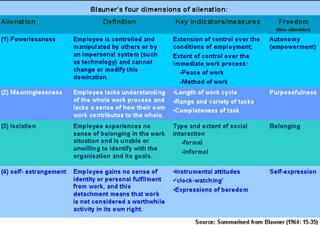
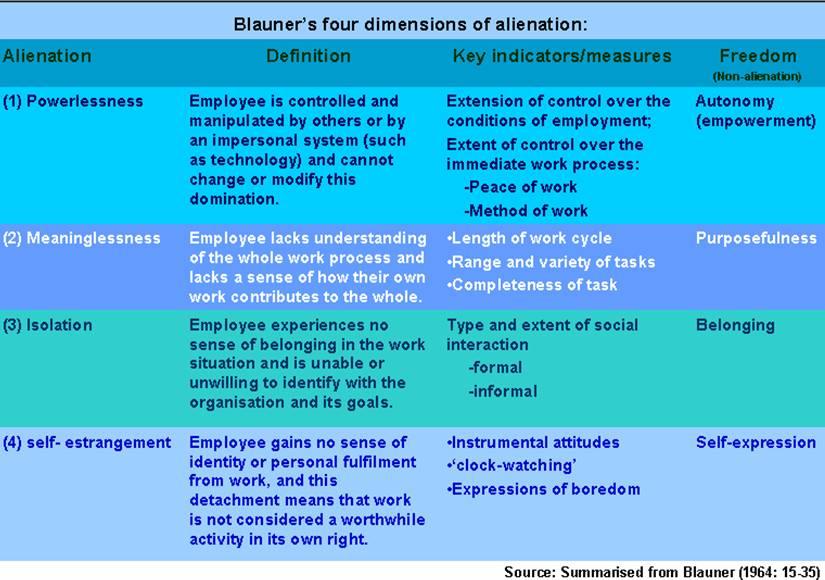
Both of these assumptions suggest that it is insufficient to view alienation as an objective condition (the same for all employees under capitalism) however, alienation should be considered as a subjective experience (differing from situation to situation, and person to person). Blauner (1964) has undertaken in this manner to explore the concept. Blauner (1964) begins from the proposition that ‘alienation is a general syndrome made up of a number of different objective conditions and subjective feelings-states which emerge from certain relationships between workers and sociotechnical settings of employment’. He also stresses that alienation should be divided into four dimensions, each of which can be investigated for different workers to enable a profile of alienation to be drawn up which are summarised as following table. (Click on diagram to enlarge.)
Assumption 1: alienation is not unavoidable under capitalism.
Assumption 2: work has different meaning for different people.
Both of these assumptions suggest that it is insufficient to view alienation as an objective condition (the same for all employees under capitalism) however, alienation should be considered as a subjective experience (differing from situation to situation, and person to person). Blauner (1964) has undertaken in this manner to explore the concept. Blauner (1964) begins from the proposition that ‘alienation is a general syndrome made up of a number of different objective conditions and subjective feelings-states which emerge from certain relationships between workers and sociotechnical settings of employment’. He also stresses that alienation should be divided into four dimensions, each of which can be investigated for different workers to enable a profile of alienation to be drawn up which are summarised as following table. (Click on diagram to enlarge.)
There is … no simple answer to the question: Is the factory worker of today an alienated worker? Inherent in the techniques of modern manufacturing and the principles of bureaucratic industrial organisation are general alienation tendencies. But in some cases the distinctive technology, division of labour, economic structure, and social organisation-in other words, the factor that differentiate individual industries-intensify these general tendencies, producing a high degree of alienation; in other cases they minimize and counteract them, resulting instead in control, meaning, and integration. (Blauner, 1964: 166-7)
Eventually, this leads Blauner to a position of technological determinism: he suggests that greater automation will free workers from drudgery of assembly-lines and machine-minding and will result in decreasing alienation for employees (Blauner, 1964: 182-2). This is an optimistic projection that suggests the problem of alienation will be resolved within the capitalist framework- a position which was passionately challenged by Braveman (1974) and subsequent labour process theorists.
Eventually, this leads Blauner to a position of technological determinism: he suggests that greater automation will free workers from drudgery of assembly-lines and machine-minding and will result in decreasing alienation for employees (Blauner, 1964: 182-2). This is an optimistic projection that suggests the problem of alienation will be resolved within the capitalist framework- a position which was passionately challenged by Braveman (1974) and subsequent labour process theorists.
Thursday, September 15, 2005
Alienation:
The word ‘alienation’ mostly used in the media (especially in serious late night TV talk shows and Sunday newspapers) and arises in everyday conversation. Yet it remains one of the consented terms in the academic study of work. Alienation is an objective state and builds on concepts originally defined by Karl Marx, while Robert Blauner introduces elements of subjectivity into the analysis. It illustrates the importance of viewing work as a rich and varied domain of human activity. It is concerned with the ways in which employees get through their working day: how they survive the boredom, tedium, monotony, drudgery and powerlessness that characterise many jobs. There is one central principle around which the discussion is organised: the notion that in order to ‘survive’ work, people are obliged to become resourceful and creative in developing strategies that allow them to assert some control over, and construct meaning for, the work activities they are directed by managers to undertake.
In dynamic world where the subjective experiences of individuals are collectively constructed and reconstructed to create shared understandings and develop norms that guide and pattern behaviour. In real scenario, it is also a regulated world where the structural constraints imposed by power holders (especially managers) limit the actions of individuals and workgroups. The result is a curious mixture of consent and resistance to work.
Marx argues that alienation is an intrinsic part of the capitalist labour process and therefore is an unavoidable objective state in which all workers find themselves. It apparent itself because in selling their labour power, employees are surrendering the right to control their labour, how and when work should be undertaken becomes the prerogative of employers.
According to Karl Marx (1930:713) under capitalism all the means for developing production are transformed into means of domination over and exploitation of the producer; that they mutilate the worker into a fragment of human being, degrade him to become a mere appurtenance, make his work such a torment that its essential meaning is destroyed. (quoted in Fox, 1974: 224)
According to Marx, employees experience four types of estrangement as a result of this relationship:
1) self-estarangement: According to capitalism, work is merely the means for people to acquire money to satisfy their needs out-side of working hours however work ought to be a source of satisfaction in its own right. As a result, employees experience a sense of ‘self-estrangement’ because while they are in work undertaking the activities as instructed by their managers, they cannot be themselves (separate from their true selves) which make them to experience a sense of alienation.
2) estrangement from the product of their labour: Marx labels a process as ‘objectification’ that the output (the product or object) of one’s labour is the physical expression of the effort that has been undertaken and the skills that have used. However, the product of a person’s labour is not owned by the employee; it becomes the property of the capitalist. Therefore the product becomes an alien object. Marx states it:
The alienation of the worker in his product means not only that his labour becomes an object, an external existence, but that it exists outside him, independently, as something alien to him, and that it becomes a power on its own confronting him; it means that the life which he has conferred on the object confronts him as something hostile and alien. (Marx, 1969: 97)
3) estrangement from their species being: The alienation caused by self-estrangement and estrangement from the product has wider repercussions for humankind. Marx argues that through work, people express their creativity, produce the means of their own existence and hence realise their humanity. This free, creativity endeavour is the very purpose of life, but under capitalism work becomes coercion: forced labour. This means that people become estranged from their very nature; they are left alienation from their ‘species being’.
4) estrangement from others: People are left estranged from each other due to estrangement from their essential nature. Marx argues that human beings are distinct from animal due to their self-awareness. So that a person can understand the world through his/her own actions and behaviour, and by appreciating the role and estrangement combine to create conditions in which the unique qualities of humankind are diminished. Under forced labour, people are owned and controlled. They experience this directly and also recognise this estrangement in other people. As a result, they are both alienated from their own humanity and from others. (Click on diagram to enlarge.)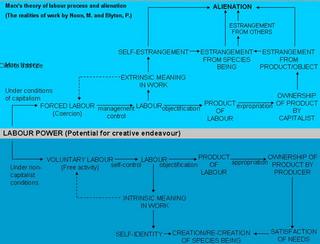
In dynamic world where the subjective experiences of individuals are collectively constructed and reconstructed to create shared understandings and develop norms that guide and pattern behaviour. In real scenario, it is also a regulated world where the structural constraints imposed by power holders (especially managers) limit the actions of individuals and workgroups. The result is a curious mixture of consent and resistance to work.
Marx argues that alienation is an intrinsic part of the capitalist labour process and therefore is an unavoidable objective state in which all workers find themselves. It apparent itself because in selling their labour power, employees are surrendering the right to control their labour, how and when work should be undertaken becomes the prerogative of employers.
According to Karl Marx (1930:713) under capitalism all the means for developing production are transformed into means of domination over and exploitation of the producer; that they mutilate the worker into a fragment of human being, degrade him to become a mere appurtenance, make his work such a torment that its essential meaning is destroyed. (quoted in Fox, 1974: 224)
According to Marx, employees experience four types of estrangement as a result of this relationship:
1) self-estarangement: According to capitalism, work is merely the means for people to acquire money to satisfy their needs out-side of working hours however work ought to be a source of satisfaction in its own right. As a result, employees experience a sense of ‘self-estrangement’ because while they are in work undertaking the activities as instructed by their managers, they cannot be themselves (separate from their true selves) which make them to experience a sense of alienation.
2) estrangement from the product of their labour: Marx labels a process as ‘objectification’ that the output (the product or object) of one’s labour is the physical expression of the effort that has been undertaken and the skills that have used. However, the product of a person’s labour is not owned by the employee; it becomes the property of the capitalist. Therefore the product becomes an alien object. Marx states it:
The alienation of the worker in his product means not only that his labour becomes an object, an external existence, but that it exists outside him, independently, as something alien to him, and that it becomes a power on its own confronting him; it means that the life which he has conferred on the object confronts him as something hostile and alien. (Marx, 1969: 97)
3) estrangement from their species being: The alienation caused by self-estrangement and estrangement from the product has wider repercussions for humankind. Marx argues that through work, people express their creativity, produce the means of their own existence and hence realise their humanity. This free, creativity endeavour is the very purpose of life, but under capitalism work becomes coercion: forced labour. This means that people become estranged from their very nature; they are left alienation from their ‘species being’.
4) estrangement from others: People are left estranged from each other due to estrangement from their essential nature. Marx argues that human beings are distinct from animal due to their self-awareness. So that a person can understand the world through his/her own actions and behaviour, and by appreciating the role and estrangement combine to create conditions in which the unique qualities of humankind are diminished. Under forced labour, people are owned and controlled. They experience this directly and also recognise this estrangement in other people. As a result, they are both alienated from their own humanity and from others. (Click on diagram to enlarge.)
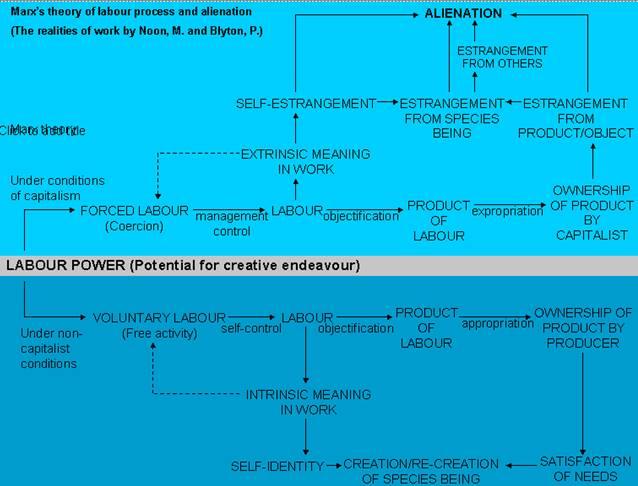
Non-alienation conditions:
The bottom half of the diagram suggests how under non-capitalist conditions the problem of alienation might be avoided. In both diagram, it is clear that there are similarities, the difference is that the person undertaking the work remains in control of both their labour and the product of their labour. The consequence of self-control over one’s labour is that a person is more likely to derive intrinsic meaning from the work being undertaken, rather than only seeing it as a means of getting money. In turn, this might mean that a person’s self-esteem and feelings of worth are enhanced- therefore it contributes to their self-identity. Overall, there is no alienation because the four features of separation do not occur.
References:
Marx, K. (1930) Capital, London: Dent.
Marx, K. (1969) ‘Alienated labour’, in T. Burns (ed) Industrial Man: Selected readings, Harmondsworth: Penguin, pp. 95-109.
Marx, K. (1976) Capital, Vol. 1, Harmondsworth: Penguin.
Noon, M. and, Blyton, P. (2002) The realities of work: Palgrave, pp. 228-232.
The bottom half of the diagram suggests how under non-capitalist conditions the problem of alienation might be avoided. In both diagram, it is clear that there are similarities, the difference is that the person undertaking the work remains in control of both their labour and the product of their labour. The consequence of self-control over one’s labour is that a person is more likely to derive intrinsic meaning from the work being undertaken, rather than only seeing it as a means of getting money. In turn, this might mean that a person’s self-esteem and feelings of worth are enhanced- therefore it contributes to their self-identity. Overall, there is no alienation because the four features of separation do not occur.
References:
Marx, K. (1930) Capital, London: Dent.
Marx, K. (1969) ‘Alienated labour’, in T. Burns (ed) Industrial Man: Selected readings, Harmondsworth: Penguin, pp. 95-109.
Marx, K. (1976) Capital, Vol. 1, Harmondsworth: Penguin.
Noon, M. and, Blyton, P. (2002) The realities of work: Palgrave, pp. 228-232.
Sunday, September 11, 2005
Love, Attraction and Loneliness:
Am I really lonely? If I ask same question to others I will get simple answer: No, you are absolutely not lonely. This is a part of life and we need change sometime. What sort of change do I need? Now, at last I can assume that I need somebody or partner. Am I attracted with somebody? Have I met my dream girl? I am not quite sure where my dream girl is?
What produces attraction may change with time and circumstance? If I am feeling bad about myself, I may be attracted to a person who is complimentary and supportive. If I am feeling bored with daily events, I may be attracted to someone who promises change and excitement. Attraction has no single cause.
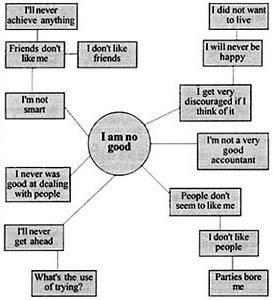
Loneliness is to make a self-defeating attribution. The individual is saying, “I am too uninterested and unattractive for anyone to care about.” The depression and inactivity then reduce the likelihood of the individual seeking new relationships. We are only human beings who have different skills, experiences and knowledge however all of us are not psychologists and do not know different psychological aspects happen in our daily life. Most of the people love their near and dear ones. They would not knowingly do anything to damage the self-esteem of their loved ones. Sometimes they do not say exactly what they mean. For example, sometime our loved one may say, "I did not like you very much when you told me this". We may take it to mean that he/she does not like us at all. It would be better if he/she had said, "I get scared and nervous when you shout". This is the way, an individual can make clear that it is the behaviour that is beings criticized, not the worth of the person. The same applies also in interpersonal relationships at workplace, play-ground and so on. (Click on diagram to enlarge.)
 The odds are that most of the people are not aware that their words are so harsh. Most peers and friends honestly want to support and encourage their peers and subordinates and help them feel loved. They try but they may not do everything perfectly. Self-esteem is a pride and acceptance of our self. It is our sense of personal worth. When we feel worthwhile we are able to make good decision, experience acceptance from others and give and receive love. Loneliness increases to the people who are in Love however love often causes pain.
· Depend on each other
· Want very much to help each other
· Want an exclusive relationship.
There are various reasons which individuals are attracted to each other:
Familiarity and proximity: - They must have some form of regular contact or association. This includes such situations as attending the same class, working in the same office, and living in the same apartment building.
Personal needs: -We are attracted to individuals who satisfy our needs and desires. These include the need for love, emotional support, and the desire for financial status and attractive physical appearance.
Similarity: -Similar in terms of socio-economic level, race, religions, beliefs, and education level. e.g. in a study with students.
Reinforcement: -Individual tend to attracted to individuals who reinforce and support their own opinions, values and ideas or who share similar interests, such as hobbies and activities.
Parental models: - It is sometimes suggested we are attracted to individuals who possess the trail of our theory, females are oedipal attracted to males who possess the trails of their fathers, male are attracted to female who have the trails of their mothers.
I have tried to explain the psychological aspects how the attraction develops from love to hate which has been tried to explain as followin g figure. (Click on diagram to enlarge.)
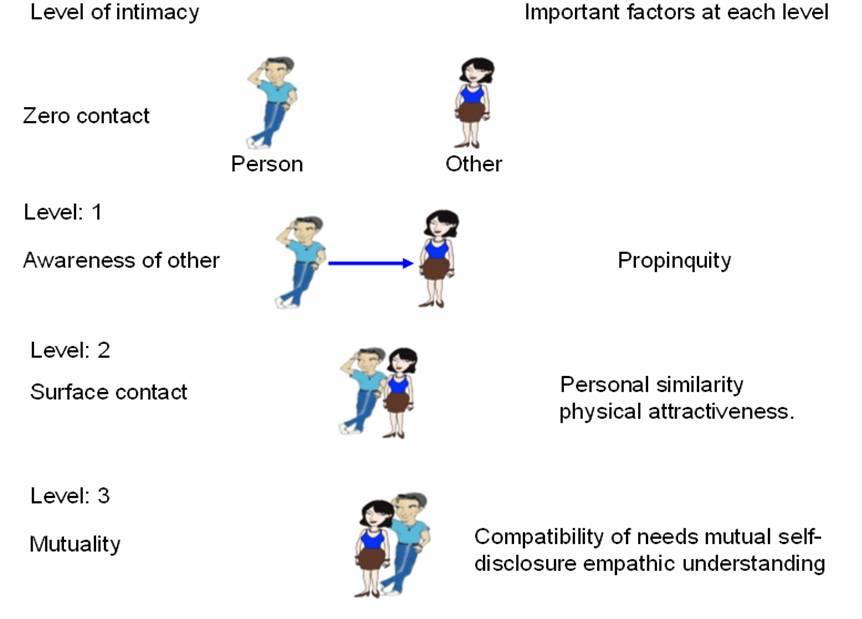
Deep relationships between people in western culture usually progress through a regular series of stages. Starting with zero contact, mutual awareness develops as a result of proximity, repeated exposure, or a positive response to physical appearance. At the level, that of surface contact, mutual interests and attitudes may be explored. If relations continue to be rewarding couple may move to the level of maturity.Matuality increases to the extent that the participants reveal themselves to one another, accept each other, and complement each other’s needs. Marriage and friendship is depending on person’s sacrifice and loyalty. (Click on diagram to enlarge.)
What produces attraction may change with time and circumstance? If I am feeling bad about myself, I may be attracted to a person who is complimentary and supportive. If I am feeling bored with daily events, I may be attracted to someone who promises change and excitement. Attraction has no single cause.
Loneliness is to make a self-defeating attribution. The individual is saying, “I am too uninterested and unattractive for anyone to care about.” The depression and inactivity then reduce the likelihood of the individual seeking new relationships. We are only human beings who have different skills, experiences and knowledge however all of us are not psychologists and do not know different psychological aspects happen in our daily life. Most of the people love their near and dear ones. They would not knowingly do anything to damage the self-esteem of their loved ones. Sometimes they do not say exactly what they mean. For example, sometime our loved one may say, "I did not like you very much when you told me this". We may take it to mean that he/she does not like us at all. It would be better if he/she had said, "I get scared and nervous when you shout". This is the way, an individual can make clear that it is the behaviour that is beings criticized, not the worth of the person. The same applies also in interpersonal relationships at workplace, play-ground and so on. (Click on diagram to enlarge.)
 The odds are that most of the people are not aware that their words are so harsh. Most peers and friends honestly want to support and encourage their peers and subordinates and help them feel loved. They try but they may not do everything perfectly. Self-esteem is a pride and acceptance of our self. It is our sense of personal worth. When we feel worthwhile we are able to make good decision, experience acceptance from others and give and receive love. Loneliness increases to the people who are in Love however love often causes pain.
· Depend on each other
· Want very much to help each other
· Want an exclusive relationship.
There are various reasons which individuals are attracted to each other:
Familiarity and proximity: - They must have some form of regular contact or association. This includes such situations as attending the same class, working in the same office, and living in the same apartment building.
Personal needs: -We are attracted to individuals who satisfy our needs and desires. These include the need for love, emotional support, and the desire for financial status and attractive physical appearance.
Similarity: -Similar in terms of socio-economic level, race, religions, beliefs, and education level. e.g. in a study with students.
Reinforcement: -Individual tend to attracted to individuals who reinforce and support their own opinions, values and ideas or who share similar interests, such as hobbies and activities.
Parental models: - It is sometimes suggested we are attracted to individuals who possess the trail of our theory, females are oedipal attracted to males who possess the trails of their fathers, male are attracted to female who have the trails of their mothers.
I have tried to explain the psychological aspects how the attraction develops from love to hate which has been tried to explain as followin
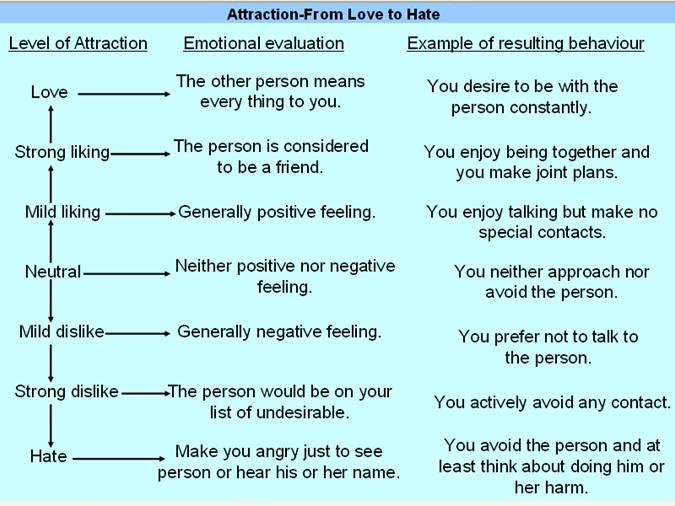 g figure. (Click on diagram to enlarge.)
Deep relationships between people in western culture usually progress through a regular series of stages. Starting with zero contact, mutual awareness develops as a result of proximity, repeated exposure, or a positive response to physical appearance. At the level, that of surface contact, mutual interests and attitudes may be explored. If relations continue to be rewarding couple may move to the level of maturity.Matuality increases to the extent that the participants reveal themselves to one another, accept each other, and complement each other’s needs. Marriage and friendship is depending on person’s sacrifice and loyalty. (Click on diagram to enlarge.)
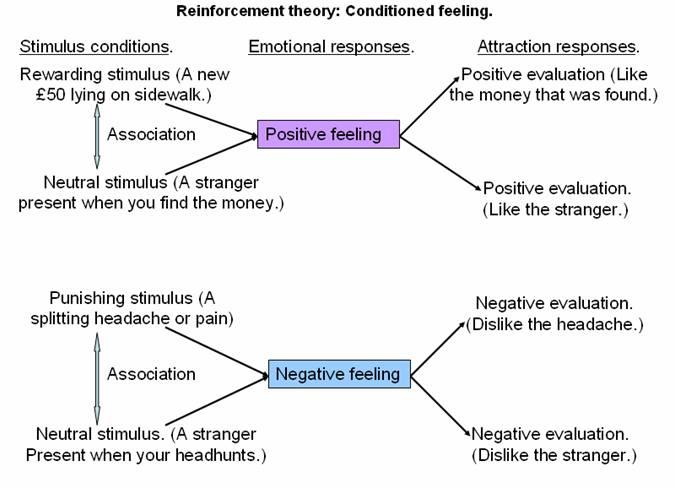
The three most important of target dependent variables: propinquity (The more I see you, the more I like you) or physical closeness, the emotions of feeling that an individual happens to be experiencing, and the level of that person’s need for affiliation. We can take reinforcement theory about the conditioned feeling based on psychological theory as follows: (Click on diagram to enla rge.)
rge.)
 rge.)
rge.)References:
Saturday, September 10, 2005
How The Brain Works:
Few days ago there was a documentary on BBC "How The Brain Works: why Kevin cannot help being an outsider". I found a commentary article by Clive Cookson in Science & Technology column in Financial Times which made me to write something about this topic as well. I love psychology and, to do research on human behaviour is being my passion since my dissertation research. Such topic always attracts me, so I thought it would be useful to make a note for future reference.
The discovery of brief but marked deterioration at puberty in the ability to recognise some emotions was the by product of a large study taken at the institute of Child Health, looking at different in social intelligence between boys and girls. It was designed to investigate the causes of autism and its milder manifestation Asperger's syndrome, represent extreme forms of normal male brains.
The temporary dip in social intelligence "followed by recovery and acceleration to adult levels of achievement", turned out to affect both sexes. The loss of ability to detect emotions in other people was most marked for anger and sadness. Prof. Skuse said the Kevin phenomenon "probably reflects the rewiring of the brain that occurs due to genetic and hormonal changes" during puberty.
Nine out of 10 people with autism and Asperger's are male. According to the popular "extreme male brain" theory, promoted particularly by Simon Baron-Cohen at Cambridge University, the reason boys are so vulnerable is simply that syndrome represents the extreme form of male (as opposed to female). As prof Baron-Cohen said in his recent book "The essential Difference", "the female brain is predominantly hard-wired for empathy. The male brain........... for understanding and building systems."
Inability to decipher facial expressions is characteristic of autistic disorders. Autism also impairs the ability to remember faces and to work out which way people are looking. If extreme male brain theory is correct, boys as a whole should be significantly worse than girls at recognising emotion, prof Skuse believes.
Prof Skuse said that the results of study did not strongly support the extreme male brain hypothesis. He began by supporting the theory however he also stressed that he is very sceptical at this moment. A lot of evidence for it comes from questionnaire-based methods, which may jut be reflecting cultural expectations.
At the age of six, female performance was indeed significantly better: 70 percent of boys were worse than the average for girls at recognising emotion. But the differences diminished with the age and by lat adolescence boys and girls were very similar, although a small female advantage persisted for some emotions (recognition of disgust, for example). The overlap between the sexes is more than 90 percent by t he age of 17.
Prof Skuse stress his view that whatever the ultimate "cause" of autism, the male preponderance "must implicate the sex chromosome, directly or indirectly," Females may be protected in some way from the complex risk factors by the fact that they have two X-chromosomes while male have only one.
Prof Skuse is beginning to think that the hunt for causes of autism in the way people handle social information may be misguided: "There may be something else going on" he says.
So autism remains mysterious, but the scientific drive to explain it is throwing up fascinating observations-such as insights into the teenage mind.
The discovery of brief but marked deterioration at puberty in the ability to recognise some emotions was the by product of a large study taken at the institute of Child Health, looking at different in social intelligence between boys and girls. It was designed to investigate the causes of autism and its milder manifestation Asperger's syndrome, represent extreme forms of normal male brains.
The temporary dip in social intelligence "followed by recovery and acceleration to adult levels of achievement", turned out to affect both sexes. The loss of ability to detect emotions in other people was most marked for anger and sadness. Prof. Skuse said the Kevin phenomenon "probably reflects the rewiring of the brain that occurs due to genetic and hormonal changes" during puberty.
Nine out of 10 people with autism and Asperger's are male. According to the popular "extreme male brain" theory, promoted particularly by Simon Baron-Cohen at Cambridge University, the reason boys are so vulnerable is simply that syndrome represents the extreme form of male (as opposed to female). As prof Baron-Cohen said in his recent book "The essential Difference", "the female brain is predominantly hard-wired for empathy. The male brain........... for understanding and building systems."
Inability to decipher facial expressions is characteristic of autistic disorders. Autism also impairs the ability to remember faces and to work out which way people are looking. If extreme male brain theory is correct, boys as a whole should be significantly worse than girls at recognising emotion, prof Skuse believes.
Prof Skuse said that the results of study did not strongly support the extreme male brain hypothesis. He began by supporting the theory however he also stressed that he is very sceptical at this moment. A lot of evidence for it comes from questionnaire-based methods, which may jut be reflecting cultural expectations.
At the age of six, female performance was indeed significantly better: 70 percent of boys were worse than the average for girls at recognising emotion. But the differences diminished with the age and by lat adolescence boys and girls were very similar, although a small female advantage persisted for some emotions (recognition of disgust, for example). The overlap between the sexes is more than 90 percent by t he age of 17.
Prof Skuse stress his view that whatever the ultimate "cause" of autism, the male preponderance "must implicate the sex chromosome, directly or indirectly," Females may be protected in some way from the complex risk factors by the fact that they have two X-chromosomes while male have only one.
Prof Skuse is beginning to think that the hunt for causes of autism in the way people handle social information may be misguided: "There may be something else going on" he says.
So autism remains mysterious, but the scientific drive to explain it is throwing up fascinating observations-such as insights into the teenage mind.
Friday, September 09, 2005
Case study:
Case study is used to research few objects for numerous considerations. A case study is an empirical study that investigates a contemporary phenomenon within its real-life context when the boundaries between the phenomenon and context are not clearly evident and are used multiple sources of evidence. An important advantage with case study research is the opportunity for a holistic view of a process (Gummesson, 1991). That is to enable the researcher to study many different aspects, examine them in relation to each other, view the process within its total environment and also utilise the researcher’s theoretical knowledge and understanding. The case studies are the preferred strategy when
(1) “how” or “why” questions are being posed,
(2) when the investigator has little control over events and
(3) when the focus is on a contemporary phenomenon within some real life context (Yin, 1994).
Sources to a case study are not limited to qualitative research, quantitative methods could be used as well (Yin, 1994). The nature of a case study could also be of either quantitative or qualitative nature. A quantitative case study tests a theory while a qualitative case study creates theories (Merriam, 1994). Main sources of information in the case studies should be documentation (research papers, books, manuals, internal reports etc), interviews (with technical and management personnel) and direct observations (industrial studies).
(1) “how” or “why” questions are being posed,
(2) when the investigator has little control over events and
(3) when the focus is on a contemporary phenomenon within some real life context (Yin, 1994).
Sources to a case study are not limited to qualitative research, quantitative methods could be used as well (Yin, 1994). The nature of a case study could also be of either quantitative or qualitative nature. A quantitative case study tests a theory while a qualitative case study creates theories (Merriam, 1994). Main sources of information in the case studies should be documentation (research papers, books, manuals, internal reports etc), interviews (with technical and management personnel) and direct observations (industrial studies).
Thursday, September 08, 2005
Jagjit's song
Today,while I was on my way to University,I had downloaded few Jagjit's song in my mp3 player that I was listening. I found this song absolutely fantastic. I am not very good in Hindi translation but it is my small try,hope it would be all right. Any volunteer to help,would be warm welcome.
Lyricist: Atal Behari Vajpayee Artist and Music director: Jagjit Singh
Kay khooya kaya paya jagmee, Milte aaur bhechadte nagmee,
Majhee kise se nahi sikayaat, Yaadapi chala gayaa pag pag me,
Yak dhristee biti par daali, Yadoo ki woo taali tatoolee,
Apnee he manse kuchha bole, Apnee he manse kuchha bole,
Majhee kise se nahi sikayaat, Yaadapi chala gayaa pag pag me,
Yak dhristee biti par daali, Yadoo ki woo taali tatoolee,
Apnee he manse kuchha bole, Apnee he manse kuchha bole,
Prithibi lakhoo anssa purani, Jivan yak annanta kahani,
Par tanki apni semayee, yaadapi sauoo sabda ki baani,
Yetana kafee hai antima dastak paar darbaja kholee,
Apnee he manse kuchha bole, Apnee he manse kuchha bole,
Par tanki apni semayee, yaadapi sauoo sabda ki baani,
Yetana kafee hai antima dastak paar darbaja kholee,
Apnee he manse kuchha bole, Apnee he manse kuchha bole,
Janam maran ka avirat phera, Jivan banjaroo ka deera,
Aaj yaha kaal kaha puch hai, kauna janata kidheer sabera,
Addheeyara aakash asimita, prana ki pankkha ko tolee,
Apnee he manse kuchha bole, Apnee he manse kuchha bole.
Aaj yaha kaal kaha puch hai, kauna janata kidheer sabera,
Addheeyara aakash asimita, prana ki pankkha ko tolee,
Apnee he manse kuchha bole, Apnee he manse kuchha bole.
Wednesday, September 07, 2005
The Economics of Manufacturing:
The economics miracle of our age has been the strength with which previously vanquished economics of Japan and West Germany have risen from the ashes of war to become two of the wealthiest societies in the world. They have achieved this result through the execution of sound manufacturing strategies clearly invented to produce high quality technology products requiring substantial research and development (R&D) expenditure and massive investment in new capital plant and machinery. China’s vast manufacturing base is raising its GDP by around 9 percent a year as a result of poorly endowed with natural resources and massive manpower. China will have the second largest economy in the world by 2050, after US. As a result of the growing tended to increase the proportion of manufacturing products both exported and imported by industrial nation like the US, EEC nations and Asian countries (Japan, Singapore, Taiwan, India and so on), China is being more successful and better equipped for this competitive rivalry than others.
A nation’s ability to capture and retain a consistent or increasing share of the world market for manufactured products has considerable economic implication. In the first place it means it means that the largest economic sizes of plant incorporating the best technologies can be employed in the confidence that their capacities will be filled, yielding ‘technical benefits of scale’ and providing the user with cost advantages. Secondly, such investments permit productivity gains to be realized by replacing or supplementing human effort with machine power and artificial intelligence.
Productivity improvements can be made in the face of dwindling profits providing there exists the human will to realize such improvements. To achieve this end it is necessary for pride (in the product being manufactured) and total commitment of the workforce (to make products better than those of competitors) to predominate over entrenched restrictive working practices and antipathy or even suspicion of technological and organisational change. Therefore, a Luddite mentality must not prevail if a nation’s workforce is to prosper in the long run but instead it must be fired by the passion to excel in the manufacture of products which it must carefully select and fund accordingly.
Manufacturing organisations have to accommodate the inevitable obsolescence of products and processes, by anticipating and meeting market change. They can achieve this in three ways:
Through incremental improvements to their products, plants, processes and working methods;
By exploiting their expertise in different marketing areas; and
Through radical innovations incorporating new technologies, processes and products.
Technological innovation requires a commitment both at the national and corporate level for innovation requires a commitment both at the national and corporate level for invention and development of innovations which then become the nation’s ‘seed corn’ for its future prosperity. A definitive policy towards technological innovation is required for another major reason. The major industrial nations compete for markets against each other but also to an ever increasing extent with manufacturers from developing nations. The industrialized nations have moral obligation to ensure that the living standards of the poorer nations are raised substantially anyway but, as manufacturing processes and techniques become standardized, these nations will implement these schemes and with modern plants and cheap labour they will posses a comparative cost advantage permitting them to take market share where conventional products are concerned. To contain this change at a rate which is politically acceptable to those involved, the developed nations have to invent and exploit new products and processes which involve high levels of human skill, knowledge and inventiveness: in other words they have to innovate to survive.
Mao Tse Tung (1950) explained his view in his book "The Little Red Book" that to this day many of comrades still do not understand that they must attend to the quantitative aspects of things-the basic statistics. They have no figure in their heads, and, as a result, cannot help making mistakes. From this argument, we can figure out that eventually most of the companies need to invest in new, more productive assets if that wish to survive and prosper.
A nation’s ability to capture and retain a consistent or increasing share of the world market for manufactured products has considerable economic implication. In the first place it means it means that the largest economic sizes of plant incorporating the best technologies can be employed in the confidence that their capacities will be filled, yielding ‘technical benefits of scale’ and providing the user with cost advantages. Secondly, such investments permit productivity gains to be realized by replacing or supplementing human effort with machine power and artificial intelligence.
Productivity improvements can be made in the face of dwindling profits providing there exists the human will to realize such improvements. To achieve this end it is necessary for pride (in the product being manufactured) and total commitment of the workforce (to make products better than those of competitors) to predominate over entrenched restrictive working practices and antipathy or even suspicion of technological and organisational change. Therefore, a Luddite mentality must not prevail if a nation’s workforce is to prosper in the long run but instead it must be fired by the passion to excel in the manufacture of products which it must carefully select and fund accordingly.
Manufacturing organisations have to accommodate the inevitable obsolescence of products and processes, by anticipating and meeting market change. They can achieve this in three ways:
Through incremental improvements to their products, plants, processes and working methods;
By exploiting their expertise in different marketing areas; and
Through radical innovations incorporating new technologies, processes and products.
Technological innovation requires a commitment both at the national and corporate level for innovation requires a commitment both at the national and corporate level for invention and development of innovations which then become the nation’s ‘seed corn’ for its future prosperity. A definitive policy towards technological innovation is required for another major reason. The major industrial nations compete for markets against each other but also to an ever increasing extent with manufacturers from developing nations. The industrialized nations have moral obligation to ensure that the living standards of the poorer nations are raised substantially anyway but, as manufacturing processes and techniques become standardized, these nations will implement these schemes and with modern plants and cheap labour they will posses a comparative cost advantage permitting them to take market share where conventional products are concerned. To contain this change at a rate which is politically acceptable to those involved, the developed nations have to invent and exploit new products and processes which involve high levels of human skill, knowledge and inventiveness: in other words they have to innovate to survive.
Mao Tse Tung (1950) explained his view in his book "The Little Red Book" that to this day many of comrades still do not understand that they must attend to the quantitative aspects of things-the basic statistics. They have no figure in their heads, and, as a result, cannot help making mistakes. From this argument, we can figure out that eventually most of the companies need to invest in new, more productive assets if that wish to survive and prosper.
Monday, September 05, 2005
Discrimination:
Every organisation’s management is seeking to discriminate between people on the basis of whether or not they have the appropriate attributes to carry out the job. The main issue is not whether discrimination is occurring however discrimination as based on fair criteria. The word ‘discrimination’ has lost its literal meaning and is more normally used to imply criticism. There have been identified six criteria that represent the main bases of discrimination and lead to accusations of unfairness:
Sex/gender;
Race/ethnicity;
Disability;
Sexual orientation;
Religion;
Age;
These are not limited categories so that people find themselves experiencing unfair discrimination from several different directions. It depends upon individuals who experience one or several sources of disadvantage based on work experience or expertise. The experience of discrimination also has some common manifestations which transcend these individual categories.
Sex/gender;
Race/ethnicity;
Disability;
Sexual orientation;
Religion;
Age;
These are not limited categories so that people find themselves experiencing unfair discrimination from several different directions. It depends upon individuals who experience one or several sources of disadvantage based on work experience or expertise. The experience of discrimination also has some common manifestations which transcend these individual categories.
Wednesday, August 31, 2005
Decision:
It is true that many decisions we make subconsciously arise out of our physical and biological needs and derive from the pressure to survive physically. We also make decisions in developing skills like swimming, riding. What we learn to do continiously with frequent repetiton becomes habit and we do it without thinking about it. An automatic decision is a decision that made intuitively and subconsciously. It is automatic when it is repeated as habit either mentally or physically as a result of learning. It is known through it is difficult to draw a sharp distinction between the two. When we fall short in our physical habit.
Continue...............
Continue...............
Thursday, August 25, 2005
Development of DC framework:
Hutchins (1991, 1995) is the main architect of the DC framework when he was studying complex ship navigation of U.S. Navy vessels. Hutchins (1995) was interested to know about how people go about knowing what they know and of the contribution of the environments in which knowing is skilled. These questions became the main source of foundation of the DC framework. He published a paper, "How a cockpit remembers its speed" (1995), in which he explained about the classical cognitive science approach. Classical cognitive could be applied to a unit of analysis that is larger than a person. In contrast, a classical cognitive science approach efforts to assume what was inside an individual's mind since these information processing phenomena can not be directly observed.
Distributed cognition is not some "new" kind of cognition, rather a recognition of the perspective that all of cognition can be fruitfully viewed as occurring in a distributed manner. Rogers and Ellis (1994) encouraged Hutchin's DC framework and also argued that it attempt to overcome the limitations of existing single-discipline frameworks for studying combined working purpose. The main point in the paper is that any sufficient of work activities requires crossing conventional disciplinary boundaries such that there can be analysis and synthesis of information from traditionally separate sources. Rogers and Ellis presented Hutchin's DC framework as one that crosses the conventional disciplinary boundaries (e.g, cognitive, social, organisational).
Nardi (1996) discussed critically about DC and argued that the DC framework uses an unreasonable conception that artifacts are cognizing entities. Nardi also discussed that an artifact cannot know except materials and resources in the system that can be used in a deliberate and conscious way by humans. An artifact serves as a medium of knowledge for a human. As a result, DC places people and machines/artifacts on equal cognitive footing in his critics. Wright et al. (2000) argued against Nardi’s criticism by clarifying the 'misunderstanding'. He stated that DC views technological artifacts as objects of cognition. Wright et al. (2000) argue that artifacts can be used in a deliberate and conscious way by humans and thus humans have a different epistemic status to technological artifacts, although both are modeled as representational systems in DC.
Wright et al., (2000) developed a 'distributed information resources model to HCI model based on DC concepts. This model has two components: information structures and information strategies. Information structures allow for the description of the information form and content and how information is distributed between people and artifacts. Information strategies describe different ways in which resources can be used to make decisions about action. The strategy a user adopts is shaped in part by the resources available. This model would help to relate HCI and Computer Supported Cooperative Work (CSCW) issues more closely. The resources model by Wright et al. (2000) is one of the very few direct attempts to use the ideas of DC to account for HCI.
Presently, Hollan et al. (2000) are presenting DC as a "new foundation for human computer interaction research". They are working on an integrated framework for research that includes their DC framework while combining ethnographic observation with controlled experimentation.
Distributed cognition is not some "new" kind of cognition, rather a recognition of the perspective that all of cognition can be fruitfully viewed as occurring in a distributed manner. Rogers and Ellis (1994) encouraged Hutchin's DC framework and also argued that it attempt to overcome the limitations of existing single-discipline frameworks for studying combined working purpose. The main point in the paper is that any sufficient of work activities requires crossing conventional disciplinary boundaries such that there can be analysis and synthesis of information from traditionally separate sources. Rogers and Ellis presented Hutchin's DC framework as one that crosses the conventional disciplinary boundaries (e.g, cognitive, social, organisational).
Nardi (1996) discussed critically about DC and argued that the DC framework uses an unreasonable conception that artifacts are cognizing entities. Nardi also discussed that an artifact cannot know except materials and resources in the system that can be used in a deliberate and conscious way by humans. An artifact serves as a medium of knowledge for a human. As a result, DC places people and machines/artifacts on equal cognitive footing in his critics. Wright et al. (2000) argued against Nardi’s criticism by clarifying the 'misunderstanding'. He stated that DC views technological artifacts as objects of cognition. Wright et al. (2000) argue that artifacts can be used in a deliberate and conscious way by humans and thus humans have a different epistemic status to technological artifacts, although both are modeled as representational systems in DC.
Wright et al., (2000) developed a 'distributed information resources model to HCI model based on DC concepts. This model has two components: information structures and information strategies. Information structures allow for the description of the information form and content and how information is distributed between people and artifacts. Information strategies describe different ways in which resources can be used to make decisions about action. The strategy a user adopts is shaped in part by the resources available. This model would help to relate HCI and Computer Supported Cooperative Work (CSCW) issues more closely. The resources model by Wright et al. (2000) is one of the very few direct attempts to use the ideas of DC to account for HCI.
Presently, Hollan et al. (2000) are presenting DC as a "new foundation for human computer interaction research". They are working on an integrated framework for research that includes their DC framework while combining ethnographic observation with controlled experimentation.
Wednesday, August 24, 2005
Changing the role of manufacturing systems engineer
There have been done many studies in human performance and their behaviours in the past. In the early time on 1920s, Henry Ford was influenced by the work of Fredrick Taylor to improve the efficiency of the line workers. Fredrick Taylor had stated his view that "Hardly a worker can be found who does not devote his time to studying just how slowly he can work". This statement made Henry Ford to devote his time to speed up the workers’ performance. He developed new idea at Ford’s Detroit factory where he divided car production into simple repetitive tasks so that there was not to be need for skilled labour and men could learn to do any job quickly, as each job was broken into smaller operations. It was being done by many different men at many different machines.
Since 1927 to 1932, Roethlisberger and Dickson researched on work situations that affect the morale and productive efficiency of shop-workers. They unexpectedly observed that people’s performance reflects the way they are measured. This study is known as the Hawthorne Effect nowadays.
In the mid of 1930, Kurt Lewin developed a dynamic theory of personality. This was based on empirical observation to predict psychological behaviour in which researcher has to consider the whole situation: the momentary structure and the state of the person and the psychological environment. This observation leads to a new way of thinking. Lewin established that the behaviour of the people could be described in terms of the person and environment. This definition can be expressed as follows:
B = f (P, E)
where, B stands for behaviour, E stands for Environment and P stands for the Psychological profile of a person.
In 1930s, Tolman and Lewin formulated the general "expectancy-theory" model of human motivations that provides one way to analysing and predicting which courses of action an individual will follow when he has the opportunity to make personal choices about his/her behaviour. The motivational "force" to engage in behaviour is a multiplicative function of (a) the expectancies the person holds about what outcomes are likely to result from that behaviour and (b) the valence of these outcomes. Recently it has been usefully applied to behaviour in organisational setting (Vroom, 1964; Porter & Lawler, 1968) which can be expressed in symbols as follows:
MF = E x V
where, MF stands for motivational force, E stands for expectancy and V stands for valence.
There has been done other research about people at work which includes of behavioural research and applied psychology. Bonnes and Secchiaroli analysed the literate in environment psychology in which they found that physical factors such a light, noise and temperature can affect performance of an individual. Some of the recent studies also include factors such as air quality and colours.
Lewinian research helps to conceptualise the relationship between people, their environment and their behaviour. The main focus of previous work has been on understanding the interactions between physical, social and economic environment and behaviour.
Newell and Simon argued that an environment cannot be defined independently from the tasks an agent sets out to do. However in their models, tasks typically do not require sensitivity to background social and cultural constraints. Real work environments are a complex in social, cultural, cognitive, and physical constraints. Newell and Simon chose to study do not involve dense common interactions typical of the way we deal with complex machinery such as airplanes, automobiles (car), etc.
Coordination is that we engage in a real world activity or task, our effective environment is a shifting coalition of resources and constraints, some physical, some social, some cultural, some computational (involving both internal and external computational resources). When this shifting coalition of resources and constraints is appropriately coordinated, the tasks we set out to achieve are accomplished. Lack of coordination leads to lack of success.
Today, the dominant assumption in psychology is that the point of activity is to change the environment in a manner that leads, or ought to lead, to goal satisfaction. This view restated in the language of problem solving is that actions should advance an agent to states in the task environment that lie closer to the goal state. In particular, people undertake actions to save attention, memory and computation; they recruit external elements to reduce their own cognitive effort by distributing computational load. This makes sense only if they are closely coupled to the world. If this observation is accepted it has important outcome for design. Not only we must design environments to make it easier to take the next step toward goal accomplishment; we need to design them to make it easier for us to perform our other actions that are easier to perform epistemic, complementary, coordinative actions.
The need for human factors research in a future manufacturing design environment is great especially considering the changing role of the engineer for manufacturing system. In the current manufacturing system design, a single engineer is a ‘manual controller’s such that he/she controls the manufacturing design and makes the decisions.
In the organisational environment, for example, manufacturing system design is virtually eliminated. An engineer/ system design is responsible for the system control function and the system design itself will be able to ‘self-separate’ from other system in the surrounding area. Distributed cognition is needed to assist the engineer’s changing role from a manual controller to a supervisory controller. This change in the engineer’s role will occur with small repeat over many years. Research for this dissertation examined the current organisational environment and may provide a baseline for future research involving the transition of the current organisational environment to human factors.
Since 1927 to 1932, Roethlisberger and Dickson researched on work situations that affect the morale and productive efficiency of shop-workers. They unexpectedly observed that people’s performance reflects the way they are measured. This study is known as the Hawthorne Effect nowadays.
In the mid of 1930, Kurt Lewin developed a dynamic theory of personality. This was based on empirical observation to predict psychological behaviour in which researcher has to consider the whole situation: the momentary structure and the state of the person and the psychological environment. This observation leads to a new way of thinking. Lewin established that the behaviour of the people could be described in terms of the person and environment. This definition can be expressed as follows:
B = f (P, E)
where, B stands for behaviour, E stands for Environment and P stands for the Psychological profile of a person.
In 1930s, Tolman and Lewin formulated the general "expectancy-theory" model of human motivations that provides one way to analysing and predicting which courses of action an individual will follow when he has the opportunity to make personal choices about his/her behaviour. The motivational "force" to engage in behaviour is a multiplicative function of (a) the expectancies the person holds about what outcomes are likely to result from that behaviour and (b) the valence of these outcomes. Recently it has been usefully applied to behaviour in organisational setting (Vroom, 1964; Porter & Lawler, 1968) which can be expressed in symbols as follows:
MF = E x V
where, MF stands for motivational force, E stands for expectancy and V stands for valence.
There has been done other research about people at work which includes of behavioural research and applied psychology. Bonnes and Secchiaroli analysed the literate in environment psychology in which they found that physical factors such a light, noise and temperature can affect performance of an individual. Some of the recent studies also include factors such as air quality and colours.
Lewinian research helps to conceptualise the relationship between people, their environment and their behaviour. The main focus of previous work has been on understanding the interactions between physical, social and economic environment and behaviour.
Newell and Simon argued that an environment cannot be defined independently from the tasks an agent sets out to do. However in their models, tasks typically do not require sensitivity to background social and cultural constraints. Real work environments are a complex in social, cultural, cognitive, and physical constraints. Newell and Simon chose to study do not involve dense common interactions typical of the way we deal with complex machinery such as airplanes, automobiles (car), etc.
Coordination is that we engage in a real world activity or task, our effective environment is a shifting coalition of resources and constraints, some physical, some social, some cultural, some computational (involving both internal and external computational resources). When this shifting coalition of resources and constraints is appropriately coordinated, the tasks we set out to achieve are accomplished. Lack of coordination leads to lack of success.
Today, the dominant assumption in psychology is that the point of activity is to change the environment in a manner that leads, or ought to lead, to goal satisfaction. This view restated in the language of problem solving is that actions should advance an agent to states in the task environment that lie closer to the goal state. In particular, people undertake actions to save attention, memory and computation; they recruit external elements to reduce their own cognitive effort by distributing computational load. This makes sense only if they are closely coupled to the world. If this observation is accepted it has important outcome for design. Not only we must design environments to make it easier to take the next step toward goal accomplishment; we need to design them to make it easier for us to perform our other actions that are easier to perform epistemic, complementary, coordinative actions.
The need for human factors research in a future manufacturing design environment is great especially considering the changing role of the engineer for manufacturing system. In the current manufacturing system design, a single engineer is a ‘manual controller’s such that he/she controls the manufacturing design and makes the decisions.
In the organisational environment, for example, manufacturing system design is virtually eliminated. An engineer/ system design is responsible for the system control function and the system design itself will be able to ‘self-separate’ from other system in the surrounding area. Distributed cognition is needed to assist the engineer’s changing role from a manual controller to a supervisory controller. This change in the engineer’s role will occur with small repeat over many years. Research for this dissertation examined the current organisational environment and may provide a baseline for future research involving the transition of the current organisational environment to human factors.
Tuesday, August 23, 2005
Distributed cognition:
Distributed Cognition is the concept that cognition is socially distributed among a group of people, the resources and materials (technological artifacts) in the work environment (a small sociotechnical system). Basically, a cognitive process is not necessarily limited to the brain as traditional cognitive science assumes. Hutchins (1995) argues that cognitive science raised these boundaries primarily for analytic convenience but these boundaries are not realistic as human cognition exists in its natural habitat. Therefore, DC assumes that a cognitive process involves the interactions among many brains and technological artifacts (Hollan et al., 2000). Artifacts are the materials and resources in the system that can be used in a purposeful and conscious way by humans.
The argument [for DC theory] is as follows. Cognitive processes involve trajectories of information (transmission and transformation), so the patterns of these information trajectories, if stable, reflect some underlying cognitive architecture. Since social organization - plus the structure added by the context of activity - largely determines the way information flows through a group, social organization may itself may be viewed as a form of cognitive architecture (Hollan et al., 2000, p. 177).
Hollans’s argument helps us to examine cognitive activities of people in their mutual working environments than the working of the individual mind. "Distributed cognition is not some "new" kind of cognition, rather a recognition of the perspective that all of cognition can be fruitfully viewed as occurring in a distributed manner" (Halverson, 2002, p. 248).
DC does not only refer to distributed information. It also refers to the architecture through which information is transmitted and represented. Additionally, DC does not claim that artifacts are cognizing entities. The theory simply models both humans and their artifacts as representational systems. Therefore, DC is concerned with representations of inside and outside the human head and the transformation these structures undergo (Nardi, 1996). The focus is on the representations both internal to the individual and those created and displayed by artifacts. With this viewpoint, DC can help answer of the question, "What information is required to carry out some task and where should it be located, as an interface object [hardware or software] or as something that is mentally represented by the user?" (Wright, Fields, and Harrison, 2000, p. 12).
The main goal in DC is to account for how the distributed structures that comprise the sociotechnical system and are coordinated. This is skilled by analysing various contributions of the environment in which the work activity takes place. These contributions come from the representational media (e.g., instruments, displays, manuals, navigation charts, etc), the interactions of individuals with each other, and their interactions with artifacts in the environment (Rogers and Ellis, 1994).
The argument [for DC theory] is as follows. Cognitive processes involve trajectories of information (transmission and transformation), so the patterns of these information trajectories, if stable, reflect some underlying cognitive architecture. Since social organization - plus the structure added by the context of activity - largely determines the way information flows through a group, social organization may itself may be viewed as a form of cognitive architecture (Hollan et al., 2000, p. 177).
Hollans’s argument helps us to examine cognitive activities of people in their mutual working environments than the working of the individual mind. "Distributed cognition is not some "new" kind of cognition, rather a recognition of the perspective that all of cognition can be fruitfully viewed as occurring in a distributed manner" (Halverson, 2002, p. 248).
DC does not only refer to distributed information. It also refers to the architecture through which information is transmitted and represented. Additionally, DC does not claim that artifacts are cognizing entities. The theory simply models both humans and their artifacts as representational systems. Therefore, DC is concerned with representations of inside and outside the human head and the transformation these structures undergo (Nardi, 1996). The focus is on the representations both internal to the individual and those created and displayed by artifacts. With this viewpoint, DC can help answer of the question, "What information is required to carry out some task and where should it be located, as an interface object [hardware or software] or as something that is mentally represented by the user?" (Wright, Fields, and Harrison, 2000, p. 12).
The main goal in DC is to account for how the distributed structures that comprise the sociotechnical system and are coordinated. This is skilled by analysing various contributions of the environment in which the work activity takes place. These contributions come from the representational media (e.g., instruments, displays, manuals, navigation charts, etc), the interactions of individuals with each other, and their interactions with artifacts in the environment (Rogers and Ellis, 1994).
Monday, August 22, 2005
Distributed Cognition Case Studies:
There have been several case studies conducted in DC approach to analyse various work systems. Hutchins (1995) was the first who actually began to develop his DC framework while studying navigation as it is performed by a team on the bridge of a naval vessel. He assumed that a new framework was needed to understand the complex cultural nature of cognition, and how cognition can occur in real life. Hutchins (1995) used DC to understand a memory task in the cockpit of a commercial airliner. It was a good example to show that how DC is used to analyse a small sociotechnical system as a unit of analysis rather than a single individual mind.
Hutchins and Klausen (1996) later used DC to describe the communication between the airplane pilots and air traffic controllers for changing the plane's cruising altitude. This is an example of the sociotechnical system which is being analysed that sometimes can be distributed (i.e., physically and socially) that air traffic controllers are on the ground and not in the cockpit.
Ackerman and Halverson (1998) used DC to study a telephone hotline group that focus in answering human resource questions for company employees. The group uses a set of informal routines that can solve a large range of problems. The DC analysis for this case showed a number of interesting aspects to the organisation's memory. Organisation’s memory describes a supra individual memory that uses several people and many artifacts (Ackerman and Halverson, 1998). The authors described how a simple phone call process involved several different memory states, and how a human agent translated among representational states or reconstructed memory states by using the DC framework. The authors also showed that the memories involved in this example were often complexly distributed, interwoven, and occasionally overlaid. The necessary information to answer or solve a customer's question or problem is recovered from the "organisational memories" of the telephone hotline group.
Rogers and Ellis (1994) used DC to describe the functional role of shared representations in the coordination of activities in a hospital department and computer-mediated work in an engineering company. David Chris (1999) compared and contrast with the coordination and environment design in an organisation. Decortis, Noirfalise, and Saudelli (2000) compared and contrasted DC with activity theory and cognitive ergonomics as applied to a transport company.
These case studies show that DC can be used to analyse work systems in a variety of domains. In every case study, the unit of analysis was a small sociotechnical system. Further, a systems-level cognitive viewpoint was used to document the information flow of the system. For each case study, the authors explained about the structures of the system were coordinated to produce the system’s behaviour.
Hutchins and Klausen (1996) later used DC to describe the communication between the airplane pilots and air traffic controllers for changing the plane's cruising altitude. This is an example of the sociotechnical system which is being analysed that sometimes can be distributed (i.e., physically and socially) that air traffic controllers are on the ground and not in the cockpit.
Ackerman and Halverson (1998) used DC to study a telephone hotline group that focus in answering human resource questions for company employees. The group uses a set of informal routines that can solve a large range of problems. The DC analysis for this case showed a number of interesting aspects to the organisation's memory. Organisation’s memory describes a supra individual memory that uses several people and many artifacts (Ackerman and Halverson, 1998). The authors described how a simple phone call process involved several different memory states, and how a human agent translated among representational states or reconstructed memory states by using the DC framework. The authors also showed that the memories involved in this example were often complexly distributed, interwoven, and occasionally overlaid. The necessary information to answer or solve a customer's question or problem is recovered from the "organisational memories" of the telephone hotline group.
Rogers and Ellis (1994) used DC to describe the functional role of shared representations in the coordination of activities in a hospital department and computer-mediated work in an engineering company. David Chris (1999) compared and contrast with the coordination and environment design in an organisation. Decortis, Noirfalise, and Saudelli (2000) compared and contrasted DC with activity theory and cognitive ergonomics as applied to a transport company.
These case studies show that DC can be used to analyse work systems in a variety of domains. In every case study, the unit of analysis was a small sociotechnical system. Further, a systems-level cognitive viewpoint was used to document the information flow of the system. For each case study, the authors explained about the structures of the system were coordinated to produce the system’s behaviour.
Sunday, August 21, 2005
Distributed Cognition in Mnaufacturing Systems:
Manufacturing System is one of the challenging and complex operation composed of large area of interactions between people, materials, machines, information and environment in the process of wide variety of products. Manufacturing system design and redesign is the continuous process which depends on the necessity to respond of rapidly changing of consumers’ needs, desires, and tastes. Organisations are currently meeting unexpectedly to compete in this continuously changing demand by enabling their flexibility to respond rapidly to meet new demands. These rapidly changing of customers demand always pressurised the organisation to change in their manufacturing facilities, technologies, methods, people and the products that they produce for the market. The managers and engineers who can learn from observations of successful organisation and can find guidance in recognised principles of good manufacturing system design. They can relate this knowledge to their own organisation by using structured analysis and design methods.
The performance of people which is generally based on environment within which they work, however this research purpose is to make the results adaptable to focus on distributed cognition of the readers or users choices.
The principles of distributed cognition which cognitive engineers need to design better work environments are principles which explain interactivity and distributed cognition. Human agents interact with themselves and others, their work spaces, and the resources and constraints that populate those spaces. In the process of developing these principles is to clarify the fundamental concepts of environment, coordination, and behavioural function.
The performance of people which is generally based on environment within which they work, however this research purpose is to make the results adaptable to focus on distributed cognition of the readers or users choices.
The principles of distributed cognition which cognitive engineers need to design better work environments are principles which explain interactivity and distributed cognition. Human agents interact with themselves and others, their work spaces, and the resources and constraints that populate those spaces. In the process of developing these principles is to clarify the fundamental concepts of environment, coordination, and behavioural function.
Monday, August 08, 2005
The Next Knowledge Superpower:
Few years ago, Stories and News began to appear in the international media suggesting that China and India were "stealing" jobs from wealthy nations- not only industrial jobs even white collar jobs of well educated people, like those that had migrated to south-east Asia and China.Today we know that the trickle of jobs turned into a flood. China and India are now back office of many banks, a magnet for labour intensive, tedious programming, and the customer services voice of everything from British Airways to Microsoft.
In real life,the changes in India and China have been more profound than this suggests.Over the past few years alone, more than 100 IT and science based firms have located R&D labs in India. These are not drudge jobs: high-tech companies are coming to India to find innovators whose ideas will take the world by storm. Their recruits are young graduates, straight from India's universities and elite technology institutes, or expats who are streaming back because they see India as the place to be- better than Europe and the US. This knowlodge revoluation has begun.
This is the great opportunity for Nepal being situated between two future Superpower countries. Nepal's foreign policy is also good between both countries. There is more influence of India than China because of open border, culture, climate and so on. Today,In India high-tech is not the sole perserve of the rich. Autorickshaw drivers began using mobile phone so that customers can call for a ride. Technology companies are extending internet connections to the remostest locations. Small,renewable electricity generators are appearing in villages, and the government is using home- grown space technology to improve literatecy skills and education in far flung areas.
These all efforts are often piecemeal and progress is slow in Nepal.Today, Illiteracy is reducing only at the rate of 1.3 percent per annuam.At this rate, Nepal will need another 25 years to attain a literacy rate of 95 percent. Hopefully,Development in India and China's technologies can speed up in this progress in Nepal. Science too has its role to play. We cannot be industrially andeconomically advanced and we cannot be technologically advanced unless we are scientifically advanced. One of the critical issues facing Nepal is the gulf between the academic world and industry. The notion that scientific ideas lead to technology and from there to wealth is not widespread.Nepal needs economic liberalisation and competation between Nepalese comapnies which is being tamed, so they are under no pressure to come up with new ideas, nor did academics promote their ideas to industry.
Nepal's attitude to patents are a product of that mindset.The country has no tradition of patenting, and only recently have institutes and academics started spinning off companies and failing for patents in earnest. Most applications filed in Nepal still come from foreign companies. Until now, the country did not recognise international patent rules, a failure that hampered interactions with foreign compaines.The suspecion remains that Nepalese comapanies are out to steal ideas. Nepalese companies and people are not not yet able to wipe away that image. While Nepal has adopted those international rules on paper, there is still concerns about strictly they will be enforced.
Bringing research round to a more commercial way of thinking is not the only issue that academia must face uo to.Another cultural problem, according to some scientist and researchers, is that too often instituations have an ethos of playing safe. Researchers who devise and test daring theories are criticised if they fail, discouraging the kind of ground breaking research that Nepal needs.
In recent years, IT and outsourcing has improved the economy and quality of life of people but negative effect on science in Nepal even in India as well. IT and Management are increasing numbers because that's where money is to be made. Nepal and India should encourage to grow science based companies which can help to demand for fresh blood increases, salaries will rise and more students will opt for science.
While process of development in Nepal and current situation about Moist war. Now we Nepalese has good choice whether we want democracy or communist government? We can take example from our neighbour countries India and China. India is democratic country where government spends only $6 billion a year on research and it still has fewer scientists per head of population than China and South Korea. While IT and services are helping India log 6 percent year on year increases in GDP, China's vast manufacturing base is raising its GDP by around 9 percent a year. Even in India's strong suit of knowledge based industries, China could steal the march on it, not least because its Communist government can command change, while in the democratic government can only guide national development.
By 2050, China is going to be the second largest economy in the world and India is going to be third largest economy in the world after USA.We Nepalese have suitable time to utilise this time with our future Superpower neighbours.This communist war will black age (time) in our Nepali history and will be blamed by future generation.
Sunday, August 07, 2005
Modelling in Manufacturing System Design:
The history of modern industry today normally associated with modern day production philosophies like Just In Time and Lean Production were under development or available in the mid 19th century (Cammarano, 1997). Manufacturing System is one of the challenging and complex operation composed of large area of interactions between people, materials, machines, information and environment in the process of wide variety of products. It represents the way an individual use technology at work in planning, designing, implementing, and controlling the systems. Manufacturing system design is broad and are characterised by an obligation to combine into a whole both the physical and decision making competent of humans together with all other feature of the system design. Most of the manufacturing systems are complex, so that major design or redesign is a demanding task for today’s market. The engineers and managers who are faced with this task can find guidance in recognised principles of good manufacturing system design (Suresh and Kay 1998), they can learn from observations of successful organisations (Womack et al. 1990), and they can tailor this knowledge to their own organisations using structured analysis and design methods (Mills et al. 1996). These design methods all have some form of evaluation, usually based on a combination of analysis, judgement and bargaining be tween the practitioners involved (Mintzberg et al. 1976).
Model never completely reflect reality, reality is always more abundant. The only models that will inspire some confidence, sometimes, are large, detailed optimisation and simulation models (Meal, 1984). An analytical tool that is a valuable aid to manufacturing system design is simulation modelling. Simulation is mostly used to undertake a comparative analysis of system designs. Now, Simulation is an important part of a design or redesign process, especially in the manufacturing system. Since researchers specialise in determining individual capabilities and limitations, they can identify changes that may improve overall system performance and implement and test these proposed changes in a simulator (Arbak, Derenski and Walrath, 1993). Simulation is a coarse replication of the dynamic behaviour of the proposed system; it produces numerical performance indicators, and enables the practitioner to make informed judgements about the proposed system (Baines, Ladbrook, 2002). In other word, modelling is also known as applying a technique such as Discrete Event Simulation (DES) (Carrie 1988, Robinson, 1994). In manufacturing system design, computer based animation is widely used to build.
DES is most frequently used to use the elements of a manufacturing system that are highly deterministic in their behaviour, usually mechanical equipment such as machines, conveyors and robotics. DES model define an individual/people as a resource which is needed by activities such as machining and assembly to take place. In Some cases, modelling aids regard human issues as ergonomics. Health and Safety Executive have also issued some general guidelines on work place of manufacturing system. There is other modelling techniques also exist in manufacturing system analysis. Baines et al. (1998) examines schematic representations (e.g. IDEF0), mathematical modelling (e.g. Queuing Theory), and other simulation techniques such as System Dynamics (SD). Among those modelling, SD is a powerful, if occasionally overlooked, technique for manufacturing system modelling (Baines and Harrison 1999). Baines and Ladbrook (2002) also recognise that there is an important need to expand the capability of modelling to include the relationships between people, their working environment, and their subsequent performance in terms of productive routines. This will be a valuable aid to engineers and managers involved with manufacturing system design or redesign.
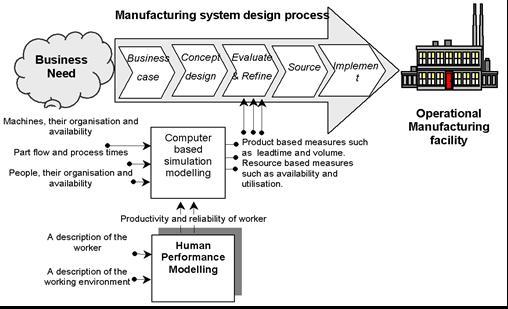 tween the practitioners involved (Mintzberg et al. 1976).
Model never completely reflect reality, reality is always more abundant. The only models that will inspire some confidence, sometimes, are large, detailed optimisation and simulation models (Meal, 1984). An analytical tool that is a valuable aid to manufacturing system design is simulation modelling. Simulation is mostly used to undertake a comparative analysis of system designs. Now, Simulation is an important part of a design or redesign process, especially in the manufacturing system. Since researchers specialise in determining individual capabilities and limitations, they can identify changes that may improve overall system performance and implement and test these proposed changes in a simulator (Arbak, Derenski and Walrath, 1993). Simulation is a coarse replication of the dynamic behaviour of the proposed system; it produces numerical performance indicators, and enables the practitioner to make informed judgements about the proposed system (Baines, Ladbrook, 2002). In other word, modelling is also known as applying a technique such as Discrete Event Simulation (DES) (Carrie 1988, Robinson, 1994). In manufacturing system design, computer based animation is widely used to build.
DES is most frequently used to use the elements of a manufacturing system that are highly deterministic in their behaviour, usually mechanical equipment such as machines, conveyors and robotics. DES model define an individual/people as a resource which is needed by activities such as machining and assembly to take place. In Some cases, modelling aids regard human issues as ergonomics. Health and Safety Executive have also issued some general guidelines on work place of manufacturing system. There is other modelling techniques also exist in manufacturing system analysis. Baines et al. (1998) examines schematic representations (e.g. IDEF0), mathematical modelling (e.g. Queuing Theory), and other simulation techniques such as System Dynamics (SD). Among those modelling, SD is a powerful, if occasionally overlooked, technique for manufacturing system modelling (Baines and Harrison 1999). Baines and Ladbrook (2002) also recognise that there is an important need to expand the capability of modelling to include the relationships between people, their working environment, and their subsequent performance in terms of productive routines. This will be a valuable aid to engineers and managers involved with manufacturing system design or redesign.
Saturday, August 06, 2005
Please, Make me:
Make me cloud so I can change my shape;
Give me capacity so I can die alive;
How do I go on my own cementry;
How do I listen my own sorrow;
Make me cheap so I can sell myself in market;
Give me capacity so I can die alive;
Shoot me again, don't leave me wounded;
leave me burning on my dead bed,don't burn me in sorrow;
Make me water so I can chage my colour;
Give me capacity so I can die alive;
Give me capacity so I can die alive;
How do I go on my own cementry;
How do I listen my own sorrow;
Make me cheap so I can sell myself in market;
Give me capacity so I can die alive;
Shoot me again, don't leave me wounded;
leave me burning on my dead bed,don't burn me in sorrow;
Make me water so I can chage my colour;
Give me capacity so I can die alive;
Subscribe to:
Posts (Atom)