Wednesday, February 01, 2006

Is Time really money?

I always remember when I was in Nepal, Mum used to tell me son you are not giving enough time on your study. You know this is the time you have to make your career; the time which you are killing now will never come back again. This time is really count as money and my answer used to be that Mum please, don’t give me lecture and advice every time, I know what is right and wrong. When I was in college even sometime she used to wake me up to go college, how silly I was but she never used to forget when I have to attend class and different stuffs. Really, it was also good time when I was with family (especially mom’s love), this remind me today that Time is more than money.
Let me move from those maudlin stuffs, it has gone and past now. There is also one proverb that past is to remember, future is to wish and present is your real time, utilise it very carefully. Long time ago, I had read one article in The Times newspaper “Scientists show that time really is money”. I am trying to go through it which I can remember and few of them are my own personal experiences.
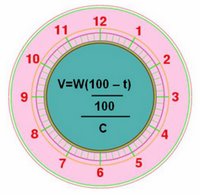
Most of us know that time is money. In economic, wages or salaries have given an indication of how we are valued at work which can refers traditional way however, by looking at salaries against taxation, the cost of living, we can see how much an hour of our time is worth whether at work or home. We can calculate it by using a mathematical formula for the monetary value of every minute of a person’s working life. Ian Walker, a professor of Economics at Warwick University has given a very simple formula to calculate it is: V= (W(100 – t)/100)/C, where V is the value of an hour, W is a person’s hourly wage, t is the tax rate and C is the local cost of living.
According to Professor Ian Walker, the equation will allow us to work out whether they are getting a fair rate for over time, as well as helping them to decide whether it is worth spending extra cash to save time for example by employing a cleaner or by taking taxi. If the amount one pays for a service is less than the value of the time you would take to do it yourself, it is generally worth splashing out.
This helps us to understand that as the value of our time rises, we are likely to buy more of it, which explains why people are paying to save time, like having someone to cut the lawn or clean the house. In other word, it shows a person’s working life by showing the precise cost of a lie–in, an extra hour at the office or even brushing one’s teeth. This formula also refers to think about how to value and use our time more effectively; vital in an age when many people feel as through they have less time to spend in the way they want to.

Monday, January 30, 2006

Enigmatic Commitment: (3)

Men have a win/lose philosophy in love. In this relationship, they care about women as much as themselves. When his heart is open, he feels so confident in himself that he is capable of making changes. If she gives an opportunity to prove his potential, he expresses his best self. To experience fulfilment he must begin to live his life motivated by love. If he feels that he cannot succeed then he regresses back to his old selfish ways. He wants to use his power and skills in the service of others, especially in service of the woman whom he likes. In that situation, there is beginning to develop a new philosophy, a win/win philosophy. He wants a world where everyone cared for themselves as well as for others.
Most of the men are not only hungry to give love but they are starving for it as well. When his relationship fail he finds himself depressed and stuck in alone. He stops caring and doesn’t know why he is so depressed. It is difficult to be motivated when he is not needed. To make him motivated again, he needs to appreciated, trusted and accepted. If he does not motivate then he start kill himself slowly, in other words, it is a slow death for a man. He starts drink, smoke and get involved in fight or unnecessary argument. I can remember, I was nearly to fight with one guy in Mall last week. I started smoking heavily again (I am regretting and punishing myself). Neither, I like anything nor I care anything nowadays (stopped talking with most of the friends because they may tell something which can hurt me more). Sometime I think to go far away from this city but I don’t know where I can get peace.
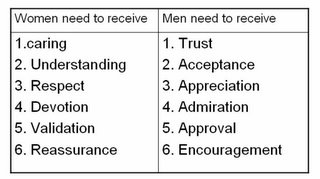
Generally, Men and Women have different emotional needs. Typically, Men give in relationship what he wants and Women give what she wants. Women instinctively appreciate the little things. The only exceptions are when a woman doesn’t realize a man needs to hear appreciation. When a woman feels unloved and neglected it is hard for her automatically to appreciate what a man does do for her. She feels resentful because she has given so much more than he has. This resentment blocks her ability to appreciate the little things. I can remember, when I told her I quit smoking and was excepting to hear her appreciation but she didn’t tell me except how are you feeling now? Did you find hard to quit? I was thinking she might become happy that I quit smoking because she just told me once which can make her feel that I really care a lot. Sometime, both Men and Women think they give and give but do not get back which can feel their love is unacknowledged and unappreciated. Most of the Men strive for greater and greater success because they believe it will make them worthy of love. I have noted few of the points which are taken from the book about women and men expect from each other.A men’s deepest fear is that he is not good enough or that he is incompetent. He compensates for this fear by focusing on increasing his power and competence. Success, achievement and efficiency are far most in his life. A man appears most uncaring when he is afraid. Just women are afraid of receiving, man are afraid of giving. To extend himself in giving to others means to risk failure, correction, and disapproval. These consequences are most painful because deep inside his unconscious he holds an incorrect belief that he is not good enough. This belief was formed and reinforced in childhood ever time he thought he was expected to do better. When his accomplishments went unnoticed or were unappreciated, deep in his unconscious he began forming the incorrect belief that he was not good enough.
Just as women are sensitive to feeling rejected when they don’t get attention they needed, men are sensitive to feeling that they failed when a women talks about problems. This is why it is so hard for him to listen sometimes. He wants to be her hero. When she is disappointed or unhappy over anything, he feels like a failure. Her unhappiness confirms his deepest fear: he is just not good enough. Many women today don’t realize how vulnerable men are and how much they need love too. Love helps him to know that he is enough to fulfil others.
At last but not the least, my comment with her became enigmatic so I could not fathom what should I name it? Unfortunately, I am fatigued with everything and want to cry on her arm like small kid.

Thursday, January 26, 2006

Enigmatic Commitment: (2)

That evening was strange, this evening is also strange;She was close to me, she is close to me today as well,On those eyes there were my thoughts, on those unspoken words there were my happiness,I used to think she is singing by using my name and introverting,I thought she is coming close to me……………….
I have taken few of the relevant quotes from the book according to my experience. I found that when women pull away then Men started get curious towards her. They (Men) started trying to get closer to her. I can remember that when I did call on her mobile. She didn’t reply at all. I left voice messages that I want to talk to her. On that period, I had really miserable time. When I felt that I am fully separated, then suddenly I felt my need for love and intimacy again. I think she might be surprised and called me after four weeks. I tried to explain my feelings to her and requested her few time to meet. She agreed to meet me but changed her plan again and at last we met on Saturday. How do I explain my feelings and happiness on those eight days? Nobody can imagine even I can’t explain in words that how much happy I was when she said she wants to meet me. I changed my daily routine even I stopped smoking because she knew that I was still smoking. I started reading and asking friends that how can I impress her. I was waiting a good moment so that I can listen her feelings and tell her about my feeling as well. It is worth to say that in Love few hours are also memorable in life. My flat mates started asking that am I really in Love? When I used to come home from work, I used to ask my flat mate Stephen to dance with me in Nepali songs. He was really surprised by seeing such a change in my behaviour.
I think Women pull away for different reasons. Sometime she does not understand Men’s feelings and afraid of being hurt again. Sometime, when Men disappointed her that makes also pulling away from Men. I can remember one incident that when we met last time on Saturday. When we went to buy suit for post – graduate ceremony at Mall on my request, one mature woman started asking me that I had day off and all those stuff. I tried to ignore her and told her that she always shows too much interest towards me but I don’t like her and there are few other girls as well whom I don’t like at all. I also told her that my family are asking me to get marry. But in my view, I was telling her indirectly that nobody can take your position. You are the only person whom I can trust and will be happy. I am pretty sure, my statement (in my innocence) hurt her but I had not any mean to hurt her. It took me far away from her and today our communication broke out. It did hurt me as well because she didn’t understand me and trust me. To know a person, it can take ages then how can she evaluate me in few words and days?
Men always pull away to fulfil his need for independence or autonomy. When we met second time at my work place and went to city centre. I had a lot of things to do. I was trying to sort all those work first then give her more time. I used to call her once in a week and then used to make myself occupied by different unsolved work. I was trying to establish myself on her level. When I felt that I finished some degree of work then I motivated to give my love and receive the love and care I need. I think it was not my fault because it is Men nature which I knew by reading this research book.
I found only one place where some of us express our feelings. I always remember one thing when we get frustration at that time we start praying God, you know why? Because we believe that God listens everything what we are saying but never reply. Perhaps, this is the way of life goes. Krishna has explained in Bhagavad-Gita when human beings allow their mind to muse on objects of sense-enjoyments, an attraction for them is created. Attraction develops into craving and from craving follow causes for anger. Anger produces delusion. Delusion confuses the memory and understanding of things; from this confusion of understanding follows the disintegration of the power of discrimination; with discrimination gone, the human perishes.The top secret of difference in coping with stress in Men and Women are: When Men become stress, they are increasingly focused and withdrawn. They feel better by solving problems. Men want to make improvements when they feel that they are being approached as a solution to problem rather than as the problem itself. But Women are increasingly overwhelmed and emotionally involved and they feel better by talking about problems. Continued......

Monday, January 23, 2006

Enigmatic Commitment: (1)

I often talk with my silence and see in your mind's eye: What did I get except meet love one and part again? how does somebody say he is lonely with out you? If you were with me this time, you would ask me different questions, share your feelings, and worry about me.
Few days ago, I was reading “Men are from Mars and Women are from Venus” and I used to take it my work place as well to read it in free time. Last Friday, one of my work colleague started giggling to me when he saw that book without taking any interest about it. I tried to convince him that it’s really conversant book in which the writer has tried to explain about the difference between Men and Women communication style, its meaning and how it can affect in relationship life. John Gray (the writer of this book) has given his own family example and how he had felt in such situation which really encouraged me to write about my feelings today. It is very much true that you can’t live with them, and you can’t live without them! I think my feeling and experience will really assist somebody, if not, then it will help me to remind in future that I had gone through it.
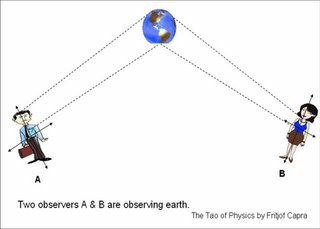
Everybody have different view and experience about identical obsession and the answer will be also different. To explain it, I can give very simple example, which, most of us have gone through it. Let’s imagine, two observers are observing an earth, in that situation if we ask that what they are thinking about it. I am pretty sure that there will be bit different answer because everybody explains how they have experienced, felt, sense and so on about it in different time and situation. Fritjof Capra has stressed it in terms of relative theory which has shown in drawing as below. If observer A sees the apple to his left and slightly inclined, so that the upper end is nearer to him. On the other hand, Observer B sees the apple to her right and in such a way the upper end is farther away. By extending this two dimensional example to three dimensions, it becomes clear that all spatial specifications – such as ‘left’, ‘right’, ‘up’, ‘down’, ‘oblique’, etc – depend on the position of the observer and are thus relative. The temporal order of two events was assumed to be independent of any observer. Specifications referring to time – such as ‘before’, ‘after’ or ‘simultaneous’ – were thought to have an absolute meaning independent of any coordinate system.

To be honest, when I left Nepal since then I started living alone. This loneliness took me far from everybody and today far from you. I never gave few minutes to think in those six years about the love and caring which you gave me in few days. I instinctively felt a need to talk about my feelings with you. I was not immediately concerned with finding solutions to my problems but rather tried to find relief by expressing myself and being understood. Alas you broke our communication and I came back my lonely world again. I tried to explain you but you didn’t give me any chance.
When I had not met you, I was lonely but I was not that much piteous how much I am today but I learned so many things. Today, I am going through few of them to analyse which I can remember. In this process, I may be right or wrong because it is just one sided because I don’t know her affection towards me. I might be wrong person or not her type of person.
Why did you thieve my heart if you had to break it?Why did you become my sweetheart if you had to make me alone?Why did you break my heart, why did you fall in love, why did you go away, away, away and far away? Continued...

Wednesday, January 11, 2006

The state we are in:

Knowledge economy discourse is being used in countries like China and India to make a case for permitting multinational companies however Nepalese are losing allure with Nepal’s development:
The media have been all agog over the rise of crises in Nepal. Women, children and other non-combatants are being primary victims. The key characteristics of the war in Nepal at high risk of internal fighting are neither political nor social, but mere economic. Maoist rebel leaders form themselves as heroically fighting to guide in an era of liberty and prosperity. However it seldom works this way. Civil war typically leaves a legacy of economic, social and political ruin. But the damage extends to neighbour countries because drugs and terrorism flourish and spread from regions of disorder, even they appear to be isolated from their country which is happening in India now. Another common consequence of rebellion and disorder is rape, strike and fight.
According to World Bank calculations, the total of 2.3 billion people in China and India, nearly 1.5 billion earn less than $2 a day. Both are poor, largely agricultural countries. Nepal is also poor where around sixty percent people depend in agriculture. China, India and Nepal are sailing in same boat however Nepal didn’t choose its main priorities as unemployment and a spirit of nation’s atma vishwas (self confidence); we can take several such examples a kind of substantial growth seen in Japan in the 1950s and 1960s, South Korea in the 1970, China and India today.
Nepal's foreign policy is also good between China and India. There are more influence of India than China because of open border, culture, and climate. Today, India high-tech is not the sole preserve of the rich. Auto rickshaw drivers began using mobile phone so that customers can call for a ride. Technology companies are extending internet connections to the remote locations. Small, renewable electricity generators are appearing in villages, and the government is using home- grown space technology to improve literacy skills and education in far flung areas. This knowledge revolution has begun in our neighbour countries. Conventional wisdom now suggests that globalisation is responsible for this feat. But does Nepal have it as a nation and, if not, what must Nepal do to get it?
Nepal’s illiteracy is reducing only at the rate of 1.3 percent per annum. At this rate, Nepal will need another more or less 50 years to attain a literacy rate of 95 percent. We cannot be industrially and economically advanced and we cannot be technologically advanced unless we are scientifically advanced. One of the critical issues facing Nepal is the gulf between the academic world and industry. Science too has its role to play. The notion that scientific ideas lead to technology and from there to wealth is not widespread. Nepal needs economic liberalisation and competition between Nepali companies which is being tamed, so they are under no pressure to come up with new ideas, nor did academics promote their ideas to industry.
Of course, people are going India, Arab and Developed Countries for employment because of political instability and lack of opportunity for employment and government’s future policy. Some of them are attempting to gain illegal passage to developed countries by holding false passport and documents. Despite the perception that Nepalese immigrants tend to be deprived illiterate prone to crime, Nepalese who emigrates is not that country's most destitute citizens. They tend to come from the mid-skilled classes, not from the poorest. More than anything else, it is a perceived lack of opportunity that encourages citizens to leave country. Government is also encouraging those who are going aboard to train different skills so that their income will increase by many folds, and has already made the first move a program to provide loan through banks to those who cannot afford money to go abroad.
Most of the people in Nepal dream of being overseas so that they are watching foreign channel rather Nepal TV, are also the main source of aspiring to be somewhere else for better future and employment. So many Nepalese dream of leaving significantly threatens Nepal's economic development, social well-being, and political stability. Every year Nepal loses two to three percent of its GNP to brain drain. Nepal loses between 1,000 and 2,000 professors, doctors, and engineers and high skilled professionals annually. This loss means fewer well-educated, ambitious citizens who could help lead our country. However there is an irony here, for if through immigration Nepal loses capital in some forms; gains it through the money its immigrants send back to their families. If we look at the number of households receiving the remittance in Nepal, it increased from 23 percent in 1995/96 to 52 percent in 2003/04, contributed close to about 12 percent to the Nepal’s GDP.
Rich countries like Arab and other Developed countries want migrants' labour, but do not want to look after these newcomers when they grow old. Ideally, rich countries would like a constant rotation of workers, arriving while they are young and active, leaving before they grow old and dependent. For its part, temporary and circular migration is also better for poor country like Nepal. One reason is remittances: the longer an immigrant stays away from home, the smaller the share of his/her wages he/she sends back. In Germany, the same phenomenon happened in reverse. The availability of cheap guest-workers in German factories slowed the adoption of new labour-saving technology. As the saying went at the time: Japan is getting robots while Germany gets Turks.
Nepalese households invest more than half of their savings in physical ones such as land, houses, cattle, and gold instead of putting money into financial assets. In rural areas, the proportion is even higher. This fact shows that Nepalese people mistrust of banks and are the largest consumers of gold. Let us take an example in Pokhara, there have been invested to build houses but they are all empty. Households could earn higher returns by investing in financial assets, and the country would be better off if savings were pooled to finance more productive investments.
This dilemma may help explain why the Nepalese government can seem unsure about security, unemployment, and social stability. There is confrontation between three parties: government, political parties and Communist follower “Maoist”. If we ask about the current situation to them, they give a very simple answer without taking any responsibility that we don’t have a lot of resources like India and China. Now, our greatest resource and valuable export is our human potential. That's a powerful incentive, even if it does spank of actively encouraging a brain drain from developing countries like Nepal. But then, India’s Late Prime Minister Rajiv Gandhi's well-known prescription still holds: "Better brain drain than brain in the drain". Competition for brains and ideas is where the battle for global influence should be waged.
Above all, Nepal should learn from the experience of other countries to avoid killing incentives for work rather than encouraging people to go abroad, and should make it easier for workers to learn new skills, so it is all the more important to invest in education. All that is needed is a more welcoming environment for foreign educational institutions, investor and students, as well as a greater tolerance for market in tourism. Nepal needs to revitalise its economy, modernise its institutions, rewrite the contract between the members of society and recover its self esteem. I could go on and on, but the point should be clear that Nepal's future is in Nepalese hands and will be what Nepalese make of it.

Thursday, December 08, 2005

UGO Taxi & Mini Bus Company:

Background of Company:
UGO taxi & Mini Bus Company is better known, as UGO taxis are hire agents in Bristol. This company also hire for tour, Minibus, wedding limousine car. For historic tours and highland bus hire as well as coach hire come to Coach Company and Bus Company that knows the area. This company offers interesting sightseeing tours, either shared or personal, to make the most of your stay in beautiful Bristol city. This company also takes great pride in offering a personal service to all customers.
The company has plans to expand into other areas in UK by acquisition of small exciting taxi or Minibus hire companies, increasing business performance by improving servicing processes are a rapidly growing area of interest and one which typically generates very substantial business benefits. The company has simple booking system and it senior management realised to improve the business activities. The company’s operation manager wants to new IT system to introduce best practices into the organisation. UGO taxi for which I have created the IDEF model is a medium sized taxi and bus company. It involved in a business that provides quality transport service for pre booked journey for individuals and groups. The company business is growing that made company to face difficulty to maximise the efficiency and quality of service, the company while maintaining and the flexibility and responsiveness to the demand generator.
*Low resource utilisation which means the vehicle is idle and capital is tied up needlessly.
*High unplanned overtime levels which are forced by the need to get late running orders delivered.
*Too much stock which leads to excess capital tied up, too many vehicles are in hand but not being used effectively.
*A high level of late service deliveries which gives many problems, including inability to retain customers and more expensive service costs.
*Inability to identify which impact of changes to the service plan such as additional, high priority orders and mechanical failure.
*High cost of labour with many periods when labour is idle.
Forecasting model of UGO:
Forecasting is the predication, projection or estimation of uncertain future events or levels of activities. It is basic to planning that represents the preparation of budget and is concerned with probable events. The future is uncertain and numerous techniques, numerical or statically formula and assumption have to try and limit the amount of uncertainty. Probability theory is the one statically method that is used very widely in many business organisation. Forecast enables to develop a clear plan and the right objectives to select.
Forecast can make UGO management think ahead and give a singleness of purpose to planning by concentrating attention on the future. It is also the foundation of company’s entire logistics process. It can be affected by many factors which include trends relating to the general economy, political, international, the strength of competitors and servicing cost trend. The items which can affect forecasting in UGO are:
#Political stability;
#Population trends;
#Price levels;
#Government controls and fiscal policy;
#Employment, service and company income;
#Technical environment- i.e. computers, IT and the impact of speed of developments.
In the process of forecasting in UGO, it is important to stress the need to examine the economic environment and possible fluctuations in the company profits and relationships to possible cycles to business activity.
UGO is going to plan for longer periods (i.e. 10 years) because it is going to implement computer and IT, a forecast of technological changes is vital for it. The revision is continually made of the basic assumptions on which the plans were based, as circumstances change and thus new plans would be developed. It is important to be familiar with the five major characteristics of demand forecasting which are:
*Average: Demand trends to cluster around a specific level.
*Trend: demand consistently increases or decreases over time.
*Seasonality: demand shows peaks and valley at consistent intervals. These intervals can be hours, days, week, months, years or seasons.
*Cyclical: Demand gradually increases and decreases over an extended period of time, such as years. Business cycles (recession and expansion) and service life cycles influence this component of demand.
*Random error: Variations that cannot be explained or predicated.
The magnitude of the error, referred to as forecast accuracy, is what determines whether the forecasts are good or bad. Careful selection of appropriate forecasting techniques and the best practices will help business improve forecast accuracy.
There are number of approaches available in the forecasting methods. These range from extrapolation of trends of technology to more advanced methods such as
Subjective or judgement method: This method utilise opinions to develop forecasts and generally used when historic data is not available. The basic for judgement methods is that the decision maker possesses sufficient experience to establish forecasts. In general, they are low cost and have rapid development time. However, they are not consistently accurate and subject to bias by group creating the forecast.
#Delphi technique which is a procedure for arriving at a consensus of opinion among a group of experts, who are given a detailed questionnaire about a problem. They give written opinions that are everyone reads the opinions of others and can revise their own ideas. Direct contact and debate is avoided purposively as this may produce hasty attachment to some ideas.
#Brainstorming usually involves conducting a group meeting on a problem and any idea is welcomed, however strange. The hope is that many ideas may be generated as there is freedom to let idea flow, and from these, positive solutions may emerge.
#Scenario construction is a method used to make long-range forecasts. It is a logical description of events. The committee or ‘think-tank’ examines details of alternative events. A well-constructed scenario exploring each adjustment or re-adjustment may produce a reasonably accurate forecast.
#Sales force estimation which is closest to the customer and immersed in the marketplace, creates estimates of customer demand. Because of their proximity to the customers, information from the sales force can be very reliable. However, individual biases and can decrease the effectiveness of this technique.
#Executive opinion that usually have a good understanding of the broad-based factors that influence demand, create estimates of customer demand. This can be good method to use when creating forecasts for new or very strategic product or service. However, it consumes valuable executive time and requires consensus between executives.
Causal (Econometric) is a newer development in forecasting. This is done through the construction of mathematical models in which various factors of the economy are given mathematical values and their effect upon each other ascertained through the solution of equations. The level of country’s economy is of course a vital factor upon which a company’s sales and revenue plans are based.
In other word, Causal methods create forecasts by determining a cause-effect relationship between independent variables and the demand for the service. Two examples where casual methods could be used to create forecasts will help to illustrate this:
#Forecasting MIS: Long-range forecasts for UGO Taxi Company can be used to forecast IT used or accessed IS by customers.
#Promotion planning: if the customer price of product is reduced by 1.50 per unit, how will it affect demand?
One of the benefits is that causal methods provide good long term forecast accuracy. However, the forecasts are only as good as the independent variables identified and the model created. They require careful thought and insight into the variables that effect demand.
#Linear Regression (Simple and Multiple):
Simple liner regression generates a forecast by linking one independent variable to the demand for the product or service. For example, demand or order of taxi may be dependent on the fare that is charged for the service. A model would be developed which described this relationship. Given a specific demand or order, a demand forecast for UGO taxi will be generated.
Multiple linear regressions generate a forecast by linking two or more independent variables to the demand for the service. For example, Order of taxi is may be dependent on the fare that is charged for the service, the quality of service and customer pick-up time. A model would be developed which described this relationship. Given a specific order or demand, fare, quality of service and pick-up time for UGO taxi will be generated.
Time Series analysis is a procedure which identifies information which forms patterns over a period of time. A projection is made by extrapolation from past experience. Trends for the past years are noted and projected into the future. In the short term, it performs very well; in long term, it generally performs poorly. These techniques are best used for (a) mature products, (b) products with a large amount of historical data, or (c) products with smooth, random demand variations.
Demand forecasting software easily systematises these forecasting methods. Because of this, forecasting large number of items by these methods is easily performed with software.
#Naïve is a simple forecasting technique for the next period is equal to the demand for the current period. This is a simple, low-cost method that only takes trend into account. However, if demand is variable, this is a poor method to use.
#Moving average (simple and weighted): A simple moving average method is used to determine the average amount of demand over a given period. The weighted moving average technique allows each period in the calculation to carry its own weight. UGO can specify that recent demand will be weighted more heavily in the calculation than older data.
Moving average techniques are most appropriate for stable demand patterns, when demand does exhibits trend or seasonality components. Unfortunately, if trend or seasonality exists in the demand, the forecasts will lag in their ability to predict future demand.
#Exponential Smoothing (Single, double, triple): Exponential smoothing methods require user-specified factors to calculate the forecast:
*Smoothing (averaging): reactivity of forecast to current demand period.
*Trend: dampen or accelerate trend in the forecast.
*Seasonality: dampen or enhance the effect of seasonality on the forecast.
Single exponential smoothing uses the smooth factor only in the forecast calculation. Double exponential smoothing uses the smoothing and trend factors in the forecast calculation. Triple exponential smoothing uses the smoothing, trend and seasonality factors in the forecast calculation. These techniques are popular and easily calculated with demand planning software. These performs well in short term forecasts, it does not perform as well on products with low demand.
The graphs and data plotted from the forecasting table shows the class of domain as below. Since the company which was operation on existing data and of which it was realised need of IT based system should introduce to import efficiency of company. After critical analysis on the outmoded operational sequence, it was identified that the drop of demand was very low at a particular period on the previous operation.
Furthermore to improve the existing system, demand pattern, EWMA, EWMA ABC, Period, Seasonal forecast, trend forecast, trend and seasonality enhanced forecast (TSEF), were calculated to show a solid improvement in the new demand. The new demand plotted clearly shows how the performances will determine the actual demand of the period. This actually synchronise with IDEF model to produce the fitted ERP system. The forecasting table shows that the demand of the ready existing data is lower than the new demand.
IDEF model of UGO taxi:
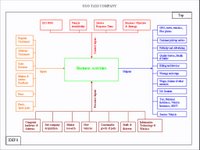
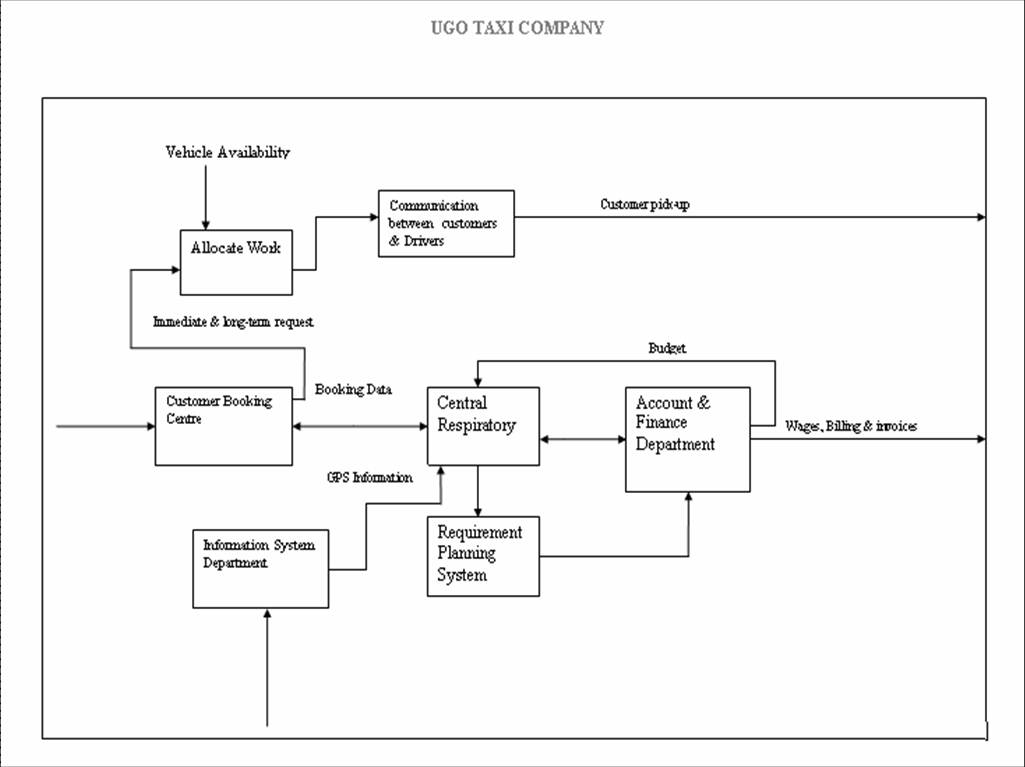
IDEF0 is used to produce a “function model” which is a structured representation of the activities or processes within the environment or system. In every manufacturing or service organisation there is a variety of reason to improve the system but in this context of UGO taxi, we can define as (1) competition within the market is demanding more competitive systems which can operate upper limits of productivity. (2) Customers are become more demanding so that requiring new service systems to become more flexible and have shorter lead-time. (David Osullivan 25 March 1991).
IDEF is a structured technique that has become synonymous with the design of manufacturing systems is the Icam (Integrated computer Aided Manufacturing) programme. IDEF0 is that complex systems can be described in terms of the activities performed in the system and in such a way as to expose detail progressively through a hierarchical decomposition. IDEF0 in fact closely reflect the activity modelling part of the SADT methodology. (David Osullivan).
A model of UGO IDEF0 is a representation of a set of components of a system area. This model is developed for understanding, analysis, improvement or replacement of the system. Systems are composed of interfacing or interdependent parts that work together to perform a useful function. System parts which can be any combination of things, including people, information, software, processes, equipment, products, or raw materials. The model describes what a system does, what controls it, what things it works on, what means it uses to perform its functions, and what it produces.
IDEF0 is a modelling technique based on combined graphics and text that are presented in an organized and systematic way to gain understanding, support analysis, provide logic for potential changes, specify requirements, or support systems level design and integration activities in UGO. An IDEF0 model is composed of a hierarchical series of diagrams that gradually display increasing levels of detail describing functions and their interfaces within the context of a system.
IDEF0 is an engineering technique for performing and managing needs analysis, benefits analysis, requirements definition, functional analysis, systems design, maintenance, and baselines for continuous improvement. IDEF0 models provide a "blueprint" of functions and their interfaces that must be captured and understood in order to make systems engineering decisions that are logical, affordable, Integra table and achievable. The IDEF0 model of UGO taxi reflects how system functions interrelate and operate just as the blueprint of a product reflects how the different pieces of a product fit together. The goal is improve the management of tangible and intangible assets according to UGO’s a along range plan development of new system comprising and this IDEF diagram of UGO’s taxi has presented to illustrate how the IDEF0 and IDEF1 structure can be applied in Service Company like UGO Taxi CompanyBackground of Company:
UGO taxi & Mini Bus Company is better known, as UGO taxis are hire agents in Bristol. This company also hire for tour, Minibus, wedding limousine car. For historic tours and highland bus hire as well as coach hire come to Coach Company and Bus Company that knows the area. This company offers interesting sightseeing tours, either shared or personal, to make the most of your stay in beautiful Bristol city. This company also takes great pride in offering a personal service to all customers.
The company has plans to expand into other areas in UK by acquisition of small exciting taxi or Minibus hire companies, increasing business performance by improving servicing processes are a rapidly growing area of interest and one which typically generates very substantial business benefits. The company has simple booking system and it senior management realised to improve the business activities. The company’s operation manager wants to new IT system to introduce best practices into the organisation. UGO taxi for which I have created the IDEF model is a medium sized taxi and bus company. It involved in a business that provides quality transport service for pre booked journey for individuals and groups. The company business is growing that made company to face difficulty to maximise the efficiency and quality of service, the company while maintaining and the flexibility and responsiveness to the demand generator.
Low resource utilisation which means the vehicle is idle and capital is tied up needlessly.
High unplanned overtime levels which are forced by the need to get late running orders delivered.
Too much stock which leads to excess capital tied up, too many vehicles are in hand but not being used effectively.
A high level of late service deliveries which gives many problems, including inability to retain customers and more expensive service costs.
Inability to identify which impact of changes to the service plan such as additional, high priority orders and mechanical failure.
High cost of labour with many periods when labour is idle.
Description of model:
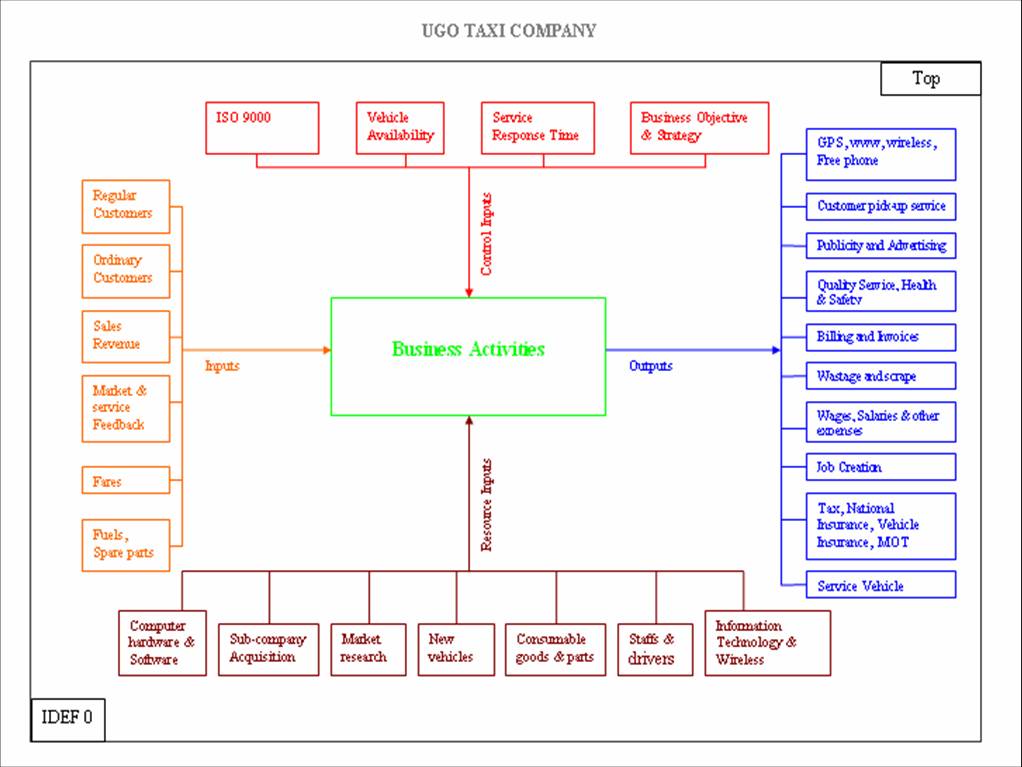
At the centre of the business is the newly designed computer based ERP system which is an integrated system. IDEF model is the approach towards the implementation to restructure the company to produce and efficient and effective operation cycle- input, control, resource and output carries the real function which will determine the validity of the transformation in the company. It collects data from different functional areas of company such as:
The inputs data are:
Regular customers, Ordinary customers
Sales revenue,
Market & service feedback,
Fare,
Fuel, Spare parts etc.
The Control Inputs are:
Vehicle availability,
Service response time,
Business objective & strategy,
ISO 9000
The Resource inputs are:
Computer hardware & software,
Sub company acquisition,
Market research,
New vehicles,
Consumable goods and parts,
Staff & drivers,
Information technology & wireless.
The outputs are:
GPS, www, wireless, free phone,
Customers pick up service,
Publicity and advertising,
Quality service, health & Safety,
Billing and Invoices,
Wastage and scrape,
Wages, salaries & other expanses,
Job creation,
Tax, NI, Vehicle Insurance, MOT,
Service Vehicle.
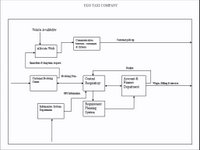
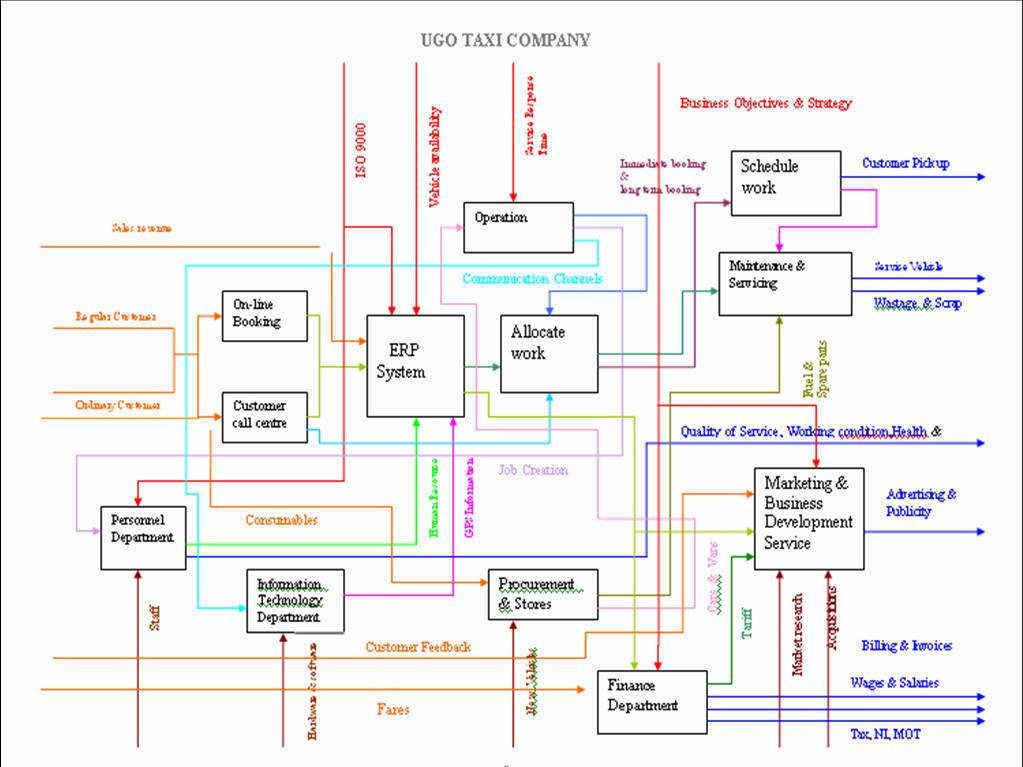
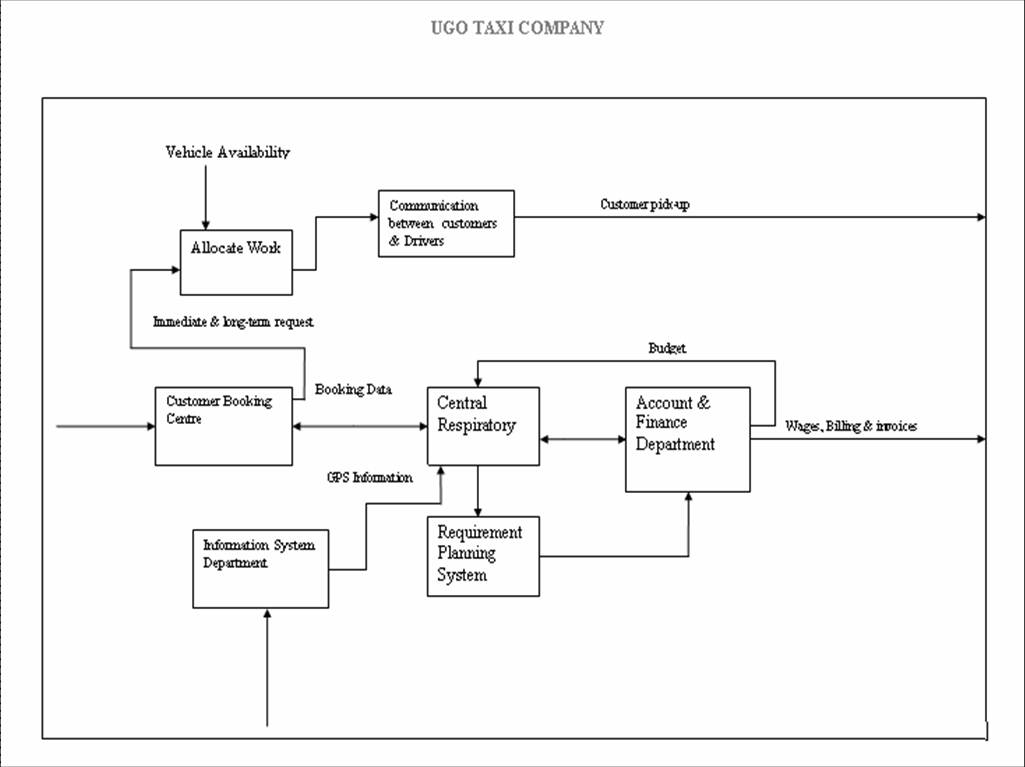
The raw data of inputs, control inputs and resource inputs to the business that produce output which has shown in IDEF0 model. The company is driven by demand, which may include customers order or sales order forecast. The overall situation can be shown in the attached IDEF model diagram. UGO taxi’s daily basis operation process, the company has launched its new IT based server to make work more effective and reliable.
Business objective and strategy: The ideal is for UGO Company to formulate specific objectives and develop policies, within the frame of general objectives, which together result in co-ordinated and controlled, decision making. To be able to survive, UGO must earn sufficient profits to sell services, of certain quality, at competitive price. A newer approach to consideration of objectives is the ‘stakeholder’ theory which suggests that UGO has responsibility to maintain an equitable and working balance among the claims of the interested groups, i.e. stockholders, employees, customers, suppliers, vendors and the public.
Booking system: UGO has provided various communication services to the customer for booking services. Customer can book their taxi, minibus, wedding limousine car tour and so on through the internet, direct communication with driver, free phone and so on. Customer can access internet and get more and more information which can help them to get information about the company policy and services. They can book through internet which would be cheaper and efficient for customer and the company. It can help the company to maintained the data about the customer i.e. customer status (medium class or rich class, quality oriented or general customer, area and location etc) that can help to company to make future planning and strategy.
Feedback: Feedback involves passing information from one point in a system back to an earlier point with a view to modifying behaviour. Feedback is connected with planning, with its determination of instructions to be used as directives for activities, and the standards for comparison. Control comes from comparison with standards showing the need for corrective action, and analysis of deviation so future plan can be readjusted. The UGO can collect the customer feedback through different source i.e. internet user customer, regular customer, drivers and market survey which will help it for future business planning and service.
Fare: Fare is the main resource for UGO business success. It would depend on the company policy that which type of customer that company has targeted in the market. There would be variety of customer and each customer has different sort of demand, in this case fare would play very vital role. Customer can get information about the fare while they are booking the taxi or minibus through call centre, company’s web site. That will help them to fast and quick information to decide their needs.
Fuels and spares parts: The taxi company always need fuel and the spare parts for driving, maintenance and vehicle servicing. Company can keep data and save millions of pound through this department by keeping the data about the Fuels consumed, Spare parts and the vehicle servicing.
Control and call centre: Control is the back bone of this company in which most of the process is done in this department. Most of the information would be held in this department to give the quality and reliable service to the customer. This department will deal with customer, drivers as well as company’s other department to make the service reliable and convey correct data at correct time by using different IT system e.g. GPS which will help to give the data about the driver’s current position and mileage they travelled, company’s website will help to take customer’s order and feedback which will very important to marketing department. The controller mobilise the driver and try to give good service as customer required.
Allocate work: It deals with the long term request as well as immediate booking. The control IT department can relay that information within a twinkle of an eye by sophisticated computerised system and provide service in the right time with quality service. The company’s IT department can allocate the job to driver by using the software which can help to allocate fast and correct at the right time.
Schedule work:In this process, the company use to allocate the duty and the rota for the driver to give the service. It is basically deal with fleets, company fleet schedule for servicing or repairs more especially due date or period. It handles long term customer request. The company can keep all the data in computer that could help in the future purpose.
Finance department: Finance department generally involve in different operation process i.e. tariff (Fares), buy fuel & spare parts, prepare budget for the taxi company and so on. This department can keep all this information and provide the different information with database to all interested parties. The company’s financial department will keep the employees database and their salaries, vehicle’s database and its associated things which will help to give information to other department in the right time with correct information.
Marketing department: The marketing department generally involved in promotion and advertising. The different associated data and information from different will help the marketing department to do promotion and advertising. Company can target different customer by promoting company’s policy and service. The marketing department associated with job advertising which will help the current market’s for job. The current IT service will help to create job and it will make interested and make the goodwill of company.
ISO 9000: The Company has decided to implement ISO 9000 which will help all the department, staffs and customer to provide correct information and the work in balance and filed. The company will take health, safety and the environment (HSE) issues extremely seriously at the highest level. Safety is always the first item on any work. The company has also going to implement policy which is based on following principle:
*Risk reduction is everyone’s responsible,
*Awareness, involvement and support of all staffs, drivers and customers is essential when identifying hazards and assessing and controlling risks,
*Continuous improvement must be the way of life, with business setting goals and measurements to drive progress.
*To reduce risk and road accident, company will issue driver’s hours and techno graphs.
The business process of UGO can be affected by different factors which have mentioned earlier as well. The business problems listed earlier obviously have successful scheduling system which is essential to develop a detailed, agreed definition of the business problem and enhance of the business process and its associated issues. In addition to consider the physical operations of scheduling within the company and the various business issues included information system. There are two types of information required which may be supplied by other systems, or in some case directly entered into the scheduling system itself. The two types of scheduling system are:
Static data
Number of vehicles,
Number of drivers,
Routes.
Dynamic data
Traffic congestions,
Available vehicles,
Available drivers.
Benefits:
The typical benefits of IDEF model based on demand forecasting of UGO taxi are list below:
Fuel efficiency,
Reduced idle time,
On time pick up and drop,
Efficient allocation of job,
Job creation in the market (Professional)
There are also large numbers of less quantifiable benefits, such as;
Increased quality of service
Reduce response time to customer
Ability to promise pick up
Capacity analysis, e.g. Ability to identify bottlenecks in the systems expansion,
Reaction to problems, e.g. identification of impact of breakdown of vehicles,
Prediction of problems, e.g. where on line booking is linked to a booking control system and can continually re schedule to identify predicted changes in service response as conditions on the any mishap.
The need for IT systems:
The need to improve competitive position is driven by various factors. Some of the most prominent of these are:
National competition: Many taxi companies are finding that they must improve efficiency and service considerably in order to compete with emerging service providers in their marketplace.
Ready to use vehicle: Timeless availably of well maintained and serviced vehicles to provide service is now insisted upon far more than new in many modern companies where quality of service has become the norm.
Increasing service range: market forces are leading to rapid increase in the number of new services which a business must provide.
Based on the keys factors of demand forecasting and IDEF model, we can develop the important technical features and properties from which we can realise the full potential and value of demand.
Conclusion:
The computer based scheduling and demand forecasting system has come of age for almost survive providing sector. Those companies which adopt it can improve their business performance in many areas. Together, these usually provide substantial commercial company is using an on line booking system as well as customer call centre. All the booking information goes into the booking system and then into the central database from where all the data is used by different functional areas. Scheduling system is a system that receives booking information and then plans the work accordingly and gives on-screen schedules to the operations people, so that they can allocate work to the drivers. All the details pertaining to the best shortest routines to the destinations, traffic congestions, mileage, number of vehicles available, number of drivers available, status of vehicles in the maintenance department for serving all that information is available to them by scheduling system.
Conversely, any company which does not optimise its decision support in this area is at immediate disadvantage. The gap between users and non users can only increase as service demands increase, leading to poorer performance and eventually collapse.
Refrences:
Appleby, Robert C, 1991, Modern Business Administration, Pitman Publishing, London WC2E 9AN
International Journal of Project management Vol.20, No.3 April 2002, page 194
International Journal of Computer Integrated Manufacturing, Vol. 7, No.2, March-April, 1994, page 101
International Journal of Computer Integrated Manufacturing, Vol.14, No.5, sept-Oct 2000, page 473
International Journal of Computer Integrated Manufacturing, vol. 11, no.5, sept-oct 1998 page.416
International Journal of Computer Integrated Manufacturing, vol.6 no.4 july-Augt. 1993, page 252
http://www.boc.com/
http://www.gistworld.com/

Wednesday, December 07, 2005

Please, stop giving money to the beggars:

Last week, I was on my way to room, I met few homeless people at city centre. Those homeless peoples have held their hands out to me and I have ignored many and felt terrible. I started thinking that may be my £1 can worth them to buy something to eat. This matter came in my again and again why people don’t want to work even government have given them a lot of opportunities to work. I can astonish how difficult it is to give money away properly. Because there are a lot of good job opportunities in rich countries compare to poor countries, the understandable generosity of relativity wealthy visitors and volunteer risks turning begging into a comparatively attractive profession-which is a self-defending process.
Let us suppose that an unskilled worker can make £1 a day, and a beggar can make £5 a day, in this situation who would be like to be an unskilled worker and work hard whole day? An unskilled worker will leave the jobs to beg until five times as many beggars are chasing the tourists and volunteers, returns collapse to a £1 a day, and the rest of unskilled workers continue their job. In other word, it applies to where families send their children: to school or to the jobs or to the streets? For the same reason, guides and taxi drivers will wait hours and days for the single lucrative tourist. This doesn’t do anyone any good.
It is true that begging often carries a stigma. Perhaps unskilled worker would rather work for £1 than beg for £2. Unfortunately, this is no better: our money is still doing nothing more than compensating beggars for the stigma of begging. This process of “rent-dissipation” is not limited to beggars. For instance, the net benefit of being crushed but getting cheap goodies in the New Year sales should be roughly zero-otherwise more people would be there is the scrum.
We will only help if we can hand out money without encouraging people to chase those handouts. When we work out how to do that, then it is assured that we have done great job now.

Tuesday, December 06, 2005

Arranged marriage:

Most of us still believe in arranged marriage for cultural reasons. This will mean that we don’t have an opportunity to cohabit first to find out how well things would work. Sometime we would like to take a decision that is more rational than emotional. There are a lot of things that we would like in men/woman, but hardly anyone has it all. In this situation why don’t we take an opportunity to analyse this dilemmas with the tools of Adam Smith which I have tried to write on the economic secrets of everyday life.
Let’s suppose, when we vote somebody in election to choose a member who represent us. In this situation, we are the “principals” and those elected person would be the “agents” who supposedly represent us. In the same manner, when shareholders elect a board of directors to maximise shareholder value, the directors are their agents. Those directors will hire managers to do their bidding: similarly, the managers are agents again.
Let’s think for a moment: are principles ever happy with what their agents get up to? Similarly, we can understand why economists speak of sometime called the “principle-agent problem”.
In the case of arranged marriage, our parents are acting as our agents, as they scout out a limited field of possible husbands/wives. How are we to encourage them to see our point of view?

Tuesday, November 22, 2005

Keep commitment:

Guys today, I want to write something different than my previous post. Since few weeks, I have changed my daily activity and, I found so many different things on my daily life. Then I thought why don't I share my feelings to you guys and try different way of life than how you used to live. But please be careful before trying different way of living. I don’t mean to say that you change yourself completely different way but I mean change it bit different in your daily activity. I assure that it will boost your performance and, give you bit relax, active and happiness.
In Gita, Krishna has explained when human beings allow their mind to muse on objects of sense-enjoyments, an attraction for them is created. Attraction develops into craving and from craving follow causes for anger. Anger produces delusion. Delusion confuses the memory and understanding of things; from this confusion of understanding follows the disintegration of the power of discrimination; with discrimination gone, the human perishes. In Buddhist philosophy it has been described that when the mind is disturbed, the multiplicity of things is produced, but when the mind is quieted, the multiplicity of things disappear. Fritjof Capra (1983) has stated in his view in Eastern mystics, all things and events are perceived by senses are interrelated, connected, and are but different aspects or manifestations of the same ultimate reality. Our tendency to divide the perceived world into individual and separate things and to experience ourselves as isolated egos in this world is seen as an illusion which comes from measuring and categorizing mentality. However I tried to analyse other’s thoughts and can find out what is wrong and right to convince myself.

Monday, November 21, 2005

Blogger Gyaan (Knowledge):

Nowadays, I started writing my thoughts and feeling on blog however I forgot to ask myself, does it worth which I am writing? Does it give the real knowledge like other intellectual web page, small stories and book tag give us? If not then what is the writing on blog really stand for me? Why am I writing all those crap things? My second sense sparked and ordered: stop asking too much question and concentrate on other positive things as well. In the meantime, I shouldn’t forget my humble beginning and stop writing about my ideas and inspiration.
I started searching on Google whether I can find any link and, I didn’t get satisfactory link which I was searching. In sheer desperation, I went to ask Pundit Buddhi Ram Bajee while he was busy in city to solve the problems of people. I found him sitting near to the Bagmati River at Kathmandu, quite busy on palmistry and face reading and, he was telling the solution of the problem to them. It made me to wait with out any hesitation but keep striking a question in my mind why he is in this position if he can solve others' problems, why can’t he solve his own problem? Anyway, when my turn came to ask the cause of problem and solution, he asked his parrot to give my answer by picking envelope which was already prepared before I went there. When I opened the envelope, I got very surprising answer — “An idle mind is a devil's workshop. This blog is thus a by-product of your devil evil plot in this virtual world”. I started scaring whether some evil spirit (ghost) came in my body and, asked him the solution for this devil evil work. He solved my problem just asking me to top up another Rs.50 together with one chicken. Then, I make my way to Pasupatinath where I saw Ajmeri sadhu baba busy on meditation. I went in front of him and, started praying him to solve my problem. When I switched on my computer, his voice echoed through my computer’s speaker with resounding answer — "Balak, it is a very special brand of gratuitous jabber mixed with pseudo- genuineness. That is what you do best for your writing". Bravo, I got my answer and, I was very humbled by his gyaan, thought gratitude him. Then, I promptly suggested for his gyaanAaj meri (mero) baba, Bholi timro baba”.
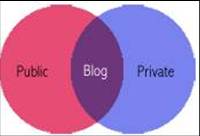
When I started writing my blog, I thought it would be my personal view and, will resolve the dichotomy that we face as an individual. Blog has over lapped the space and, has amalgamated the personal and public notion in one form called blog. If this concept has to explain in class eight by Gupta sir. He would address with his marvellous English accent — “Waitt phew minut, I weel yekshplain with pickchar on balack boode. Kundu, caan yu write watt I aim telling ona balack boode”. Now it would my turn to show the expertise writing on black board which Gupta sir is addressing about blog to our class — “U C, the red circle is public space, Blue circle is private space and the intersection set — purple flower petal shape is a blog”.
Bloggers don’t write something without any reason or thoughts and ideas in their blog. It is not just an online journal however a place to express private idea, interest and view by keeping in mind about public thoughts, ideas and suggestion. Every blogger write by hoping to read and knowing that he/she being read. Every blogger, no matter what they say, started their site because they want other people to read what they want to say. A blog is not just about introspection, it is also about performance but at the end of the day, it isn’t navel-gazing alone, it is as much navel-baring.
I always remember my school life which is one of the remarkable memories. But now, the time has passed away and I always tried to share my own past memories in this blog “How stupid I am?” Anyway, why should I care anybody’s compassion and giggle? If someone really pisses me off, I would catch him. I don’t want to tell how I would like to boil him in oil, hang him upside down from a tree, paint like a voodoo doll and do an African victory dance chanting —????? In Kishor Kumar's voice: Hmm humm humm "Jumbaaye agumbaye yaa aaygo aaygo aaygo." Thank you very much.........

Friday, November 04, 2005

Saree Gama Pada Nisa........

Perhaps, some of my friends speculate, why I am passionate about music and songs today. Some of them make fun and giggle as well, does it endorse my sentiment? Let me tell them that I am not going to listen and sing classic song "Saree Gama Pada Nisa" then whatelse? "Padee pachi aawu chha disa" Yes, my answer will be minimal and miniature that I love and adore it. There are thousands of songs however among them many, I have choosed small subset today which really give me tranquillity and touch my heart. Songs which, are composed of lyrics, the music, the vocal of singer and some indescribable elements, take me in fantasy sphere where I drop myself. I start to sing, my eyes start wet and tears started abundance which I can’t stop sometime. I think it gives a lot of brain wave of this bona fide life.
The panorama – near the seashore – just around the sunset, surrounded by the orange hues of the twilight sky – far distance I can see one tree standing alone. The strains of the santoor, the bass guitar, the saxophone in the interludes, and Kishor’s and Mukesh’s mellifluous voice……the way they complete the antaras and returns to the mukhda, each time giving it a slightly different twist and something extra….something more that tags at my heart.

Sunday, October 30, 2005

Yes, I am committed:

Of course, this question strikes several times to me from my friends when we used to talk about our past life. However, I tried to shirk such a question for long time, today I am trying to clarify to them about my thoughts and my life style. Yes, I am single but it doesn’t mean that I am lonely, miserable and drifter. Of course, I need somebody whom I can trust and share my thoughts but it doesn’t mean that I should be committed to somebody or should have girl friend whom I can share my thoughts. I can remember one of my friend who is separated and now single in the age of 55 years and still searching somebody whose life moves at the craze of every beautiful female. He goes every Friday and Saturday night out, hanging around the female and asks for dating who choose to do so. When I see such a behaviour of men then I started to imagine and ponder in this matter that should I have to change my status into COMMITTED? However, I can't simply discard myself with a 'single' status. Of course, there is a difference between someone 'single and desperately looking for' and someone 'single by choice'. The crucial question arise how do I change my status if I don’t have whom I looking for?
Yes, I have dream and she is more beautiful than an angel. Then why don’t I commit to my dream? I don’t want to commit for any alluring beauty of female. How do I trust a female whom I always endeavour to realize? How do I trust her amiable face with elusive smile that made me to fascinate towards her? I do believe that commitment to a girl makes our commitment for other things stronger and perfect. Because such a commitment makes us feel responsible. We wouldn't want to hurt our prospects, would we? Commitment to an amiable face with elusive smile and taunts will get us a fleeting material pleasure, but that will soon fade away. I should rather commit to a girl who reciprocates what I stand for, who complements me, and gets complemented in return. I think it is necessary for everyone to understand the other more deeply and to actually "feel" the other person in us. These needs to be a constant flow of love, trust and commitment to keep it smooth. It is a happy and positive emotion after all (the emotion of committing someone) so it is hard to understand why there is a hesitation to express?
Obviously, it is human nature that every opposite sex attracts each other so I was. Every men dream to share his thoughts, pain and everything to her whom he want to commit. But if she takes me in different way that I am coward and manoeuvre to face problem, then what can I say to her? I can delineate myself that I am a soft approach person who doesn’t want to dictate anybody “I like this and I don’t like this”. It is more of an occasional desire that other feels so I am feeling today, like I have to pander to her. But after a while of not hearing anything from her side, the question did come up in my mind again and again - if she is feeling bizarre about me, why won't she say about it? That in turn gradually led to me in doubts about the sincerity of the emotion about her and found that may be she started snubbing and humiliating me. I tried to be honest to her and told her everything about me. May be this took me far from her. I tried to explain her but she didn’t give me a chance. It made me embarrassed and started asking myself: What I have done to her that she despises me? When I didn’t have contemplation about her, at that time I was alone but I wasn’t that much lonely. Every success is based on commitment but my dreams of commitment altered without any reason.
Now I have to compromise my dreams and move towards the success. I have a dream to do something in this life which I have committed. I think a person can commit only one thing at a time to achieve something “success”. I shouldn’t barter this valuable time just mourning which I didn’t achieve. I should try to achieve my dreams which I used to see that I want to something. I do believe in fate as well so I am pretty sure that my fate will not be cruel to me. I can only put effort and I am pretty sure that success will be decided by my fate. So, I don’t want to comformise with this commitment to anybody. Nothing is important and valuable than my childhood dream.
Last but not the least, I would always want to commit my life to my dreams, which indeed I have. But yes, in some corner, in some hide-out, there does linger a dream in which I am committed to someone inwardly beautiful. Someone I would want to spend my every moment of life with her, someone whose presence can be comforting enough (and my presence for her) for me to accomplish my other commitments in a better manner than I would have to without her.

Saturday, October 22, 2005

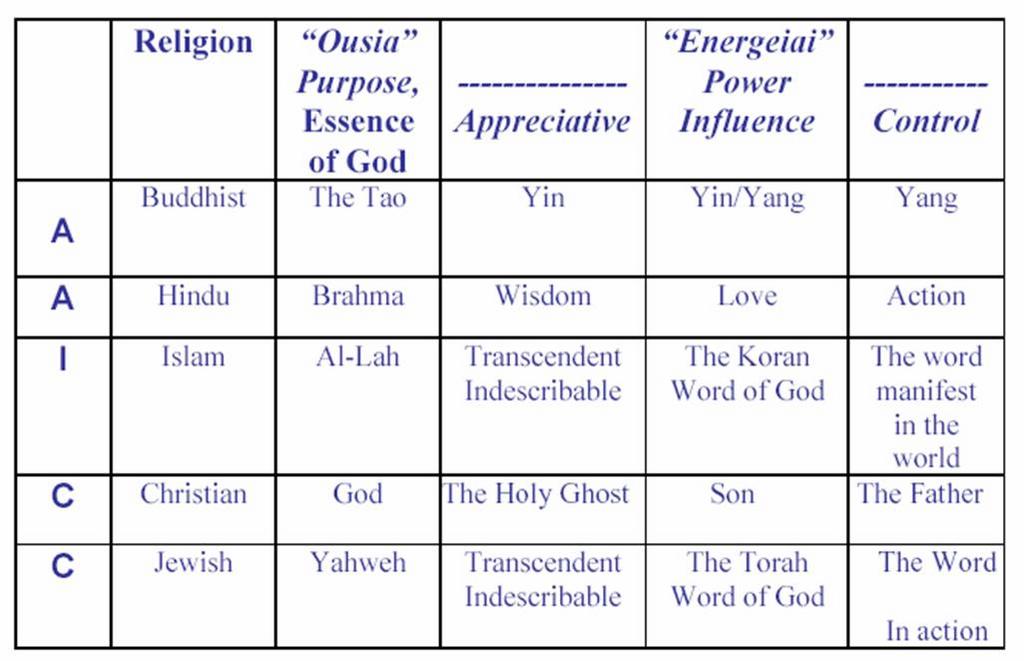
AIC Power in religions:

The AIC power pattern in the major religions:

Thursday, October 20, 2005

Nepal can be a global hub:

Today, In Nepal illiteracy is reducing only at the rate of 1.3 percent per annuam. At this rate, Nepal will need another 50 years to attain a literacy rate of 95 percent. Hopefully, Development in India and China's technologies can speed up in this progress in Nepal. Science too has its role to play. We cannot be industrially and economically advanced and we cannot be technologically advanced unless we are scientifically advanced. One of the critical issues facing Nepal is the gulf between the academic world and industry. The notion that scientific ideas lead to technology and from there to wealth is not widespread. Nepal needs economic liberalisation and competition between Nepalese companies which is being tamed, so they are under no pressure to come up with new ideas, nor did academics promote their ideas to industry.
Today, In real life most of the people are leaving country because of Nepal’s political instability and lack of opportunity for employment and government’s future policy. People are going for employment at India, Arab countries and western countries. Some of them are attempting to gain illegal passage to developed countries like European countries, USA and Australia by holding false passport and documents. Most of the people in Nepal dream of being overseas so that they are watching foreign channel rather Nepal TV, are also the main source of aspiring to be somewhere else for better future and employment. The fact that so many Nepalese dream of leaving significantly threatens Nepal's economic development, social well-being, and political stability. Every year Nepal loses two to three percent of its GNP to brain drain. Every year Nepal loses between 1,000 and 2,000 professors, doctors, and engineers annually. This loss means fewer well-educated, ambitious citizens who could help lead our country. However there is an irony here, for if through immigration Nepal loses capital in some forms, it gains it through the money its immigrants send back to their families.
Rich country like United Kingdom wants migrants' labour, but do not want to look after these newcomers when they grow old. Ideally, rich countries would like a constant rotation of workers, arriving while they are young and active, leaving before they grow old and dependent. For its part, the commission argues that “temporary and circular migration” is also better for poor country like Nepal. One reason is remittances: the longer an immigrant stays away from home, the smaller the share of his wages he sends back.
Nepali households invest more than half of their savings in physical ones such as land, houses, cattle, and gold instead of putting money into financial assets. In rural areas, the proportion is even higher. This fact shows that Nepal's people mistrust of banks and are the world's largest consumers of gold. They possess billion of dollars, equal to nearly half of the country's bank deposits, and last year bought $1 billion worth, nearly five times the amount of the foreign direct investment which Nepal received. Households could earn higher returns by investing in financial assets, and the country would be better off if savings were pooled to finance more productive investments.
This dilemma may help explain why the Nepalese government can seem unsure about its policy. There is war between three parties government, political parties and Communist follower “Moist”. If we ask about the current situation to them, they give a very simple answer without taking any responsibility that we don’t have a lot of resources like India and China. Now, our greatest resource and valuable export is our human potential. We Nepalese have been working in India and United Kingdom’s defence since more than century as Gorkha Army and now it has become a tradition to become Lahure (Army) in those countries.
When we talk about civilisations, there is always rise and fall. One thing prominently comes to light that is the cycle of growth and demise is similar to the law of Diminishing returns. When a civilisation is in the establishing mode then there would need to create newer standards which are epochal. This accelerates the creative spirit of the surrounding environment and the fervent desire to contribute to the growth drives this creative spirit. However once certain exceptional standards are achieved which one may look back upon as catalytic to the growth of the society. The collective psyche tends to stagnate and basking in the glory of its achievements.

Monday, October 10, 2005

Nepal can be a global hub:

Nepal is small Himalayan kingdom situated between two future superpower China and India which will be world’s 2nd and 3rd leading economic countries respectively after USA by 2050. Nepal could take advantage from the international investment community where Western press rarely mentions that certified miracle that very large amount of global trade with China and India instead of adding “China”, “India” and “Nepal”. Let us take very simple example which I can admit that it is unscientific test-Google search about Nepal. Google search reveals over 10 times more reference linking “Nepal” and “India” than “Nepal” and “China” and 100 times more than “Nepal”, “Gorkha Army” and “Himalayan”. It is well worth to asking whether Nepal is really ready to take advantage in the regional and global economy. However, we can focus on country’s strengths and weaknesses, it would be useful to raise the question in different way “Does Nepal have the mind-set it needs to be a player in regional and global integrated economy?”
It is difficult to talk about mind-set even more difficult to talk about a nation’s mind-set. However it does seem that there are a time comes when a nation feels confident that it can take on the world, achieve any dream and meet any challenge. If we maintain this spirit, it can be an enormous aid to growth and development of our nation. The main challenge is to properly channel by government bodies, politicians, public sectors, private sectors and even every individual, as a result such spirit can be an enormous aid for development and growth of our nation. However some sociologists have criticised this argument such a spirit of nation’s atma vishwas (self confidence), we can take several examples a kind of substantial growth seen in Japan in the 1950s and 1960s, South Korea in the 1970s and, China and India today.
The economics miracle of our age has been the strength with which previously vanquished economics of Japan and West Germany have risen from the ashes of war to become two of the wealthiest societies in the world. They have achieved this result through the execution of sound manufacturing strategies clearly invented to produce high quality technology products requiring substantial research and development (R&D) expenditure and massive investment in new capital plant and machinery. China’s vast manufacturing base is raising its GDP by around 9 percent a year as a result of poorly endowed with natural resources and massive manpower.
In real life,the changes in India and China have been more profound than this suggests.Over the past few years alone, more than 100 IT and science based firms have located R&D labs in India. These are not drudge jobs: high-tech companies are coming to India to find innovators whose ideas will take the world by storm. Their recruits are young graduates, straight from India's universities and elite technology institutes, or expats who are streaming back because they see India as the place to be- better than Europe and the US. This knowlodge revoluation has begun.
This is the great opportunity for Nepal being situated between two future Superpower countries. Nepal's foreign policy is also good between both countries. There is more influence of India than China because of open border, culture, climate and so on. Today,In India high-tech is not the sole perserve of the rich. Autorickshaw drivers began using mobile phone so that customers can call for a ride. Technology companies are extending internet connections to the remote locations. Small,renewable electricity generators are appearing in villages, and the government is using home- grown space technology to improve literatecy skills and education in far flung areas.

Tuesday, October 04, 2005

Common Sense:

We are undoubtedly heard comment 'It's just common sense' when we are trying to justify an idea or give creeping to our viewpoint. However, In practice the claim that someone is 'common sense' is often used by people who do not wish to, or cannot explain their reasoning. There are two main dangers of saying 'it's common sense' which I have tried to explain by taking in social scientist's viewpoint.
1. It is not always common: When we describe an idea, issue, theory or whatever as common sense we often mean that it fits with our own understanding of the world. However, other people from different social backgrounds, ethnic groups, age groups, and so on might not share the same understanding. In other words, the idea, issue or theory is not common to them. Just because something is sensible that does not automatically make it common.
2. It is not always sense: Albert Eisten described common sense as 'the collective of prejudices we have acquired by the age of 18'. In other words, common sense explanations often close our minds to other possibilities. Just because something is common that does not automatically make it sensible. Some sense understandings are later proven by rational, logical enquiry and experience to be misguided and ill-informed.
Therefore, social scientists rarely justify something as common sense. They are always seeking to prove their claims and justify their theories and ideas.

Sunday, October 02, 2005

Lateral and Vertical thinking:

Every individual owes his/her success to his/her creativity. It is most useful in goodtime and essential in bad time as well. The main and crucial question arises that how can one achieve it? It is regarded as a magic gift of divine flash of inspiration, a chance coming together of extraordinary circumstances. It seems that one can do nothing about creativity except await it passively. It usually does come about in this passive manner-but only because we have never developed the type of thinking that encourages it.
Creativity is a “lateral thinking” type of thinking and it has been difficult to develop because in many ways, it is contrary to the traditional habits of logical thinking which we find very useful. The essential step is to understand the processes involved in creativity, escape from attitudes which inhibit these processes and to use methods for encouraging them. This is the purpose of lateral thinking, which can be learned as a skill and then used in a deliberate manner in order to achieve creativity.
Creativity is not only concerned with generating new ideas but with escaping from old ones. Continuity is the reason for the survival of most ideas, not a repeated assessment of their value. Such continuity can trap one into gross inefficiency. Freed from the prison of an obsolescent idea, one can move ahead. Furthermore, ideas (like organisations) which develop slowly over period of time tend to be cumbersome. With creativity restructing, one can slice through the inefficiency and put things together in a much simpler and more effective manner.
The huge effectiveness of mind arises directly from the way it organises information into patterns. The more firmly a pattern is established the more useful it becomes. But creativity involves breaking out of established patterns in order to look at things in a different way. Thus the very effectiveness of mind in establishing fixed patterns makes creativity very difficult. It is like having a filing system set up to store data in a particular way. In order to pursuer cross references in such a filing system, one would have to develop new ways of using it.
When creativity is regarded as a magic gift, there is nothing that can be done about it if we are not lucky enough to have the gift. But everyone can develop some skill in lateral thinking and those who develop most skill will be most creative.
An understanding of the creative process is based on the way the mind handles information. The achievement of creativity involves: an attitude of mind, an escape from traditional thinking habits specific formats and techniques, and the use of a new functional word. All these combine to give the skill of lateral thinking. This skill can be learned, practiced and used. With practice and confidence lateral thinking can become so natural a part of thinking that no special effort is required.

Saturday, October 01, 2005

Work skills:

Skill is generally considered to be a possession of the individual. It can take numerous forms-for example, knowledge, dexterity, judgement, linguistic ability-however the assumption is that it accrued by the individual as a product of accumulated education, training and experience. In survey (Francis and Penn, 1994) respondents reported over 16 different definitions when asked the question ‘What do you think is meant by the term skilled job?’. However, there was some convergence around five main characteristics: training, qualifications, apprenticeship, experience and high abilities. Francis and Penn conclude that different occupational groups will categorise skill in different ways, which suggests that person’s conception of skill is largely based on his or her own experiences of employment.
Cockburn (1983: 113) suggests that person, job and setting all three aspects need to be taken into account. In her study of (male) printworkers she argues that:
There is the skill that resides in the man himself, accumulated over time, each new experience adding something to total ability. There is the skill demanded by the job-which may not match the skill in the worker. And there is the political definition of skill: that which a group of workers or a trade union can successfully defend against the challenge of employers and other groups of workers. Cockburn has divided the skills in to three categories because each suggests a different approach to examining skill.
1) Skill in the person: Any analysis that concentrates on the person is likely to attempt to identify individual attributes and qualities, and seek to measure these through, for example, and aptitude test under experimental conditions; typically this approach has been taken by psychologists. Similarly, a questionnaire might be administrated to assess the individual’s education, training and experience, which could then be proxy for skill-a method frequently adopted by economists.
2) skill in the job: If the analytical focus is the job then the concern is less with the person performing the task than with the requirements embedded in the task itself. In this case, attention would be turned towards the complexity of the tasks required to perform the job competently- an approach typically taken by management theorists. It would also include the extent of discretion over the work-an issue of particular interest to industrial/employment relations theorists.
3) skill in the setting: if the focus is on the political and historical setting, an analysis would be assessing the way skill has developed over time and has been ‘constructed’ by different interest groups, rather than being a feature of the person or the job-an approach pursued by some sociologists, but more usually by historians.
These differences in approach to analysing skill are summarised in following table: (Click on diagram to enlarge.)
The approach of Human Capital theorists (Becker, 1964) who argue that in market economy, a person’s human capital will determine their value as an employee. For Human Capital theorist, responsibility for success in work clearly lies with the individual; they invoke the notion of the notion of a meritrocratic society, where individual endeavour is rewarded. There are three problems recognise with the human capital approach:
1) Inequality of opportunity: The approach assumes that everyone has the same opportunity of access to the activities that improve human capital. For example, a person has to be offered a job in order to gain work experience however when there are high rates of unemployment allowing employers to pick and choose, a person with no work experience is less likely to be offered a job, they are consequently unable to gain work experience.
2) Validity of the skill measures: A general problem is whether the variables of education, training and experience are valid measures of skill. The number of years of a person spends in formal education is linked to qualifications attained, but even then it does not necessarily mean that skills learned will be appropriate or transferable to the work setting. Similarly, while the measurement of training may be a better indicator of industry-specific knowledge and aptitude, it does not take into account the applicability of the training to the current context.
3) Use value of the skill: Measurement should include those attributes that have a current value-in other words the measurement of ‘skill in use’ rather than skill possessed. For example, if person learns to speak Nepali and gain qualification proving their competence, does this constitute a skill? If it has some market value, human capital theorists would say yes, but if few employers require Nepali speakers, it value is severely reduced. In other words, skill is not a fixed concept, but it is relative to its market value. In this sense, all knowledge and abilities can be seen as potential skills, but it is the demand for them and their supply that give them value. Therefore, measuring the skills possessed by the person can be misleading without exploring the labour market context.

The approach of assessing skill in the person tends to view skill as an attribute possessed by an individual, and sometimes described as a person’s human capital. While this appears to be a relativity simple way of assessing skill, the problems lie in the methods of measurement and then putting these in to practice.